
 Back





2026 Supreme(SC) 838
SUPREME COURT OF INDIA
SANJAY KAROL, NONGMEIKAPAM KOTISWAR SINGH, JJ.
Shakuntala & Ors. – Appellants
Versus
Robert Anthony & Ors. – Respondents
Civil Appeal No(s). of 2026 (Arising out of SLP(C) No(s). 9449 of 2020)
Decided On : 30-07-2026
Important Points
Benami Transaction – Intention of parties is essence of benami transaction and money must have been provided by party invoking doctrine of benami.
Subject
Civil Law - Succession and Inheritance
Act Referred
Headnote
Indian Succession Act, 1925 – Sections 33 and 35 – Prohibition of Benami Property Transactions Act, 1988 – Section 4 – Succession rights of two wives of deceased ancestor (MA) – For application of Section 33, it is essential that deceased person regarding whom succession dispute is, is a male – When MA bought property, he did so, squarely in names of his two wives – There is no concept of joint family property as under Hindu law, applicable here – When property is inherited, it is done so as tenants-in-common – There was never the case that MA had died intestate and left behind a widow and further descendants – Property always rested (owned) with two wives of MA – Application of Section 33 via Section 35, would only limit to one half of property that belonged to one widow – Intention of parties is essence of benami transaction and money must have been provided by party invoking doctrine of benami – MA bought the property for benefit of his two wives out of love and affection – Judgments of Courts below set aside. (Paras 9, 10, 12, 13.1 and 14)
Facts of the case:
Original defendant challenges judgment dated 7th February 2020 passed by High Court of Chhattisgarh at Bilaspur in Second Appeal No.290 of 2009. All three courts have taken differing views. High Court, in terms of impugned judgment, held two widows of Mattus Anthony, namely Filomina and Shyam Bai, together entitled to 1/3rd of the property, and children of Filomina (plaintiffs) being lineal descendants of MA, entitled to 2/3rd of property.
Findings of Court:
The status of Shyam Bai as wife of and later widow of MA is not in dispute; parties are ad idem that the dispute was limited to the extent of the inheritance rights of the parties and not the existence of such a right itself.
Result : Appeal allowed.
Legal Category Hierarchy
-
family law
-
succession
-
intestate succession
- widow's share
- lineal descendants
- section 35 rights of widower
- section 38 inheritance by grandchildren
-
property held in wives' names
- ownership and succession implications
-
intestate succession
-
maintenance and support
- damages and possession
-
succession
-
civil procedure
-
appellate review
- setting aside decrees
-
court fees
- filing and valuation
-
appellate review
For the Petitioner(s): Mr. Satish Pandey, AOR
For the Respondent(s): Mr. Gagan Gupta, Sr. Adv. Mr. Vikrant Singh Bais, AOR Mr. Yogesh Tiwari, Adv. Ms. Neema Singh, Adv. Ms. Priya Hingorani, Sr. Adv. Mr. Nikhil Jain, AOR Ms. Aditi Ladda, Adv. Ms. Divya Jain, Adv. Ms. Arveen Sekhon, Adv. Ms. Ankita Sharma, AOR Mr. Arjun D Singh, Adv. Ms. Ishika Neogi, Adv. Mr. Divya Tripathi, Adv. Mr. Gaurav Agrawal, Sr. Adv.(A.C.) Ms. Akriti Chaubey, AOR Ms. Shrija Rawat, Adv. Mr. Darshan Sejwal, Adv.
| Table of Content |
|---|
| 1. establishing the factual matrix and antecedent property purchase history of christians in india. (Para 1 , 2 , 3 , 4 , 5) |
| 2. analysis of section 33 and section 35 of the indian succession act regarding the definition of 'widow' and 'lineal descendant'. (Para 6 , 7 , 8 , 9) |
| 3. differentiating between personal property of wives and ancestral property, and applying rules of intestate succession for christians. (Para 10 , 11 , 12) |
| 4. addressing ancillary claims of benami transactions and rendering the final order disposing of the appeal. (Para 13 , 14) |
JUDGMENT
SANJAY KAROL, J.
1. Leave Granted.
2. The original defendant challenges the judgment dated 7th February 2020 passed by the High Court of Chhattisgarh at Bilaspur in Second Appeal No.290 of 2009. All the three courts have taken differing views.
3. The plaintiffs’ suit being Civil Suit No.51-A/2007 before the 5th Civil Judge, Class I, Bilaspur [Civil Court], was decreed and the sale deed executed by the defendants was held to be invalid. The plaintiffs were held entitled for 1/4th share of Khasra No.690/7. Defendants were entitled to vacant possession of a specified portion. The 1st Additional District Judge, Bilaspur [First Appellate Court] in the First Appeal filed by the original defendants, set aside the decree of the Civil Court and held that both plaintiffs and defendants collectively are entitled to half share each from their respective mother. However, since defendants 1 to 5 had sold their share to Defendant 6 the sale was held to be valid. The High Court, in terms of the impugned judgment, held the two widows of Mattus Anthony [MA] namely Filomina and Shyam Bai, together entitled to 1/3rd of the property, and the children of Filomina (plaintiffs) being the lineal descendants of MA, entitled to 2/3rd of the property.
4. The plaintiffs and defendants are step siblings and their successive generations. Family chart depicting the same is as follows:
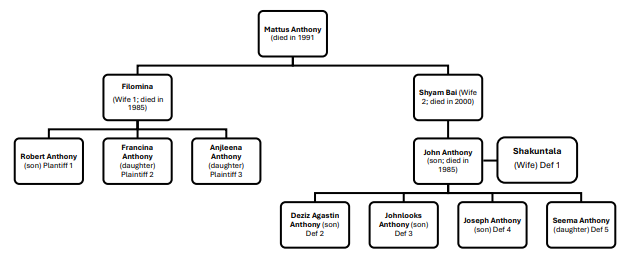
5. MA had two wives, Filomina and Shyam Bai. Filomina had three children. Shyam Bai had one son. The parties are undisputedly Christian by faith. There is no dispute regarding the marriages performed by MA and the paternity of the children so begotten. The facts in which the present dispute arises are that MA, in the year 1959, bought the portion of land for consideration of INR 300, in the name of his two wives. Filomina died in 1985. MA died in 1991 and Shyam Bai died in 2000, with her son John Antony predeceasing her in 1985. The defendants, on 19 August 2002, sold their share i.e., half out of the total 1776ft² i.e., 888 ft² to defendant No. 6, namely Marium Anthony, leading the Plaintiffs to file the suit in question. The issues framed by the Civil Court and the corresponding findings, and the points of consideration as also their findings, are encapsulated below:
| TRIAL COURT | ||
| Issues | Findings | |
| 1. | Whether the suit land being joint property of the Plaintiffs and Defendant no. 1 to 6, the sale deed dated 19.08.02 executed by the Defendant Nos. 1 to 5 in favour of Defendant No. 6 being illegal and void is not binding on plaintiffs? | Mutual partition never took place between them so the suit land is joint ancestral property of the legal heirs of Late Filomina and legal heirs of Late Shyama Bai. Any sale without permission or consent of co-owner is not legal. Since no consent of plaintiffs was obtained before sale, the sale deed is not valid and since the said sale deed is illegal, the mutation proceeding carried out in favour of defendant No.6 on the basis of said sale deed by itself is void. |
| 2. | Can it be proper to grant possession of ‘a, b, c, d’ parts of suit land to the plaintiffs from the Defendant No. 6? | Since the sale deed has been found to be illegal, the statutory right of Defendant No. 6 ends. The plaintiffs along with the defendant Nos.1 to 5 are entitled to vacant po |









