Back





2026 Supreme(SC) 935
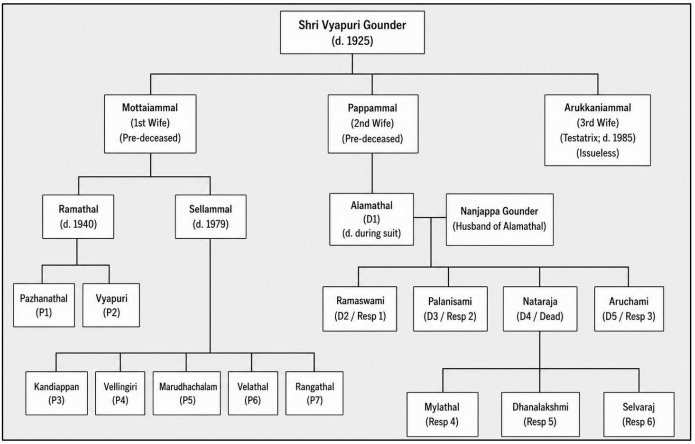
SUPREME COURT OF INDIA
Sanjay Karol, Nongmeikapam Kotiswar Singh, JJ.
Pazhanathal (Dead) Through Lrs. & Ors – Appellants
Versus
Alamathal (Dead) Through Lrs. & Ors - Respondents
Civil Appeal Nos. 10169-10170 OF 2013
Decided On : 13-08-2026
Important Points
Subject
Civil Law - Succession and Inheritance
Act Referred
Headnote
(B) Propounder of will must satisfy court's conscience that instrument is last will of a free and capable testator - Suspicious circumstances such as incorrect recitals, exclusion of natural heirs without reason, proximity of attesting witness to beneficiary, non‑examination of key witness, must be removed cumulatively - Registration does not dispense with proof of attestation - Scribe signing only as scribe is not an attesting witness unless animus attestandi established - Section 69 gateway requires satisfactory proof of unavailability of each attesting witness - Where attesting witness from another village, related to beneficiary, and no independent evidence, will fails.
Facts of the case:
The original owner died with three wives; the third wife (testatrix) inherited the property and died issueless. Dispute arose between the heirs of the first wife (appellants) and the second wife (respondents). The respondents propounded a registered Will dated 15.12.1976 (Ex.B‑13) bequeathing agricultural property to four sons of the second wife's daughter. The trial court found suspicious circumstances and held the will not proved, granting partition to the appellants. The High Court reversed, upholding the will and granting an injunction. The Supreme Court allowed the appeal, restoring the trial court's judgment.
Findings of Court:
The Will was not proved in accordance with Section 63(c) of the Indian Succession Act read with Sections 68 and 69 of the Evidence Act. Section 69 was improperly invoked as the death of the second attesting witness was not satisfactorily established. Even if assumed, suspicious circumstances were not removed: inaccurate description of property as self‑acquired, description of step‑daughter as daughter, exclusion of two branches without explanation, attesting witness related to a beneficiary, non‑examination of the best witness (the daughter), and unexplained custody. Testamentary capacity was not affirmatively proved; the scribe's evidence was insufficient to establish informed consent. Consequently, the Will fails; intestacy applies and under Section 15(2)(b) of the Hindu Succession Act the property devolves upon the heirs of the husband. The trial court's partition decree was restored.
Issues: (i) Whether the Will was duly executed and attested; (ii) Whether Section 69 of the Evidence Act was properly invoked; (iii) Whether testamentary capacity, knowledge of contents and free agency were satisfied; (iv) Whether the suspicious circumstances were satisfactorily removed.
Ratio Decidendi: For a will to be valid, strict compliance with Section 63(c) of the Indian Succession Act and proof under Sections 68 or 69 of the Evidence Act is required. Section 69 applies only when no attesting witness can be found; the burden is on the propounder to prove unavailability. Suspicious circumstances must be considered cumulatively, and the propounder must remove the resulting doubt by cogent evidence. Where a will excludes natural heirs and contains inaccurate recitals, and key witnesses are not examined, the will fails.
Result: Appeals allowed. The High Court's judgment is set aside; the trial court's common judgment and decree are restored. Parties may work out final division in final‑decree proceedings. The suit for permanent injunction stands dismissed. No order as to costs.
For the Appellant(s) : Mr. S Nagamuthu, Sr. Adv. Mr. N. L. Ganapathi, AOR Mr. Sidhant Garg, Adv.
For the Respondent(s): Mr. Sathyanarayanan, Sr. Adv. Mr. B.Karunakaran, Adv. Mr. Bhaskaran, Adv. Ms. Pooja Lakshmi, Adv. Mr. Lakshman Raja, Adv. Mr. S. Gowthaman, AOR Dr. Pooja Jha, Adv. Dr. R. Prakash, Adv. Ms. Nandita Jha, Adv. Mr. Mukesh Kumar, Adv. Mr. Akash, Adv. Mr. Vishwa Pal Singh, AOR
| Table of Content |
|---|
| 1. family succession dispute centered on will validity (Para 1 , 2 , 3 , 4 , 5 , 6 , 7 , 8 , 9 , 10 , 11 , 12 , 13 , 14 , 15 , 16 , 17) |
| 2. evidence and testimony regarding will execution (Para 18 , 19 , 20 , 21 , 22 , 23 , 24 , 25 , 26 , 27 , 28) |
| 3. trial court found will not proved due to suspicious circumstances (Para 29 , 30 , 31 , 32 , 33 , 34 , 35 , 36) |
| 4. high court reversed, holding will proved (Para 37 , 38 , 39 , 40) |
| 5. parties' arguments on proof and suspicious circumstances (Para 41 , 42 , 43 , 44 , 45 , 46 , 47) |
| 6. due execution requires proof of attestation under section 63 and 68 (Para 48 , 49 , 50 , 51 , 52 , 53 , 54 , 55 , 56 , 57 , 58 , 59 , 60 , 61 , 62 , 63 , 64 , 65 , 66 , 67 , 68 , 69 , 70 , 71) |
| 7. section 69 not properly invoked; unavailability of attesting witness not proved (Para 72 , 73 , 74 , 75 , 76 , 77 , 78 , 79 , 80 , 81 , 82 , 83 , 84 , 85 , 86 , 87 , 88 , 89 , 90 , 91 , 92 , 93 , 94 , 95 , 96 , 97 , 98) |
| 8. propounder failed to establish testamentary capacity and free agency (Para 99 , 100 , 101 , 102 , 103 , 104 , 105 , 106 , 107 , 108 , 109 , 110 , 111 , 112 , 113 , 114 , 115 , 116 , 117 , 118 , 119 , 120 , 121) |
| 9. cumulative suspicious circumstances not satisfactorily removed (Para 122 , 123 , 124 , 125 , 126 , 127 , 128 , 129 , 130 , 131 , 132 , 133 , 134) |
| 10. will not proved; intestate succession applies; trial court decree restored (Para 135 , 136 , 137 , 138 , 139 , 140 , 141 , 142) |
JUDGMENT :
NONGMEIKAPAM KOTISWAR SINGH, J.
1. Leave having been granted on 01.11.2013, these civil appeals arise out of the common judgment and decree dated 28.10.2008 passed by the High Court of Judicature at Madras in A.S. No. 231 of 1991 and Tr. A.S. No. 503 of 2002. By the impugned common judgment, the High Court allowed both first appeals preferred by the Respondents herein and decreed the Respondents’ suit for permanent injunction by setting aside the common judgment and decree dated 22.01.1991 passed by the Trial Court, Additional Subordinate Judge - III, Coimbatore in O.S. No. 665 of 1985 and O.S. No. 1344 of 1990. The Trial Court had granted a preliminary decree for partition in favour of the Appellants in O.S. No. 665 of 1985 and dismissed the Respondents’ suit for permanent injunction in O.S. No. 1344 of 1990.
2. The dispute is a family succession and partition dispute, centered on the legal proof, genuineness and effect of a registered Will dated 15.12.1976, marked as Ex.B-13, alleged to have been executed by Arukkaniammal, the issueless third wife of Vaiyapuri Gounder, the original owner. If Will (Ex.B-13) is proved in accordance with law, the respondent branch succeeds in respect of the A-schedule property. If the Will is not proved, the property inherited by Arukkaniammal from her husband would devolve, by operation of Section 15(2)(b) of the Hindu Succession Act, 1956 (“Hindu Succession Act” for short), upon the heirs of Vaiyapuri Gounder, and the appellants would be entitled to their share as per the partition decree granted by the Trial Court.
3. The principal question, therefore, is, whether the Will (Ex.B-13) is proved valid. That question requires the Court to distinguish between testamentary power, due execution and attestation, the statutory mode of proof, and the independent obligation of the propounders to remove suspicious circumstances. The validity of the Will is therefore the central issue, the questions of partition, possession and injunction being consequential.
FACTUAL BACKGROUND
4. One Vaiyapuri Gounder was the original owner of the suit properties. The suit properties consisted principally of agricultural lands described as A-schedule properties and a house property described as B-schedule property. Partition of B-schedule house property is not contested, also it is not in dispute that the properties came to Vaiyapuri Gounder in a partition between himself and his brothers.
5. Vaiyapuri Gounder had three wives. The first wife was Mottaiammal (Appellant Branch). The second wife w