


1. Plaintiffs claim possession of a plot based on an agreement to sell, while defendants set up title based on an allotment transfer and registered sale deed. (Para 2 , 5 , 6 , 8 , 9 )
 Back
Next 





2026 Supreme(SC) 1268
SUPREME COURT OF INDIA
ARAVIND KUMAR, VIPUL M. PANCHOLI, JJ.
Smt. Rano Singh And Others – Appellants
Versus
Sh. Gurbax Singh (D) Th. Lrs And Others – Respondents
Civil Appeal No. 7025 of 2012
Decided On : 16-10-2026
Important Points
Agreement to sell does not confer title; only a registered sale deed does. Suits for possession are barred if limitation expires or if a registered sale deed clouds the title, necessitating a prayer for declaration. Estoppel applies when voluntary conduct induces another to act on a representation.
Subject
Civil Law - Property Law
Act Referred
Headnote
(A) Limitation Act, 1963 - Articles 54, 59 and 64 and Section 27 - Suit for possession - Limitation period for specific performance, cancellation of an instrument, and recovery of possession - A suit for specific performance must be instituted within three years from the date fixed for performance or notice of refusal (Article 54). A suit to cancel or set aside an instrument must be filed within three years from when facts entitling the plaintiff to the relief become known (Article 59). For possession based on previous possession, the limit is twelve years from the date of dispossession (Article 64). Once the limitation period expires, the right to institute a suit is extinguished (Section 27). (Paras 35, 39, 40, 41)
(B) Transfer of Property Act, 1882 - Section 54 - Agreement to Sell vs. Registered Sale Deed - A contract for sale is only a document evidencing that a sale shall take place on settled terms and does not, of itself, create any interest in or charge on the property. Only a valid, registered sale deed is capable of conveying title and ownership rights. (Paras 44, 45, 46)
(C) Maintainability of Suit for Possession - When title is challenged by a registered sale deed in favor of a third party, it raises a cloud over the plaintiff's title. In such cases, a suit for possession simpliciter is not maintainable; the plaintiff must seek a substantive prayer for declaration or cancellation of the offending instrument. (Paras 48, 49, 52, 53)
(D) Indian Evidence Act - Section 115 - Estoppel and Acquiescence - Where a party, by declaration or act, intentionally causes another to believe a thing to be true and act upon such belief, they are estopped from denying the truth of that thing. Voluntary abandonment of contractual obligations followed by silent acceptance of the consequences constitutes direct acquiescence. (Paras 54-63) (E) Transfer of Property Act, 1882 - Section 53A - Part performance - Protection under part-performance is available only if the transferee has taken possession, done an act in furtherance of the contract, and has performed or is willing to perform their part of the contract. If the party voluntarily abandons mandatory obligations, they cannot seek shelter under this section. (Paras 64, 65, 66)
Facts of the case:
An allottee entered into an agreement to sell for a plot subject to a mandatory condition to complete construction within three years. Before the deadline, the allottee informed the society of his inability to construct and requested the transfer of the plot to another person. The society transferred the plot, the third party constructed a house and obtained a registered sale deed. Decades later, the legal heirs of the original allottee filed a suit for possession, alleging fraud and claiming ownership based on the initial agreement and payment of consideration.
Findings of Court:
The suit is barred by limitation under Articles 54, 59, and 64 of the Limitation Act. The agreement to sell did not confer title as no registered sale deed was executed in favor of the allottee. The suit for possession was not maintainable without a prayer for declaration because the registered sale deed in favor of the defendant created a cloud over the plaintiffs' title. Furthermore, the allottee's conduct in requesting the transfer of the plot created an estoppel and constituted direct acquiescence.
Issues: Whether the suit for possession was maintainable without a prayer for declaration; whether the suit was barred by limitation; whether the doctrine of part-performance applied; and whether the plaintiffs were estopped from claiming ownership.
Ratio Decidendi: A registered sale deed is the only document that conveys title in immovable property; an agreement to sell does not create ownership. A suit for possession is not maintainable when title is disputed by a registered document unless a declaration is sought. Limitation periods for cancelling instruments or recovering possession are strict and their expiry extinguishes the right to sue. Part-performance cannot be claimed by a party who has voluntarily abandoned their contractual obligations.
Result: Appeal is dismissed.
Legal Category Hierarchy
- civil law
- practice and procedure
Advocates appeared:
For the Appellant(s) : Mr. Vineet Jhanji, Adv. Ms. Jyoti Mendiratta, AOR Mr. Imran Moulaey, Adv. Ms. Ananya Basudha, Adv.
For the Respondent(s): Mr. V. Raghavachari Acharya, Sr. Adv. Mr. Chinmoy Pradeep Sharma, Sr. Adv. Mr. Sumeet Lall- 1619, AOR Mr. Kunal Sinha, Adv. Mr. Nicholas Choudhury, Adv. Mr. Sidhant Kapoor, Adv. Ms. Palak Rawat, Adv. Ms. Vanshika Ashu, Adv. Mr. Prasouk Jain, Adv. Ms. Rabiya Singh Thakur, Adv. Ms. Shalini Nair, Adv. Mr. Abhishek Wadhwani, Adv. Mr. Vijay Deora, Adv. Mr. Irfan Hasier, Adv Mr. Aditya Agarwal, Adv Mr. Samarth Goel, Adv Ms. Aashna Gill- 3840, AOR
Table of Contents
2. Plaintiffs allege fraudulent transfer of property despite payment; defendants contend forfeiture of rights due to non-performance of construction conditions and argue limitation or adverse possession. (Para 8 , 11 , 12 , 13 , 14 , 15 , 16 )
3. The court found the suit barred by limitation, noted no registered sale deed existed for plaintiffs, and observed unequivocal abandonment of contractual obligations by the original allottee. (Para 21 , 23 , 24 , 27 , 41 , 46 , 47 , 48 , 66 )
4. An agreement to sell creates no title; a suit for possession is non-maintainable without seeking necessary declaration and cancellation of a registered deed when title is in dispute. (Para 44 , 45 , 49 , 51 , 52 , 53 )
5. The appeal is dismissed, upholding the trial and high court judgments that dismissed the suit for possession. (Para 68 , 69 , 70 )
6. Can a suit for possession be maintained without a prayer for declaration when the defendant has a registered sale deed?
No. When a defendant holds a registered sale deed, the plaintiff's title is clouded, necessitating a substantive prayer for declaration and cancellation of the instrument; a suit for possession simpliciter is not maintainable under such circumstances. (Para 48 , 49 , 51 , 52 , 53 )
7. Does an agreement to sell by itself transfer ownership of immovable property?
No. Under Section 54 of the Transfer of Property Act, an agreement to sell does not create any interest or charge on the property. Valid title in immovable property valued over one hundred rupees is only conveyed through a registered sale deed. (Para 44 , 45 )
8. Does the doctrine of part-performance under Section 53A of the Transfer of Property Act apply when the transferee fails to perform obligations?
No. Protection of Section 53A requires the transferee to be ready and willing to perform their obligations. Where the transferee voluntarily abandons mandatory conditions like construction, they cannot claim the benefit of part-performance. (Para 64 , 65 , 66 )
9. What is the limitation period for challenging a registered sale deed based on the plaintiff's knowledge?
Under Article 59 of the Limitation Act, a suit to cancel or set aside an instrument must be filed within three years from the date when the facts entitling the plaintiff to have the document cancelled first became known to them. (Para 27 , 35 , 40 )
10. Does direct acquiescence bar an owner from enforcing prior contractual rights?
Yes. A party who voluntarily communicates an inability to perform mandatory contractual obligations and stands by while the property is transferred to another, creates an equity through conduct which prevents them from later asserting rights inconsistent with that prior conduct. (Para 60 , 61 , 62 , 63 )
JUDGMENT :
ARAVIND KUMAR, J.
1. Heard.
2. The instant appeal is filed by the Plaintiffs who are the legal heirs of late Shri. Sohan Singh, challenging the Judgment and order of the High Court of Delhi1[Hereinafter referred to as the “High Court”] passed in RFA No.377/2010 dated 02.02.2012 whereunder the Judgment and decree passed by Additional District Judge, Tis Hazari, Delhi2[Hereinafter referred to as the “Trial Court”] dated 14.01.2010 in Case No. M-27/2009 (old Suit No.475/1975) dismissing the suit for possession came to be affirmed.
3. For the sake of convenience, the parties herein shall be referred in terms of their nomenclature, rank and status before the Trial Court, i.e., Appellants as legal heirs of Sohan Singh or Plaintiffs and the Respondent No. 1 as Defendant No. 1. As Respondents No. 2 to 10 are also the legal heirs of Sohan Singh and they are seeking identical relief to that of the Plaintiffs, hence, their claims are not discussed separately.
4. Before we proceed to formulate the question of law for adjudication of facts, we deem it necessary to first set out the inter se relationship between the parties to the suit and their respective legal heirs for better understanding. Accordingly, genealogical chart depicting the relationship between the parties to this lis and their rank as per the Trial Court and before this Court is set out hereinbelow –
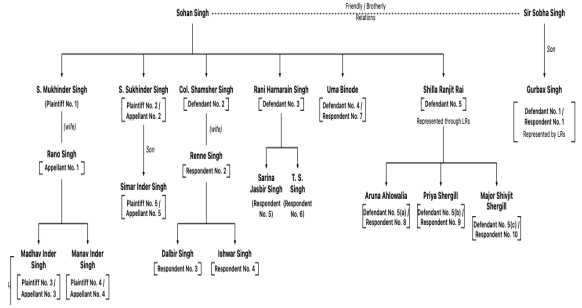
5. The dispute between the parties relate to Plot No.8, Friends Colony, New Delhi admeasuring approximately 4,132 sq.yds., together with the super-structure constructed thereon, which, for the ease of reference shall be referred to as “plot” or “suit property” hereinafter.
CASE AND ARGUMENTS ADVANCED BY THE PLAINTIFFS
6. Sohan Singh is the father of Plaintiffs, S. Mukhinder Singh and S. Sukhinder Singh. He became the member of Nathu Ram Friends Colony Co-operative Housing Building Society, 3[Hereinafter referred to as the “Society”] Ltd. on 16.01.1950 and was allotted the suit property by way of an Agreement to Sell dated 14.01.1952, with an express condition that he has to raise construction over the plot within a stipulated time-period of three years. In accordance with the said written agreement, Sohan Singh paid the sale consideration of Rs. 11,824/- along with other charges.
7. Sohan Singh had close friendly/brotherly relations with Sobha Singh and they also shared a commercial relationship as partners in a firm. Thus, Sohan Singh entrusted all matters relating to the suit property to Sobha Singh, who was acting as his agent in respect thereof. Since Sohan Singh was at Shimla, the construction of the house was assigned to Sobha Singh, who carried out the same. After the completion of the construction, Sohan Singh wrote a letter to the Society evidencing the completion of construction and contends that the ownership of Sohan Singh was duly recorded in Resolution No. 6 dated 30.08.1959.
8. The dispute, according to the Plaintiffs arose when the Society decided to transfer the plot to Defendant No. 1 vide meeting held on 13.12.1959, despite duly recording that Sohan Singh is the owner of the plot. Although the sale consideration was paid by Sohan Singh, the Society vide Sale Deed dated 03.12.1960 transferred the plot to Defendant No. 1, by way of a sham and voidable document. The Plaintiffs further contended that the plot exclusively belonged to Sohan Singh and that, aggrieved by the execution of the Sale Deed in favour of Defendant No. 1, Sohan Singh approached the Society on 14.05.1963 seeking execution of the Sale Deed in his favour upon completion of the construction. However, by letter dated 23.05.1963, the Society informed him that the plot originally allotted to him had already been transferred in favour of Defendant No. 1 and that the Sale Deed had been executed on 03.12.1960.
9. The Plaintiffs, alleging that the Society, in collusion with Defendant No. 1, fraudulently transferred the plot in favour of Defendant No. 1, approached the Registrar of Co-operative Society









