1. Claimants contested the cancellation of a Ryotwari patta granted for land originally classified as a water body in statutory settlement records. (Para 1 , 6 , 7 , 8 , 9 , 10 )
 Back
Next 


2026 Supreme(SC) 1276
SUPREME COURT OF INDIA
S.V.N. BHATTI, N.V. ANJARIA, JJ.
S. Gururaj – Appellant
Versus
The Additional Chief Secretary/Commissioner Of Land Administration And Others – Respondents
Civil Appeal No. 13629 of 2026 With Civil Appeal No. 13630 of 2026 With Civil Appeal No. 13631 of 2026
Decided On : 16-10-2026
Important Points
Ryotwari pattas cannot be granted for non-ryoti lands, such as water bodies/poramboke, regardless of zoning changes. Such grants are void under Section 14-A of the Act, 1948. However, bona fide purchasers misled by government fraud may be entitled to alternative site allotments to mitigate hardship.
Subject
Land Law - Revenue and Land Tenure
Act Referred
SECURITISATION AND RECONSTRUCTION OF FINANCIAL ASSETS AND ENFORCEMENT OF SECURITY INTEREST ACT: S.14
TAMIL NADU ESTATES ABOLITION AND CONVERSION INTO RYOTWARI ACT: S.14(a), S.3(15), S.3(16), S.14(a)(1), S.3, S.11
TAMIL NADU ESTATES LAND ACT: S.20(a)
TAMIL NADU ESTATES ABOLITION AND CONVERSION INTO RYOTWARI ACT: S.14(a), S.3(15), S.3(16), S.14(a)(1), S.3, S.11
TAMIL NADU ESTATES LAND ACT: S.20(a)
Headnote
(A) Tamil Nadu Estates (Abolition and Conversion into Ryotwari) Act, 1948 - Sections 3(15), 3(16), and 14-A - Grant of ryotwari patta for water body/poramboke land - Prohibited - Nature of land is determined by appreciating entries in the earliest revenue records, including survey and settlement records (Paras 17, 19) - Section 14-A expressly bars the grant of ryotwari patta in respect of any private tank or oorani and mandates the cancellation of any patta erroneously or mistakenly issued over such lands (Paras 4, 11C)
(B) Tamil Nadu Town and Country Planning Act, 1971 - Zoning regulations - Notifying an area as a "Mixed Residential Zone" cannot be construed as taking away the government's rights in poramboke lands, forests, or water bodies; zoning does not override the statutory bar under the Act, 1948 (Paras 20, 21)
(C) Natural Justice - Where a ryotwari patta is challenged, notice to the person who holds the patta and claims interest in the property is sufficient; denial of opportunity to subsequent third-party purchasers is not a valid ground for challenge (Para 22)
Facts of the case:
Land recorded as government poramboke/tank was erroneously granted a ryotwari patta by a district official. Based on this patta, the land was subdivided, apartments were constructed, and units were sold to third-party buyers. The land was also mortgaged to a bank. The Commissioner of Land Administration subsequently cancelled the patta, finding the grant fraudulent and contrary to law. The High Court upheld the cancellation and ordered the demolition of the structures and restoration of the water body.
Findings of Court:
The court found the land was historically classified as a water body/poramboke and thus not "ryoti land," rendering the grant of patta illegal under Section 14-A. Zoning as a residential zone does not extinguish the government's title to poramboke land. While the demolition was legally justified, the court noted that bona fide purchasers were misled by the government's own records and approvals.
Issues: Whether a ryotwari patta can be validly granted for land recorded as a water body; whether zoning a land as a residential zone overrides statutory bars against granting patta for tanks; and whether bona fide purchasers should be evicted without alternative remedy when misled by state officials.
Ratio Decidendi: Non-ryoti lands, specifically water bodies and communal poramboke, fall outside the scope of patta grants under the Act, 1948. The nature of the land is determined by the earliest revenue records. Statutory prohibitions against granting patta for tanks cannot be effaced by zoning regulations. However, to prevent irreparable financial injury to bona fide purchasers misled by the state's fraudulent records, the state must provide alternative commensurate sites before proceeding with demolition.
Result: Civil Appeals are dismissed.
Legal Category Hierarchy
- administrative law
- property law
- urban planning and development
Advocates appeared:
For the Appellant(s) : Mr. K. S. Mahadevan, Adv. Ms. Swati Bansal, Adv. Mr. R. Rangarajan, Adv. Mr. Aravind Gopinathan, Adv. Mr. R. K. Srivastav, Adv. Mr. Rajesh Kumar, AOR Mr. T Raja, Sr. Adv. Mr. M. A. Chinnasamy, AOR Mr. C Raghavendren, Adv. Mrs. C Rubavathi, Adv.
For the Respondent(s): Ms. Jayasree Narasimhan, AOR Mr. R. Sarbeshvaran, Adv. Mr. Siddheesh Yadav, Adv.
Table of Contents
2. Appellants contended the land was mistakenly classified as a water body and was eligible for patta as ryoti land, while respondents maintained its status as protected communal property. (Para 14 , 15 , 20 , 22 , 23 )
3. The court observed that statutory prohibition against granting patta for water bodies is absolute, and administrative zoning notifications cannot alter the legal nature of such land under the Act. (Para 17 , 18 , 19 , 21 , 24 , 26 )
4. Under the Act, 1948, water bodies and communal poramboke lands are excluded from the definition of ryoti land and are statutorily prohibited from being granted as ryotwari patta. (Para 2 , 3 , 4 , 11 , 24 )
5. Appeals dismissed; court affirmed cancellation of patta but ordered the state to allot a commensurate site to displaced flat owners as equitable relief. (Para 27 , 28 , 29 )
6. Does the classification of land as a mixed residential zone in a development plan override its classification as a water body in revenue records?
No. Notifying an area under development regulations does not extinguish the government's rights over communal poramboke land or water bodies, as zoning laws do not affect the statutory status of such land under the Land Abolition Act. (Para 20 , 21 )
7. What is the legal status of a ryotwari patta granted in respect of a private tank or water body under the Act, 1948?
Such a patta is fundamentally prohibited. Section 14-A expressly bars the grant of patta for private tanks or ooranis and mandates that any patta previously granted for such land shall stand cancelled and be deemed legally void. (Para 4 , 11 , 18 , 24 )
8. Can a mortgage or third-party interest create a valid charge against the state if the primary title was procured through administrative fraud?
No. If a title, such as a ryotwari patta, is procured through administrative fraud over government watercourse land, then no valid charge or interest can be created against the state, as the mortgagor lacked any marketable title. (Para 11 )
JUDGMENT :
S.V.N. BHATTI, J.
1. The Civil Appeals assail the Orders dated 11.07.2024 and 02.07.2025 in Writ Petition No. 8661 of 2020 before the High Court of Judicature at Madras. Civil Appeal Nos. 13630 and 13631 of 2026 were filed by Tamil Nadu Mercantile Bank Limited, Valasaravakkam Branch, Chennai. S. Gururaj, the flat buyer, filed Civil Appeal No. 13629 of 2026.
2. The Tamil Nadu Estates (Abolition and Conversion into Ryotwari) Act, 1948 (“Act, 1948”) provides for the repeal of the permanent settlement. It also provides for the acquisition of landholders’ rights in permanently settled and certain other estates in the erstwhile Province of Madras, now the State of Tamil Nadu, and for the introduction of ryotwari settlement in such estates. The Act, 1948, while doing away with the intermediary system in land regulation and administration, contemplated recognising a ryot’s entitlement to protection of possession and the grant of a ryotwari patta for ryoti land.
3. “Ryot land” means1[P Ramanatha Aiyar: Advanced Law Lexicon, 7th Edition, Vol. 4, Pp. 5657.] cultivable land in an estate other than private land, but does not include:
- a. beds and bunds of tanks and of supply, drainage, surplus or irrigation channels;
b. threshing-floor, cattle-stands, village sites and other lands situated in any estate which are set apart for the common use of the villagers;
c. lands granted on service tenure either free of rent or on favourable rates of rent if granted before passing of this Act or free or rent if granted after that date, so long as the service tenure subsists.
Therefore, the extended definition of Ryoti land means entirable lands in an estate by a Ryot who holds it for agriculture on condition of paying rent to the landholder which is legally due other than private land.2[State of T.N. v. His Holiness Srilla Ambalavana Pandara Sannadhi Adheenakaratha and Others, (1997) 9 SCC 313] The consideration relates to the grant of Ryotwari Patta to Respondent No. 2 for Survey No. 572, to an extent of 0.72 acres, for land locally known as “Kanakkan Pillai Kuttai”.
4. The State of Tamil Nadu, through Amendment Act No. 49 of 1974, introduced Section 14-A into the principal Act, which reads as under:
- “14-A. Ryotwari patta not to be granted in respect of private tank or oorani- (1) Notwithstanding anything contained in this Act, no ryotwari patta shall be granted in respect of any private tank or oorani.
(2) Any ryotwari patta granted in respect of any private bank or oorani under this Act before the date of publication of the Tamil Nadu Estates (Abolition and Conversion into Ryotwari) Amendment Act, 1974, in the Tamil Nadu Government Gazette, shall stand cancelled, and for the purpose of compensation under this Act, the private tank or oorani shall be deemed to be land in respect of which neither the landlord nor any other person is entitled to ryotwari patta under this Act.”
5. The controversy in the Civil Appeals turns on the District Administration's will and determination to give effect to the letter and spirit of Section 14-A of the Act, 1948.
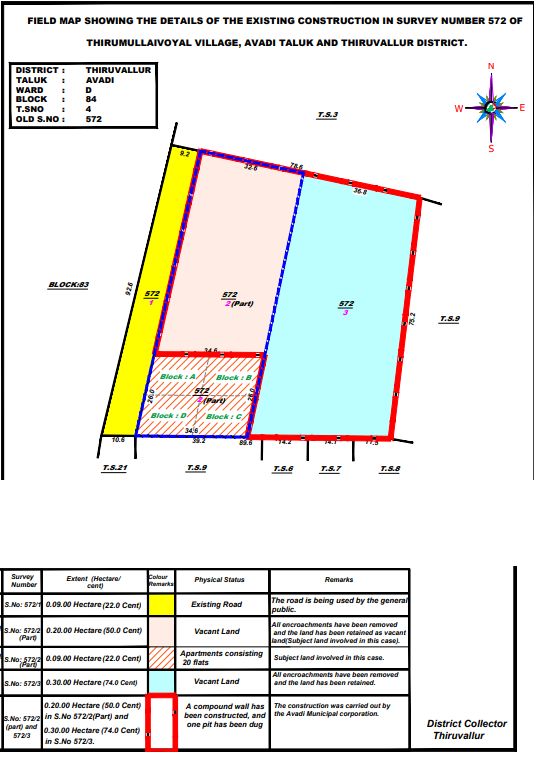
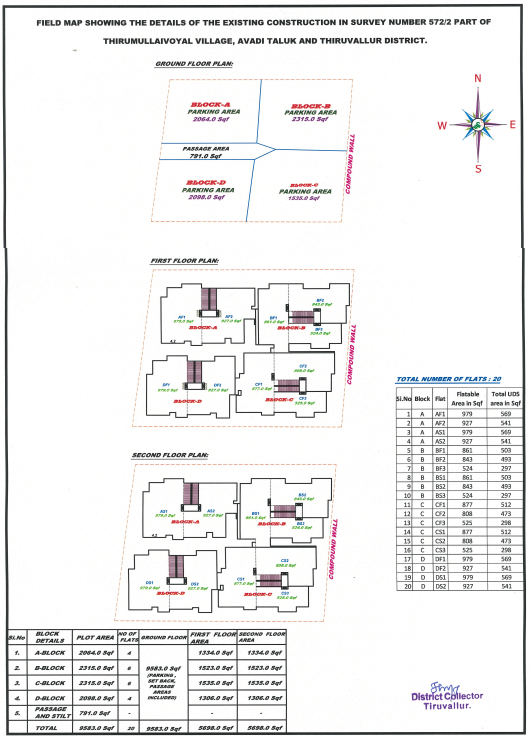
6. The subject matter of the Civil Appeals comprises 0.72 acres out of 1.68 acres in Survey No. 572, Thirumullaivoyal Village, Ambattur Taluk (now under Avadi Taluk), Tiruvallur District, Tamil Nadu. The Resurvey and Resettlement (RSR) ‘A’ Register of 1911 records it as Government Poramboke - Kanakkan Kuttai. Title Deed (T.D.) No. 300 was issued in favour of Sri T.N. Venugopal Pillai for a Minor Inam, an adjacent parcel of land to the subject matter. The subject matter was treated as an appurtenance to the Inam land and known as Kanakku Pillai Kuttai.
7. The detailed narrative in the Revenue Records regarding the origin and continuity of the subject matter is not particularly relevant either to considering the challenge to the impugned Order or to disposing of the Civil Appeals. On 28.08.1980, the heirs of the late Venugopal Pillai executed a Sale Deed for 0.50 acres of the subject matter in favour of R. Kan