1. Summoning of accused under Section 319 CrPC during trial — Challenge to order adding accused after completion of evidence. (Para 1 , 2 , 3 )
 Back
Next 


2025 Supreme(AP) 1442
IN THE HIGH COURT OF ANDHRA PRADESH AT AMARAVATI
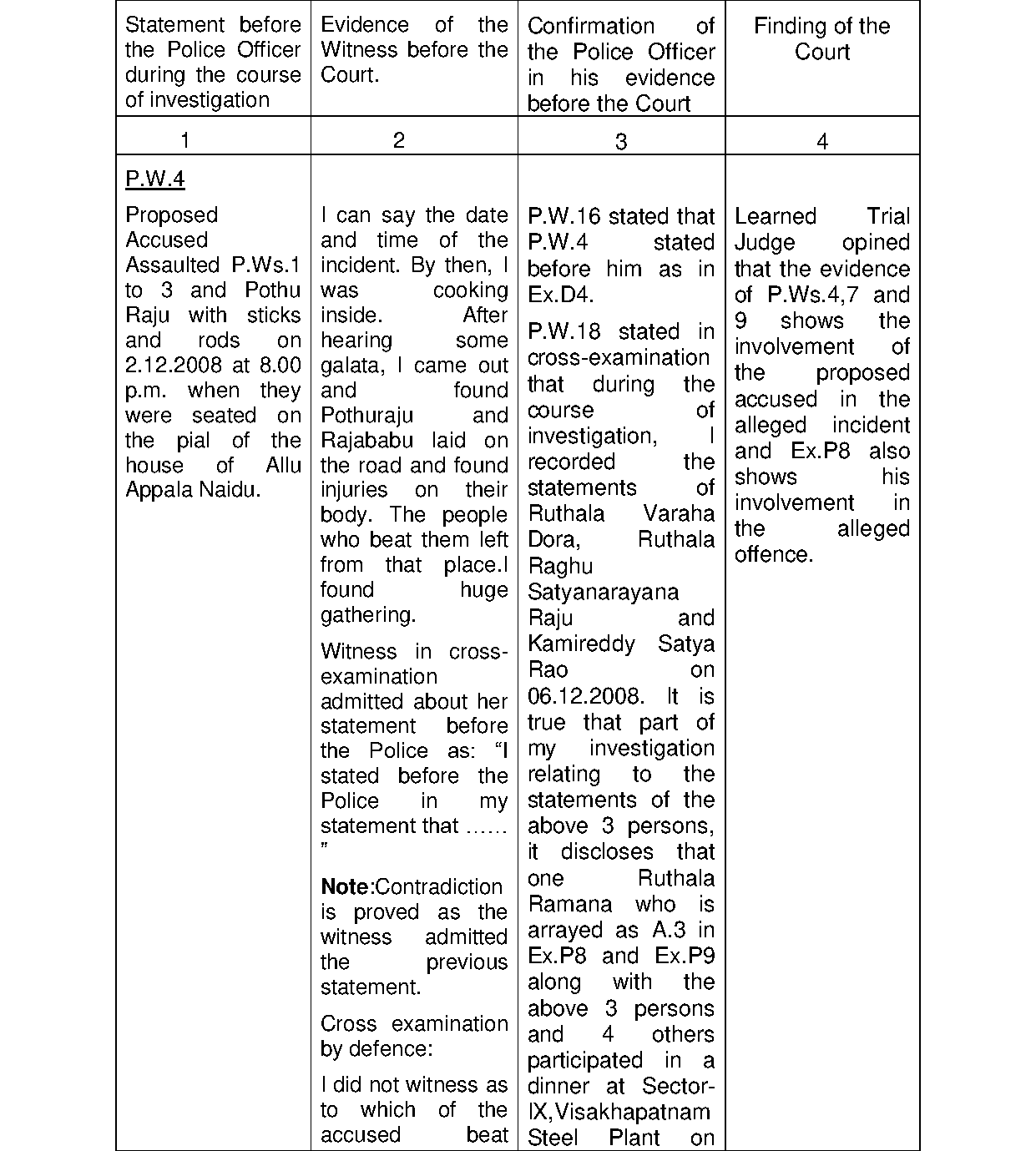
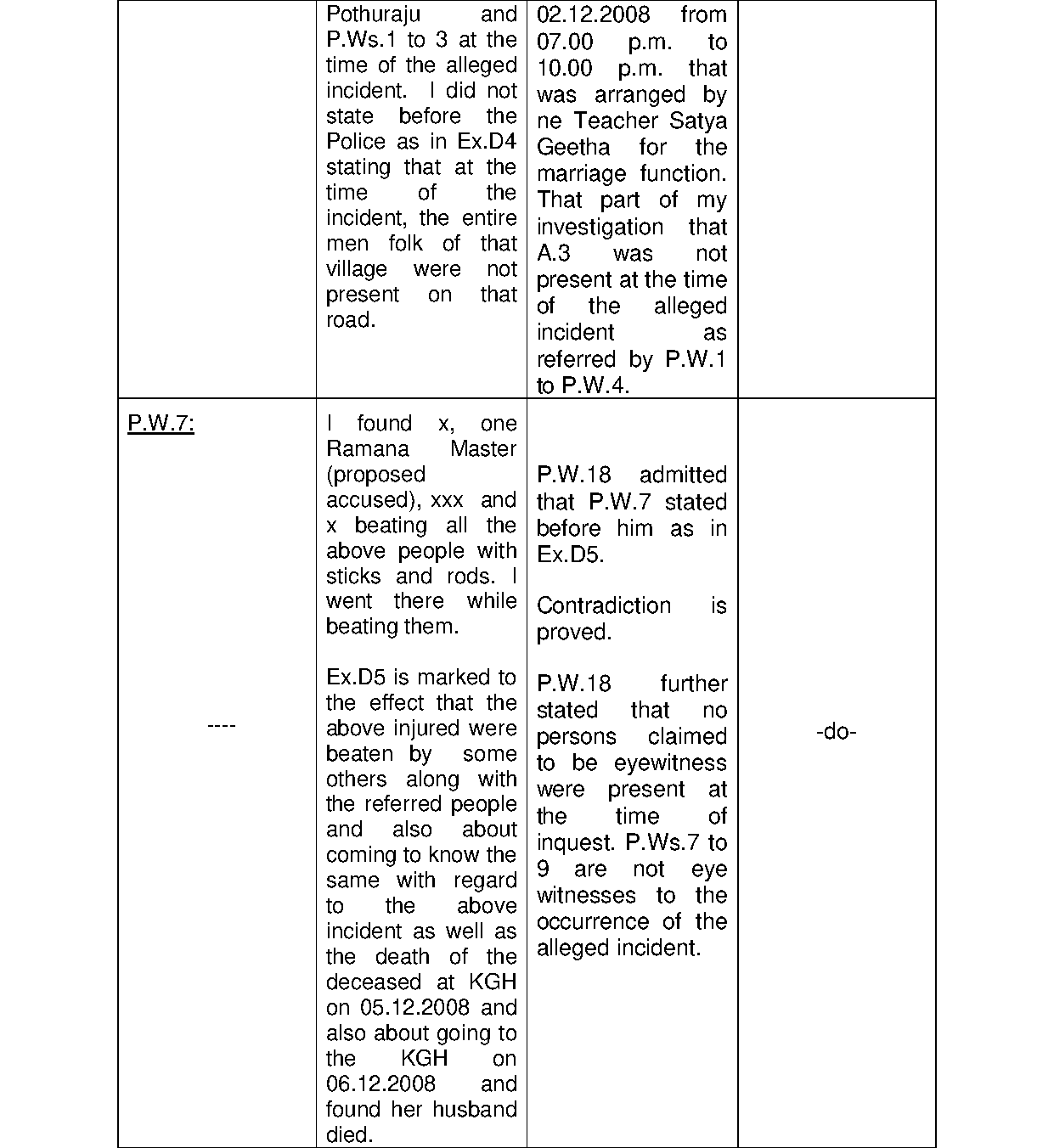
VENKATA JYOTHIRMAI PRATAPA, J.
Ruthala Ramana Alias Ramana Master, S/o Paradesi – Appellant
Versus
The State Of Andhra Pradesh – Respondent
Criminal Appeal No. 41 Of 2025
Decided On : 07-03-2025
Advocates Appeared:
For the Appellant : P A K Kishore
For the Respondent: Public Prosecutor
For the Appellant : P A K Kishore
For the Respondent: Public Prosecutor
The power under Section 319 Cr.P.C. requires evidence stronger than a prima facie case. Statements made to police are not substantive evidence and can only be used to contradict the maker, and such contradictions must be weighed against cross-examination and other evidence before summoning additional accused.
Headnote:(A) Code of Criminal Procedure, 1973 - Section 319 - Power to proceed against persons appearing to be guilty - Standard of satisfaction required for summoning additional accused - The power to proceed against a person not named in the FIR or deleted in the final report must be based on evidence that suggests more than a prima facie case, though short of a satisfaction that would lead to conviction if unrebutted (Paras 42, 46) - Court cannot mechanically issue process simply because a name is mentioned in a statement recorded before the court; it must consider the substance of the evidence (Para 42).
(B) Indian Evidence Act, 1872 - Sections 3, 145, 154 and 155 - Evidentiary value of statements recorded by police - Statements recorded under Section 161 of the Code of Criminal Procedure are not substantive pieces of evidence and cannot be used for corroboration or to contradict other witnesses; their restricted use is only to contradict the maker of the statement under Section 145 of the Evidence Act (Paras 9, 13) - Contradiction must be between the evidence of a witness before the court and the statement of that same witness before the police, not between different witnesses (Paras 19, 20).
(C) Criminal Trial - Role of cross-examination in Section 319 applications - When exercising power under Section 319, the court must not ignore cross-examination of witnesses; if material omissions or contradictions are elicited that impeach the credibility of the witness, the required satisfaction for summoning an additional accused is not met (Paras 44, 45).
Facts of the case:
The appellant's name was initially deleted from a police report due to lack of evidence. After the trial of other accused persons was completed and the matter was posted for judgment, the trial court invoked Section 319 of the Code of Criminal Procedure to add the appellant as an accused, relying on the initial complaint and evidence of three prosecution witnesses. The appellant challenged the validity of this order.
Findings of Court:
The court found that the evidence relied upon by the trial court was insufficient. The testimony of one witness, which named the appellant in a police statement, was contradictory in court and did not positively establish involvement. Furthermore, the investigating officer's testimony provided an alibi, confirming the appellant was elsewhere at the time of the incident. The trial court failed to consider the cross-examination and the standards set by the Hon'ble Apex Court.
Issues: Whether the evidence of the prosecution witnesses and the initial complaint were sufficient to invoke the power under Section 319 of the Code of Criminal Procedure to add the appellant as an accused at the stage of judgment.
Ratio Decidendi: The invocation of Section 319 requires a standard of proof higher than a prima facie case. Since police statements are not substantive evidence and the testimonies of the witnesses were contradicted by the investigating officer's evidence and the witnesses' own cross-examinations, the trial court's satisfaction was not legally sustainable.
Result: Criminal Appeal is allowed setting aside the order dated 11.09.2024 and the consequent order dated 20.12.2024 of issuance of summons to the Appellant.
Legal Category Hierarchy
- crime and sentencing
-
practice and procedure
- evidence
- criminal procedure
- statutory interpretation
Table of Contents
2. Appellant argued evidence did not disclose involvement; State argued specific allegations existed warranting addition under Section 319 CrPC. (Para 5 , 6 )
3. Court held evidence, including contradictions and Investigating Officer's report, did not satisfy the 'much stronger evidence' test under Section 319 CrPC. (Para 9 , 28 , 29 , 30 , 31 , 38 , 39 , 42 , 44 , 45 )
4. Section 319 CrPC requires more than prima facie case; evidence must strongly suggest complicity, and cross-examination cannot be ignored. (Para 42 , 43 , 44 )
5. Appeal allowed; impugned order summoning appellant under Section 319 CrPC set aside. (Para 47 )
6. What is the standard of satisfaction required to summon an accused under Section 319 CrPC?
More than a prima facie case as at charge framing but short of evidence leading to conviction; evidence must strongly suggest complicity. (Para 42 , 43 )
7. Can a court ignore cross-examination of witnesses while deciding a Section 319 CrPC application?
No. When cross-examination is on record, ignoring it while summoning an accused under Section 319 CrPC cannot be exercised. (Para 44 )
8. Is a police statement under Section 161 CrPC substantive evidence for invoking Section 319 CrPC?
No, such statements are not substantive evidence; they can only be used to contradict the witness under Section 145, Evidence Act. (Para 9 , 11 , 12 , 13 )
9. Can a witness be contradicted under Section 145 Evidence Act with another witness's police statement?
No, contradiction under Section 145 is only between the evidence of a witness and that same witness's prior police statement. (Para 19 , 20 )
10. What procedures must a trial court follow when invoking Section 319 CrPC after arguments are heard?
The court should set the matter down for re-hearing, decide on summoning, and if joint trial is ordered, commence de novo proceedings. (Para 41 )
JUDGMENT :
VENKATA JYOTHIRMAI PRATAPA, J.
Instant Appeal has been preferred by the Accused No.9, (newly added accused) challenging the validity and correctness of the Order dated 11.09.2024, in S.C.No.10 of 2015 on the file of the Court of Special Sessions Judge for SC & ST Cases-cum-XI Additional District and Sessions Judge, Visakahapatnam, by invoking the power under Section 319 of the Code of Criminal Procedure, 1973 (in short 'Cr.P.C.').
2. For the sake of convenience, the Appellant herein will be referred as 'Proposed Accused'.
Facts leading to filing of the present Appeal:
3. Initially a case in Crime No.79 of 2008 on the file of Makaravapalem Police Station for the offences under Sections 147, 148, 302, 307 and 324 read with 149 IPC and Section 3(1) (x) of SCs & STs (PoA) Act was registered against the proposed Accused along with 18 named accused and 10 unnamed accused. However, after due investigation, the Police filed report on the file of the Court of Judicial Magistrate of First Class, Narsipatnam by deleting the names of the proposed Accused and Accused Nos.10 to 19 due to lack of evidence against them. Learned Magistrate had taken cognizance of the alleged offences against Accused Nos.1 to 8 in PRC No.23 of 2009 and subsequently the case was committed to the Trial Court and numbered as S.C.No.10 of 2015. After conclusion of trial and after hearing both sides, the matter was posted for judgment on 11.09.2024. On the said date, the impugned order was passed by adding the name of the proposed Accused by exercising the power under Section 319 Cr.P.C.
4. Heard Sri P.A.K.Kishore, learned counsel for the Appellant and Ms.K.Priyanka Lakshmi, learned Assistant Public Prosecutor for Respondent No.1/State. Notice was served on the de facto complainant through Police as reported by learned Assistant Public Prosecutor.
Arguments advanced at the Bar:
On behalf of Proposed Accused
5. Learned counsel for the proposed Accused would submit that the evidence of P.Ws.4, 7 and 9 does not disclose the involvement of the proposed Accused in the alleged crime. Learned counsel would further submit that, P.Ws.7 and 9 are not even eye-witnesses to the occurrence of the alleged incident. It is submitted that Ex.P.8 does not disclose specific overtacts attributed against the proposed Accused. Learned counsel further submits that invoking of power under Section 319 Cr.P.C arose after the cross examination of P.Ws.4, 7, 9, 18 and 19 and when the matter was posted for judgment. Without considering the cross examination of the said witnesses, Learned Trial Judge passed the impugned order. Learned counsel would finally pray for setting aside the impugned order.
On behalf of the Respondents / State:
6. Per contra, learned Assistant Public Prosecutor would submit that the prosecution elicited from the evidence of P.W.4 about the involvement of the proposed Accused in the alleged crime. It is submitted that there are specific allegations against the proposed Accused in the commission of the alleged offences. As such, Learned Trial Judge has rightly ordered to add the name of the proposed Accused in the present case. Learned Assistant Public Prosecutor would finally submit that there are no grounds to interfere in the Appeal.
7. Having heard the submissions, the points that would emerge for determination are:
1) Whether the evidence of P.Ws.4, 7 and 9 coupled with Ex.P8 is suffice to proceed against the proposed accused by invoking the power under Section 319 Cr.P.C.?
2) If so, whether the impugned Order is sustainable in law?
Point Nos.(1) and (2):
8. For ready reference, the relevant part of the impugned order is extracted hereunder:
"Judgment not dictated and case suo-moto reopened as the evidence of P.Ws.4, 7 and 9 available in record shows the involvement of R.Ramana @ Ramana Master in the alleged attack on the deceased as well as on the injured on the alleged date of offence and the statement of defacto complainant i.e., Ex.P.8 also shows his involvement in the