
 Back
Back





IN THE HIGH COURT OF KARNATAKA
Anant Ramanath Hegde, J.
Vasudev Narayan Naik – Appellant
Versus
Mahadev Hammanna Naik – Respondent
Regular Second Appeal No. 5265 of 2010
Decided On : 07-09-2023
ADOPTION - Partition and Validity of Adoption - Hindu Adoption and Maintenance Act, 1956 - Sections 11, 12, 15, 16 - The court discussed the provisions of the Hindu Adoption and Maintenance Act, 1956, particularly focusing on Sections 11, 12, 15, and 16, which outline the requirements for a valid adoption, the effects of adoption, and the presumption of validity for registered adoptions. The court emphasized that the Act does not mandate an adoption ceremony, and the burden of proof lies with the party disputing the adoption. The court found that the First Appellate Court erred in its conclusions regarding the necessity of an adoption ceremony, leading to its decision to restore the trial court's ruling in favor of the appellant.
Fact of the Case:
The plaintiff sought partition and a declaration that the first defendant was not the adopted son of the deceased Vasu. The trial court ruled in favor of the defendant, affirming the adoption, while the First Appellate Court reversed this decision, leading to the current appeal.
Finding of the Court:
The court found that the First Appellate Court's conclusion regarding the invalidity of the adoption was not supported by evidence and misapplied the legal standards set forth in the Hindu Adoption and Maintenance Act, 1956. The court emphasized that the adoption deed was duly registered, and the essential requirements for a valid adoption were met.
Issues: 1) Whether the First Appellate Court erred in ignoring material evidence regarding the adoption? 2) Was the judgment of the First Appellate Court perverse for not considering the material evidence?
Ratio Decidendi: The court held that the Hindu Adoption and Maintenance Act, 1956 does not require an adoption ceremony to be valid. The registered adoption deed creates a presumption of validity, and the burden of proof lies with the party challenging the adoption. The court found that the First Appellate Court's reliance on the absence of an adoption ceremony was legally unfounded.
Final Decision: The appeal was allowed, the judgment of the First Appellate Court was set aside, and the trial court's decree affirming the validity of the adoption was restored.
JUDGMENT
1. This appeal is by first defendant in O.S.No.37/1981 on the file of the Munsiff, Ankola, challenging the divergent finding recorded by the First Appellate Court.
2. The plaintiff has sought for partition and separate possession of 6/10th share in the suit schedule properties and sought a declaration that the defendant No.1 is not the adopted son of the deceased Vasu. The First Appellate Court has allowed the appeal and consequently, granted the relief of declaration as well as the partition.
3. This appeal was admitted on 20/3/2014, to answer the following substantial question of law:
"i) Whether the first appellate Court has committed a serious error in ignoring the material evidence in order to come to the conclusion that the adoption of defendant No.1 is not proved in accordance with law?
ii) Whether the judgment and decree of the first appellate Court is perverse and illegal for not considering the material evidence placed on record?"
4. Certain facts necessary to answer the aforementioned substantial questions of law can be summerised as under:-
5. The genealogy of the parties is under:
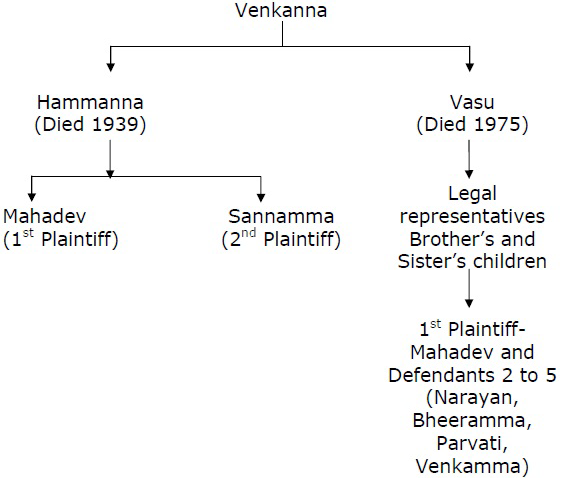
6. One Venkanna was the propositus. He had two sons Hammanna and Vasu. The elder son Hammanna died in the year 1939. Vasu died in the year 1975. Hammanna had two children, Mahadev-the first plaintiff and Sannamma-the second plaintiff. According to the plaintiffs, Vasu died issueless and after the death of Vasu a dispute arose as first defendant claimed to be the adopted son of the deceased Vasu. Hence, the suit is filed challenging the adoption.
7. The first defendant contested the suit and claimed to be the adopted son of late Vasu under the registered deed dtd. 15/9/1970 after the demise of Vasu died on 3/10/1975 and the first defendant succeeded to the properties of Vasu as a sole adopted son of Vasu.
8. The trial Court has held that the adoption is proved and dismissed the suit.
9. Appeal is filed by plaintiff no.1. Plaintiff no.2 has died by that time. Plaintiff no.1 is said to be the sole heir of deceased plaintiff no.2. In the appeal filed by plaintiff no.1, it is held that the adoption is outcome of fraud and the suit is decreed.
10. Aggrieved by the divergent finding, the first defendant is in second appeal.
11. Sri Sangram Kulkarni, learned counsel appearing for the appellant raised the following contentions:-
i) The adoption is duly registered, and under Sec. 16 of the Hindu Adoption and Maintenance Act, 1956 ('Act, 1956' for short) and there is a presumption in favour of adoption. The burden is on the plaintiff who disputed the adoption to prove that it is invalid. Burden is not discharged.
ii) The adoption does not mandate the attestation by the witnesses. The examination of attesting witness is not necessary to prove the adoption. If at all there is any discrepancy in the evidence of attesting witness, the said discrepancy does not lead to the conclusion that the adoption is invalid.
iii) Since Vasu the adoptive father had no issues, he had compelling reasons to adopt defendant No.1, and accordingly, he adopted first defendant.
iv) The First Appellate Court erred in holding that the adoption ceremony is not established. After the commencement of the Act, 1956, the performance of the adoption ceremony is not a mandatory requirement. The adoption in favour the first defendant is in compliance with the requirement of the Act, 1956.
12. Sri Srinivas Naik, the learned counsel appearing for respondent No.1 raised the following contentions:-
i) The adoption ceremony has not taken place and the same is not proved.
ii) The adoptive father attended the school on the date of alleged adoption and there is no way he could have attended the adoption ceremony given the distance between the home and the school.
iii) The attesting witnesses to the adoption have not supported the case of adoption.
iv) The alleged adoption deed also reveals that the adoptive father has executed a Will in favour of the brother of the adopted son.
v) The
AI
The Hindu Adoption and Maintenance Act, 1956 does not mandate an adoption ceremony for the validity of an adoption; a registered adoption deed carries a presumption of validity, placing the burden of....

The burden of proof lies on the claimant to establish valid adoption as per statutory requirements; registered deeds are rebuttable and do not eliminate the need for actual proof.

The validity of adoption requires clear, cogent evidence of factum, including actual giving and taking; mere documentation is insufficient without proof of the legal requirements.

Valid adoption requires proof of customary rituals and consent, with documentary evidence insufficient without corroborating proof of actual giving and taking.

The main legal point established in the judgment is that the adoption deed was obtained by fraud and misrepresentation, and the physical act of giving and taking of adoption did not take place in acc....

Point of law: A perfectly valid adoption deed can be made without an adoption deed and any status which the adopted son gets by virtue of adoption is due to the proper ceremonies being performed and ....

The validity of an adoption requires strict compliance with statutory conditions, including the consent of the biological mother, and such conditions were not met in this case.
Adoption requires strict adherence to legal prerequisites, including consent from both biological parents, making an invalid registration insufficient for legitimacy.



An indispensable Tool for Legal Professionals, Endorsed by Various High Court and Judicial Officers
Please visit our Training & Support
Center or Contact Us for assistance

Scan Me!
India’s Legal research and Law Firm App, Download now!


For Daily Legal Updates, Join us on :



 Back to top


