


1. Petitioners granted quarry leases for laterite; ILMS ID locked, preventing transport of mined mineral. (Para 1 , 2 )
 Back
Back
Next 





2026 Supreme(Kar) 324
IN THE HIGH COURT OF KARNATAKA AT BENGALURU
VIBHU BAKHRU, CJ, K.S. HEMALEKHA, J.
Shagufta Begum, W/o Irfan Aziz Mohammed – Petitioner
Versus
The State Of Karnataka – Respondent
Writ Petition No. 16816 Of 2026 (Gm-Mm-S), Writ Petition No. 16236 Of 2026 (Gm-Mm-S), Writ Petition No. 17359 Of 2026 (Gm-Mm-S), Writ Petition No. 17856 Of 2026 (Gm-Mm-S),Writ Petition No. 17983 Of 2026 (Gm-Mm-S)
Decided On : 28-07-2026
Advocates Appeared:
For the Petitioner:Sri Raveendra Gajanan Kolle, Advocate
For the Respondent:Sri K.S. Harish, Government Advocate, Sri K. Aravind Kamath, Asg A/W Sri S. Rajashekar, Cgc
For the Petitioner:Sri Raveendra Gajanan Kolle, Advocate
For the Respondent:Sri K.S. Harish, Government Advocate, Sri K. Aravind Kamath, Asg A/W Sri S. Rajashekar, Cgc
Minerals are classified as major or minor based on threshold values. Laterite with Al2O3 ≥ 20% or Fe ≥ 15% is a major mineral, requiring Central Government concurrence for lease grants; without such concurrence, the grants are impermissible.
Headnote:(A) Minerals (Evidence of Mineral Contents) Rules, 2015 - Rule 3(e) - Notification dated 25.04.2018 - Classification of minerals - Major and Minor minerals - Threshold value of minerals - Laterite with aluminous content (Al2O3) of 20% or more or iron (Fe) content of 15% or more is classified as a major mineral - Major minerals require the concurrence of the Central Government for the grant of leases (Paras 5, 10).
(B) Classification of Bauxite - Distinction between aluminous laterite and metallurgical-grade bauxite depends on silica (SiO2) content and beneficiability, but both are classified as major minerals if the Al2O3 content is 20% or above, due to their industrial utility in alumina or cement industries (Para 9).
Facts of the case:
Petitioners were granted quarry leases for the extraction of laterite. Their access to the Integrated Leases Management System (ILMS) portals was locked, preventing the transport of minerals. The State contended that the minerals in the leased areas are actually Bauxite or Iron Ore, based on threshold values, which would classify them as major minerals rather than minor minerals.
Findings of Court:
The court found that the classification of the mineral depends on the threshold values specified in the notification dated 25.04.2018. If the Al2O3 content is 20% or above, the mineral is classified as bauxite, and if the iron content is 15% or above, it is classified as iron ore. Both are major minerals. Consequently, leases for such minerals cannot be operated without the necessary concurrence from the Central Government.
Issues: Whether laterite with an Al2O3 content of 20% or more is to be considered a major mineral (Bauxite) and whether the validity of the quarry leases depended on whether the mineral content met the threshold values for major minerals.
Ratio Decidendi: The classification of a mineral as a major or minor mineral is determined by the threshold values prescribed by the Indian Bureau of Mines. If the chemical composition of the mineral exceeds these thresholds, it is a major mineral, and the grant of its lease requires the concurrence of the Central Government.
Result: Petitions disposed of by directing the State to take an informed decision based on chemical analysis of samples and communicate the same to the petitioners on or before 10.08.2026.
Legal Category Hierarchy
- administrative law
- practice and procedure
Table of Contents
2. Dispute over whether the mineral is laterite (minor) or bauxite (major) based on threshold values of Al2O3 and SiO2. (Para 3 , 4 , 8 )
3. If laterite has Al2O3 of 20% or more, or Fe of 15% or more, it is a major mineral. (Para 10 )
4. Classification as major or minor mineral depends on threshold values per notification dated 25.04.2018. (Para 10 , 11 )
5. Court disposed petitions directing state to decide based on sample analysis and communicate by specified date. (Para 12 , 13 , 14 )
6. How is laterite classified as a major or minor mineral in quarry leases?
Laterite with Al2O3 content of 20% or more is classified as bauxite (major mineral); with Fe content of 15% or more as iron ore. (Para 10 , 11 )
7. What is the relevance of silica content in classifying bauxite from aluminous laterite?
Silica content determines suitability for alumina making; high silica may reclassify the ore as aluminous laterite, but still a major mineral. (Para 9 , 10 )
8. What is the threshold value of minerals under the Minerals (Evidence of Mineral Contents) Rules, 2015?
Threshold value means limits prescribed by Indian Bureau of Mines based on beneficiability and marketability, below which material can be discarded as waste. (Para 5 )
9. What happens if quarry lease samples show mineral content above the threshold?
If Al2O3 or Fe content exceeds threshold, the mineral is a major mineral and leases granted without central government concurrence must be cancelled. (Para 10 , 12 )
10. What action must the state take following the court's order in this case?
The state must analyze samples from the leases, decide based on threshold values, and communicate the decision to petitioners by the specified date. (Para 12 , 13 , 14 )
ORDER :
VIBHU BAKHRU, CJ.
1. These petitions have been filed by the petitioners who have been granted with quarry leases for quarrying Laterite.
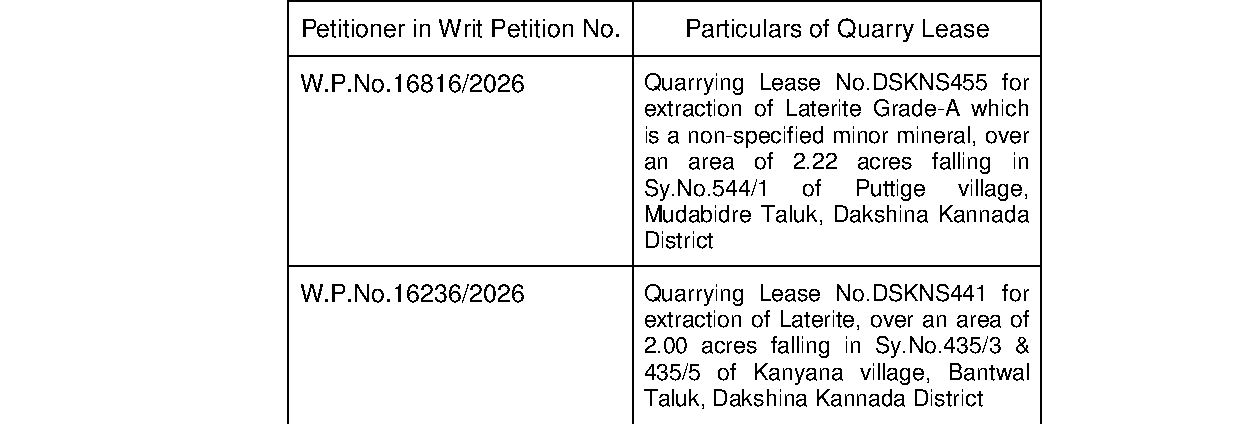
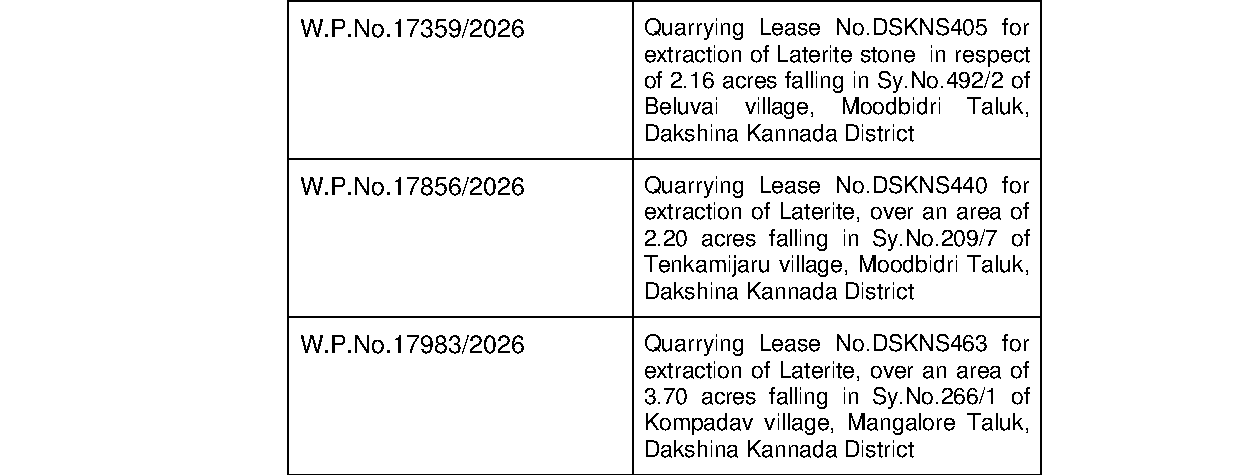
2. It is the common grievance of the petitioners that their ILMS [Integrated Leases Management System] ID's have been locked and they have been prevented from transporting Laterite mine by them. A tabular statement setting out the particulars of the respective leases granted to the petitioners is set out below.
3. The controversy in the present batch of petitions pivots on the question whether the mineral available in the leases granted to the petitioners is a major mineral.
4. According to the State, there is material to indicate that the mineral available in the quarry leases granted to the petitioners is Bauxite, as notified under notification dated 25.04.2018. The question whether the mineral is Bauxite depends on the threshold value of the specified compound/element.
5. It is relevant to note that the threshold value of minerals is defined under Rule 3(e) of the Minerals (Evidence of Mineral Contents) Rules, 2015, which explains the meaning of the threshold value of minerals as under:
"3(e) "threshold value of minerals" means the limits prescribed by the Indian Bureau of Mines from time to time based on the beneficiability and marketability of a mineral for a given region and given time, below which the material obtained after mining can be discarded as waste;"
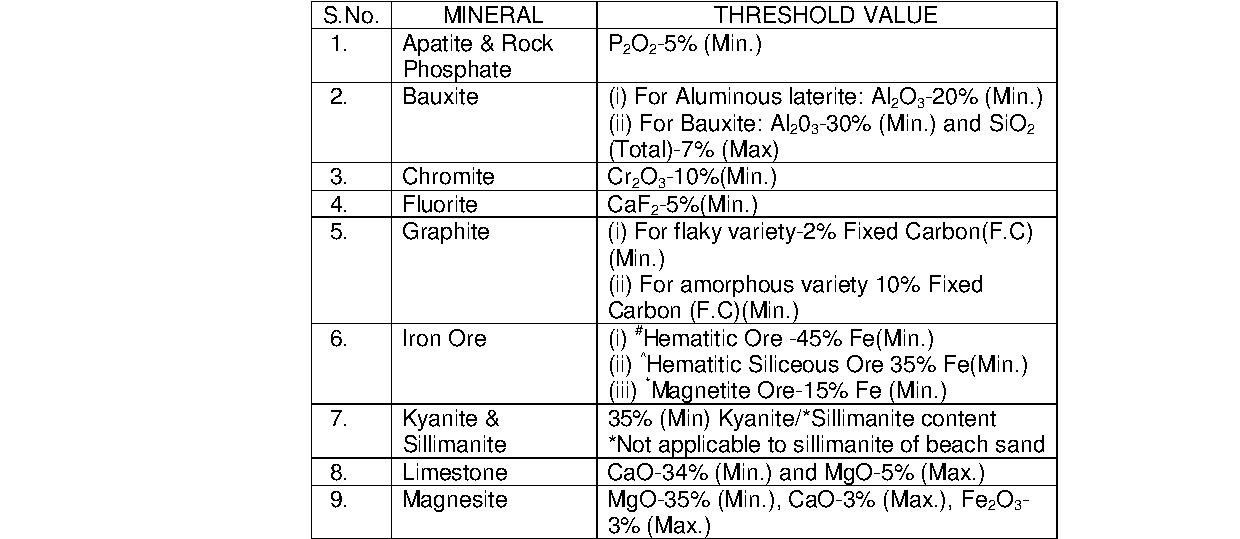
6. It is relevant to refer to the threshold value for the minerals Bauxite and Iron ore as set out in the notification dated 25.04.2018. The relevant extract of the tabular statement setting out the threshold values of the aforementioned minerals as set out in the aforesaid notification is reproduced below.
"6. THRESHOLD VALUE OF MINERALS

7. The principal controversy in the present petitions is whether laterite with aluminous content [Al2O3 content] of 20% or more is to be considered as Bauxite.
8. It is contended on behalf of the petitioners that the Laterite with Al2O3 content of 20% and above would be aluminous laterite and it would qualify as bauxite only if it is not accompanied by any other Mineral. In other words, if on a stand-alone basis the Al2O3 content is 20% or above, the Laterite would be aluminous laterite, which would qualify as bauxite. It is contended that if the laterite also contains Silica [SiO2 ], then the question of whether laterite would be classified as bauxite would depend on the SiO2 content.
The learned counsel appearing for the petitioners contends that in such eventuality, the Al2O3 content must necessarily be 30% or above and the SiO2 content must be 7% or less for laterite to be classified as a major mineral, bauxite.
9. The respondents have filed an affidavit, inter alia, explaining that bauxite is normally used for the manufacture of alumina or aluminium metal. However, it is also used in the cement industry. The threshold values of Al2O3 and SiO2 for the purpose of classification of bauxite have been explained as under:
"Role of silica content in classification of bauxite:
31. That silica content also determines quality parameters of bauxite. Its significance arises because reactive silica in the refinery reduces alumina recovery and raises production costs. Consequently, high-grade metallurgical bauxite generally requires high available alumina and low reactive silica. Even where alumina content is high, excessive reactive silica can make the ore unsuitable or uneconomical for aluminium production. Accordingly, both alumina content and silica content are considered while assessing the suitability and grade of bauxite.
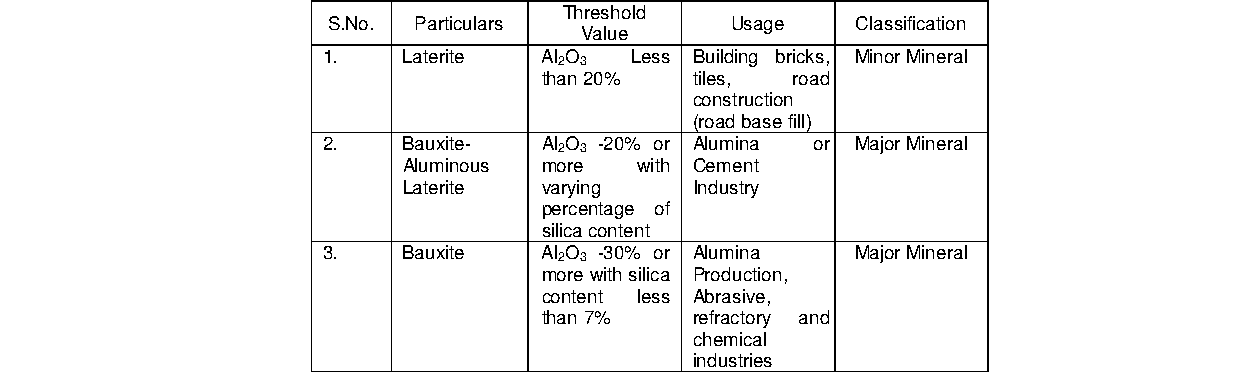
Because of its comparatively lower alumina and higher impurities, aluminous laterite has a lower commercial value than metallurgical-grade bauxite.
In view of the above, it is most respectfully submitted that Aluminous Laterite having more than 20% Al2O3 content with varying percentage of silica content is used in alumina or cement industry based on the percentage of content of sil












