1. Petitioner claimed accidental exposure without sexual intent; complainant alleged gestures with sexual overtone. (Para 4 , 5 , 6 )
 Back
Next 


2026 Supreme(Kar) 341
IN THE HIGH COURT OF KARNATAKA AT BENGALURU
M. NAGAPRASANNA, J.
Sri. Anil Rohan Menezes, C/o. John Baptist Menezes - Petitioner
Versus
The State of Karnataka, By Kodigehalli Police Station, Rep. by State Public Prosecutor - Respondent
Criminal Petition No. 6103 of 2026
Decided On : 01-09-2026
Advocates Appeared:
For the Petitioner: Sri. Abhilash H.S.
For the Respondent: Sri. K. Nageshwarappa, HCGP, Smt. Swati Gopalkrishna.
For the Petitioner: Sri. Abhilash H.S.
For the Respondent: Sri. K. Nageshwarappa, HCGP, Smt. Swati Gopalkrishna.
Accidental exposure of private parts while answering nature's call, lacking sexual intent or overtures directed toward a woman, does not constitute an offense under Section 75(2) of the Bharatiya Nyaya Sanhita, 2023, as it lacks the necessary mens rea for criminal prosecution.
Headnote:(A) Bharatiya Nyaya Sanhita, 2023 - Section 75(2) [Corresponding to Section 354A of the Indian Penal Code] - Sexual harassment - Accidental exposure of private parts while answering nature's call - Absence of sexual intent and mens rea - Whether such an act constitutes an offence - For an act to fall within the precincts of sexual harassment, it must carry sexual overtone and the requisite mens rea; an accidental or unintended exposure, bereft of sexual intent and not directed towards a woman, cannot be metamorphosed into an offence merely because it is witnessed by a woman. (Para 12)
(B) Criminal Law - Distinction between exposure and intentional exposure - Exposure of the body and intentional exposure of the body to a woman for a sexual purpose are not synonymous; criminal law punishes the latter when statutory ingredients are fulfilled and cannot mechanically criminalise the former due to unfortunate circumstances. (Para 14)
(C) Quashing of proceedings - Abuse of process - Where the substratum of the prosecution, taken at its highest, does not disclose the ingredients of the offence alleged, continuation of proceedings would be an abuse of the process of law and result in patent miscarriage of justice. (Paras 16 and 17)
Facts of the case:
A complaint was registered alleging that a petitioner exposed his private parts in a public place as a complainant was walking by. The petitioner contended that he was compelled by the exigency of nature to relieve himself by the side of the street after failing to find a public restroom and that the exposure was accidental, as he was unaware of the complainant's presence until he turned around. The complaint recorded that the petitioner was attending to nature's call and his private part came to be exposed without his attention being directed towards the complainant.
Findings of Court:
The court found that the complaint and material collected during investigation did not disclose any deliberate act of exposure directed towards the complainant or any conduct demonstrative of sexual intent. The petitioner's reaction of sudden shock upon noticing the complainant was contrary to the element of sexual intent. The mere fact that the complainant saw the private part does not supply the statutory ingredient of sexual intent.
Issues: Whether the allegations of exposure while answering nature's call, in the absence of any sexual overture or deliberate intent directed towards the complainant, satisfy the ingredients of the offence punishable under Section 75(2) of the Bharatiya Nyaya Sanhita, 2023.
Ratio Decidendi: A person answering nature's call whose private parts are inadvertently seen by a woman does not satisfy the ingredients of sexual harassment unless there is a deliberate act of exposure or conduct demonstrating sexual intent. Criminal law cannot presume sexual intent from mere exposure without foundational facts. When the allegations do not prima facie constitute an offence, the inherent jurisdiction of the court must be exercised to quash the proceedings to prevent the legal process from becoming the punishment. (Paras 12, 15, 16)
Result: Criminal petition allowed; proceedings quashed.
Legal Category Hierarchy
Table of Contents
2. Accidental exposure without sexual intent and not directed at woman does not constitute sexual harassment under Section 75(2) BNS. (Para 11 , 12 , 13 , 15 , 16 )
3. Accidental exposure without sexual intent does not attract Section 75(2) BNS; proceedings may be quashed if allegations fail to disclose ingredients. (Para 12 , 15 , 16 , 17 )
4. What are the essential ingredients of an offence under Section 75(2) of the Bharatiya Nyaya Sanhita, 2023?
The conduct must carry a sexual overtone and be accompanied by the requisite mens rea; mere exposure without sexual intent is insufficient. (Para 12 , 15 )
5. Does accidental exposure of a private part while answering nature's call constitute sexual harassment under Section 75(2) BNS?
No, an accidental or unintended exposure, bereft of sexual intent and not directed towards the woman, does not satisfy the ingredients of the offence. (Para 13 , 15 )
6. When can criminal proceedings be quashed under inherent powers for failure to disclose an offence?
If allegations, taken at face value, do not prima facie constitute any offence, continuation of proceedings would be an abuse of process and can be quashed. (Para 16 , 17 )
ORDER :
The petitioner is before the Court calling in question the proceedings in C.C.No.14887/2026 registered for the offence punishable under Section 75(2) of the Bharatiya Nyaya Sanhita, 2023 ('the BNS' for short), pending on the file of 7th Additional Chief Judicial Magistrate, Bengaluru.
2. Heard Sri. Abhilash H.S., learned counsel appearing for the petitioner - accused; Sri. K. Nageshwarappa, learned High Court Government Pleader appearing for respondent No.1 - State and Smt. Swati Gopalkrishna, learned counsel appearing for respondent No.2 - complainant
3. The facts adumbrated are as follows:
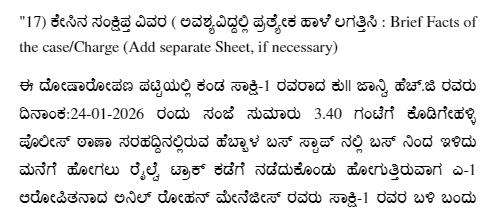
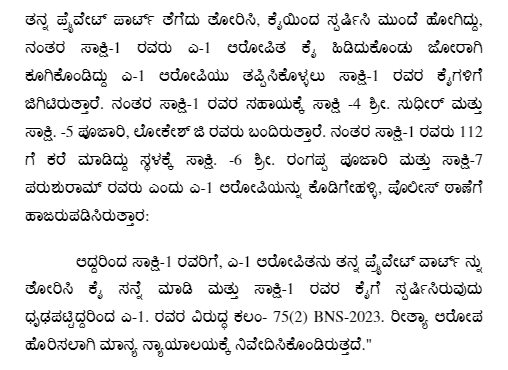
3.1. Respondent No.2 is the complainant. The genesis of the lis lies in a complaint registered on 24-01-2026, which comes to be transformed into Crime No.35 of 2026 for the offence punishable under Section 75(2) of the Bharatiya Nyaya Sanhita, 2023 (‘BNS’ for short). The allegation, shorn of embellishment, is that the petitioner exposed his private part at a public place near Hebbal at a time when the complainant was walking by. This solitary incident becomes the fulcrum around which the entire crime revolves.
3.2. The Police conduct investigation and, on its culmination, lay a charge sheet against the petitioner. It is the filing of the charge sheet and the consequential continuation of criminal proceedings that have driven the petitioner to the doors of this Court in the subject petition.
SUBMISSIONS:
PETITIONER:
4. The learned counsel appearing for the petitioner would seek to place an altogether different complexion upon the incident. He would submit that, after alighting from a bus, the petitioner was in urgent need of a restroom and frantically searched for one in the vicinity. Finding none, and being unable to resist nature’s call any longer, the petitioner sought to relieve himself by the side of the street. At that precise moment, the complainant happened to walk past the place. The petitioner, unaware of her presence, suddenly turned around and, in that fleeting moment, the complainant happened to see his private part. This accidental circumstance, according to the learned counsel, has been given the colour of a criminal act and has ultimately snowballed into the impugned prosecution.
4.1. The learned counsel would vehemently contend that an accidental exposure, bereft of any sexual overture, intent or conduct directed towards the complainant, cannot be metamorphosed into an offence merely because the complainant happened to witness it. He would submit that the ingredients necessary to constitute an offence under Section 75(2) of the BNS—corresponding to Section 354A of the erstwhile the IPC—are not merely absent, but are not discernible even in their remotest semblance from the complaint or the material collected during investigation.
COMPLAINANT:
5. The learned counsel appearing for the respondent No.2 - complainant would however contend that the petitioner was not only answering the call of nature, but was making some gestures, as well. In that light, the learned counsel submits that this is a matter where it must be permitted to be tried and for the petitioner to come out clean in a full blown trial, as to what was he doing at that point in time.
STATE:
6. The learned High Court Government Pleader also would toe the lines of the learned counsel appearing for the complainant in seeking dismissal of the petition.
7. I have given my anxious consideration to the submissions made by the respective learned counsel and have perused the material on record.
CONSIDERATION:
8. The afore-narrated facts are a matter of record. They would not require any iteration. The entire issue gets triggered from the registration of the complaint. The gist of the complaint as found in column No.10 reads as follows:
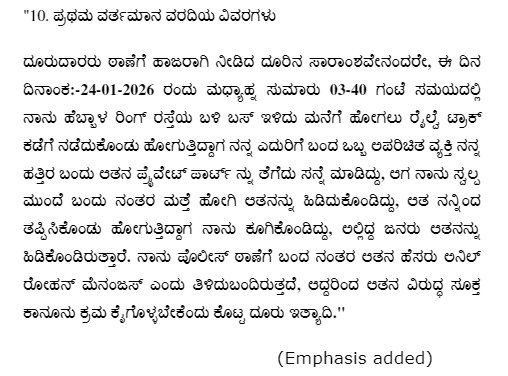
The complaint itself narrates that the complainant, after alighting from a bus, was proceeding towards the nearby railway track. At that point in time, the petitioner, without noticing the presence of the complainant, was attending to nature’s call