1. Challenge to notification transferring a part-heard murder trial at evidence stage to another court. (Para 3 , 4 , 10 )
 Back
Next 


2026 Supreme(Kar) 369
IN THE HIGH COURT OF KARNATAKA AT BENGALURU
M. NAGAPRASANNA, J.
Krishna Murthy @ Murthy S/o. Venkatesh - Petitioner
Versus
State of Karnataka, by Kamakshipalya Police Station, Bengaluru, Represented by LD SPP - Respondent
Writ Petition No.21332 of 2026 (GM - RES)
Decided On : 02-09-2026
Important Points
Statutory provisions allowing the transfer of criminal cases and the succession of judges override the general principle that the judge who records the evidence must decide. An accused possesses a right to a fair trial, but not a vested right to a specific presiding officer.
Subject
Criminal Law - Criminal Procedure
Act Referred
Headnote
(A) Bharatiya Nagarik Suraksha Sanhita (BNSS) - Sections 365, 448, 449 / Code of Criminal Procedure (CrPC) - Sections 326, 408, 409 - Transfer of part-heard criminal cases - Power of a successor Judge to act on evidence recorded by a predecessor - Power of Sessions Judge to transfer cases for the ends of justice - Re-allocation of cases based on police station jurisdictions - Whether transfer of a case at the stage of recording evidence of the investigating officer violates the principle that the judge who hears the evidence must decide - Statutory provisions for succession and transfer of proceedings override general administrative law maxims - Right to a fair trial does not include a vested right to a specific judge. (Paras 11, 11.1, 11.2, 13, 15.1, 18, 22)
(B) Administrative action - Distribution and re-allocation of judicial business - Judicial review limited to cases of arbitrariness, caprice, mala fides, or demonstrable prejudice - General administrative re-organization for the orderly distribution of work and expedition in disposal is not subject to interference unless selectively targeted. (Paras 20, 21)
Facts of the case:
The petitioner, an accused in a murder trial, challenged an administrative notification transferring the trial from one sessions court to another. The transfer was part of a general re-allocation of police stations to different courts. The notification permitted the retention of cases already at advanced stages, specifically those posted for recording the statement of the accused under Section 313 CrPC/Section 351 BNSS, final arguments, or where the matter was reserved for judgment. The petitioner's case was at the stage of recording the evidence of the investigating officer and therefore did not fall within the exceptions for retention.
Findings of Court:
The court found that the notification was a general administrative exercise aimed at the orderly distribution of judicial work. It held that the statutory scheme under the BNSS and CrPC explicitly permits the transfer of cases and empowers a successor judge to proceed based on evidence already recorded by a predecessor. Since the petitioner's case had not reached the advanced stages defined in the notification, it was subject to transfer.
Issues: Whether the administrative transfer of a part-heard criminal case, prior to the recording of the accused's statement, is illegal or violates the right to a fair trial by ignoring the principle that the judge who records the evidence must be the one to pronounce judgment.
Ratio Decidendi: Statutory provisions (Section 365 BNSS / Section 326 CrPC) serve as a legislative bridge for the transition of cases between judges, ensuring continuity of proceedings. The maxim "he who hears must decide" is a principle of administrative law and cannot override express statutory mandates in criminal procedure. The power of a Sessions Judge to transfer cases under Section 448 BNSS (Section 408 CrPC) for the ends of justice is not prohibited merely because the trial has commenced. While an accused has a right to a fair trial before a competent and impartial court, there is no vested right to insist upon trial before a specific judge.
Result: Petition dismissed.
Legal Category Hierarchy
-
crime and sentencing
-
offences against the person
- murder (Para 3)
-
offences against the person
- practice and procedure
Advocates Appeared:
For the Petitioner:Sri Hashmath Pasha, Sr. Advocate for Sri Kariappa N.
For the Respondent: Sri B.N. Jagadeesha, SPP-I, Sri M.A. Subramani.
For the Petitioner:Sri Hashmath Pasha, Sr. Advocate for Sri Kariappa N.
For the Respondent: Sri B.N. Jagadeesha, SPP-I, Sri M.A. Subramani.
Table of Contents
2. Accused argues prejudice from transfer of part-heard case; state contends no prejudice as trial continues from same stage. (Para 5 , 6 , 7 )
3. Transfer power under Section 448 BNSS is not barred by trial commencement; exceptions in notification protect only advanced-stage cases. (Para 12 , 16 , 17 , 19 )
4. A Sessions Judge's power to transfer a case under Section 448 BNSS is not extinguished merely because evidence has commenced. (Para 12 , 13 , 14 , 16 )
5. Petition dismissed; no interference with the administrative notification and transfer of the part-heard sessions case. (Para 23 )
6. Does a Sessions Judge have power to transfer a part-heard case after evidence has commenced under Section 448 of the BNSS?
Yes. Section 448 BNSS does not erect a statutory bar against transfer merely because trial has commenced. The power must be exercised with circumspection but is not extinguished. (Para 12 , 13 , 14 , 16 )
7. Can the maxim 'he who hears must decide' defeat a statutory transfer under criminal procedure?
No. The maxim from administrative law cannot override the express statutory regime under BNSS which contemplates transfer and succession of judges. (Para 18 )
8. Does an accused have a vested right to be tried by a particular judge?
No. An accused has a right to a fair trial before a competent and impartial court, but not a vested right to insist on trial before a particular judge. (Para 22 )
9. What is the effect of an administrative notification that carves out exceptions for advanced-stage cases?
The notification's exceptions (Section 313 stage, final arguments, judgment reserved) show the authority's sensitivity to prejudice. Cases outside these exceptions are subject to transfer. (Para 9 , 10 , 17 , 19 )
10. What is the role of Section 365 of the BNSS (successor to Section 326 CrPC) in a transfer of a part-heard case?
Section 365 BNSS ensures continuity of the proceeding. The successor judge may act on evidence already recorded and the trial does not start afresh. (Para 11 , 13 )
ORDER :
The petitioner - accused is before this Court seeking the following prayer:
(1) "Quash the Notification dated 20-05-2026 under reference No.ADM-1 (A) 340/2026 as per Annexure-A issued by respondent No.3 as illegal and abuse of power.
(2) Consequently, issue writ of mandamus directing the respondents to re-transfer the Sessions Case No.824/ 2013 now pending on the file of Hon’ble LVIII Additional City Civil and Sessions Judge, Bangalore City to original Court of Hon’ble LXI Additional City Civil and Sessions Jude, Bangalore City where trial was conducted, as per Annexure-B and then to dispose of the case in accordance with law in the interest of justice.
(3) And to grant such other relief or reliefs as this Hon’ble Court deems fit to grant in the facts and circumstances of the case in the interest of justice.”
2. Heard Sri Hasmath Pasha, learned senior counsel appearing for the petitioner, Sri B.N. Jagadeesha, learned State Public Prosecutor-1 appearing for respondent No.1 and Sri M.A. Subramani, learned counsel appearing for respondent Nos.2 and 3.
3. Facts, in brief, germane are as follows: -
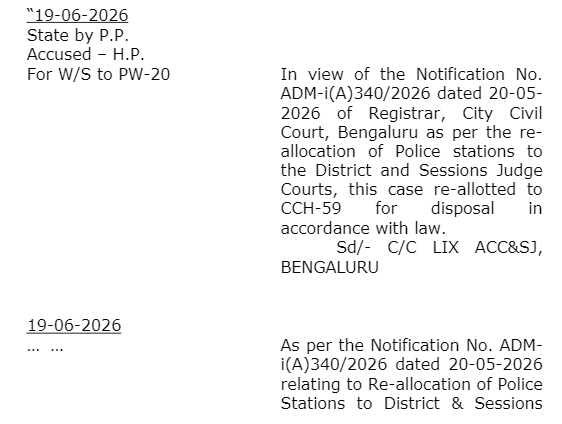
The petitioner/accused is prosecuted for an offence punishable under Section 302 of the IPC – murder in S.C.No.824 of 2013 and was facing trial before the LXI Additional City Civil and Sessions Judge, Bengaluru City. During the trial, the prosecution had examined in all 20 witnesses - PW-1 to PW-20; PW-20 being the Investigating Officer. His evidence also stood completed in the said proceedings.
4. When things stood thus, a Notification comes to be issued on 20-05-2026 transferring the trial from the Court of LXI Additional City Civil and Sessions Judge, Bengaluru City to the Court of LVIII Additional City Civil and Sessions Judge, Bengaluru City. The transfer of pending trial in S.C.No.824 of 2013 by the subject Notification is what has driven the petitioner to this Court in the subject petition.
5. The learned senior counsel Sri Hasmath Pasha, submits that the entire trial of recording evidence is conducted before the Court of LXI Additional City Civil and Sessions Judge, Bengaluru City and the learned Judge who recorded evidence is still in the same Court. It is his contention that the learned Judge who recorded the evidence is the only person who can dispose of the subject case as the learned Judge had the opportunity of observing the demeanour of witnesses. The case is at the fag end of trial and was to be posted for recording of statement under Section 313 of the Cr.P.C. The impugned notification causes serious prejudice to the petitioner as trial was at its fag end and it would result in violation of justice. He would contend that the Notification is issued without considering the mandate of Sections 326 , 408 and 409 of the Cr.P.C. Therefore, the notification is illegal. Learned senior counsel would further submit that in terms of Section 326 of the Cr.P.C., a Judge or a Magistrate who has heard and recorded whole or part of the evidence should dispose of the same and if he ceased to be in office, the succeeding Judge/Magistrate has to continue the trial. Transfer of a case from one Court to another is not permissible. He would further contend that under Section 409 (2) of the Cr.P.C, the Sessions Judge has no authority to withdraw the case from the Additional Sessions Judge as is done in the impugned Notification when trial has begun. Learned senior counsel would seek to place reliance on the judgment of the Division Bench of this Court in the case of AMRITHAPPA v. STATE OF KARNATAKA reported in 1981 SCC OnLine Kar 197.
6. The learned State Public Prosecutor – 1 on the other hand would contend that administrative action of transfer of cases or bifurcation of cases cannot be challenged by an accused. There is no prejudice caused. The entire material will be analyzed by the Court to which it is assigned and proceed with the case from the stage at which it stands. It is not a case where the trial would commence from the beginning. T