1. Cheque dishonour post bank merger — Complaint under Section 138, NI Act — Validity of cheque. (Para 3 )
 Back
Next 





2026 Supreme(Kar) 450
IN THE HIGH COURT OF KARNATAKA AT BENGALURU
M.Nagaprasanna, J.
M/S. B.S. Enterprises - Petitioner
Versus
M/S. Sree Rama And Co. - Respondent
Criminal Petition No.4240 Of 2026
Decided On : 28-08-2026
Important Points
A cheque presented after the merger of the drawee bank and the expiration of the prescribed validity period for such cheques is considered invalid; therefore, its dishonour does not attract criminal liability under Section 138 of the Negotiable Instruments Act.
Subject
Criminal Law - Negotiable Instruments Act
Act Referred
Headnote
(A) Negotiable Instruments Act, 1881 - Sections 138 and 142 - Dishonour of cheque - Merger of banks - Validity of instrument - Presentation of a cheque long after the merger of the drawee bank with another entity - If the instrument is invalid on the date of presentation due to the merger and the expiration of the prescribed period for presenting old cheques, the dishonour of such an instrument does not attract liability under Section 138 of the Act. (Paras 6, 9, 12)
(B) Section 138, Proviso (a) - Requirement of presentation within the period of validity - An invalid cheque presented after the statutory or bank-mandated validity period is not subject to the penalties of the Act. (Paras 10.2, 10.3)
Facts of the case:
A partnership firm issued a cheque drawn on a bank that had merged with another bank several years prior. The merger documentation specified a final date for presenting cheques of the erstwhile bank for clearance, after which such cheques would be held invalid. The cheque in question was presented nearly four years after this specified deadline. The bank returned the instrument unpaid with an endorsement noting the merger. Subsequently, a private complaint was filed initiating proceedings for offences punishable under Sections 138 and 142 of the Negotiable Instruments Act.
Findings of Court:
The court found that the instrument was invalid on the date of presentation as the presentation occurred significantly after the cut-off date established for cheques of the erstwhile merged bank. Consequently, the primary ingredients of Section 138 of the Act, specifically the requirement that the cheque be valid as on the date of its presentation, were not satisfied.
Issues: Whether an instrument issued on a bank that merged with another bank, presented after the merger and after the specified validity period for such cheques has expired, is a valid instrument that could attract liability under Section 138 of the Act. (Para 6)
Ratio Decidendi: For liability under Section 138 of the Act to be attracted, the cheque must be valid on the date of presentation. If a cheque is rendered invalid due to the merger of banks and is presented after the bank-specified validity period, it is an invalid instrument. Such presentation does not satisfy the requirements of Proviso (a) to Section 138, and therefore, the dishonour of an invalid instrument does not create criminal liability under the Act. (Paras 11, 12)
Result: Criminal petition allowed. Proceedings in the trial court stand quashed.
Legal Category Hierarchy
Advocates Appeared:
For the Petitioner:Sri Janardhana Reddy B.J., Advocate
For the Respondent:Sri Sriramkishan B.R., Advocate
Table of Contents
2. Petitioners: invalid cheque post merger, no liability. Respondent: disputed facts require trial; signature admitted. (Para 4 , 5 )
3. Cheque drawn on merged bank presented 4 years after validity expiry. Invalid instrument cannot attract Section 138 liability. (Para 8 , 9 , 10 , 11 , 12 )
4. A cheque presented after a bank's merger and expiry of validity period is invalid and does not attract Section 138 liability. (Para 9 , 10 , 11 , 12 )
5. Petition allowed. Proceedings quashed. Complainant at liberty to pursue other remedies. (Para 13 )
6. Does dishonour of a cheque drawn on a bank that has merged with another bank attract liability under Section 138 of the NI Act?
No, if the cheque is presented after the expiry of its validity period post-merger, it is an invalid instrument and does not attract Section 138 liability. (Para 9 , 10 , 11 , 12 )
7. What is the effect of a bank merger on the validity of outstanding cheques?
Cheques drawn on the erstwhile bank become invalid after the last date for their clearance as notified by the transferee bank, typically six months to a year post-merger. (Para 9 )
8. Can proceedings under Section 138 of the NI Act be quashed if the underlying cheque is invalid?
Yes, continuing proceedings on an invalid instrument would be an abuse of the process of law, and the proceedings can be quashed. (Para 12 , 13 )
ORDER :
M.Nagaprasanna, J.
Petitioners/accused Nos.1 to 3 are before this Court calling in question proceedings in C.C.No.40325 of 2025 (arose out of a private complaint registered by the complainant in P.C.R.No.13298 of 2025) for the offences punishable under Section 138 read with Section 142 of the ct, 1881, pending before the XII Additional Chief Judicial Magistrate, Bengaluru.
2. Heard Sri Janardhana Reddy, learned counsel appearing for the petitioners and Sri Sriramkishan B.R., learned counsel appearing for the respondent.
3. Facts, in brief, germane are as follows: -
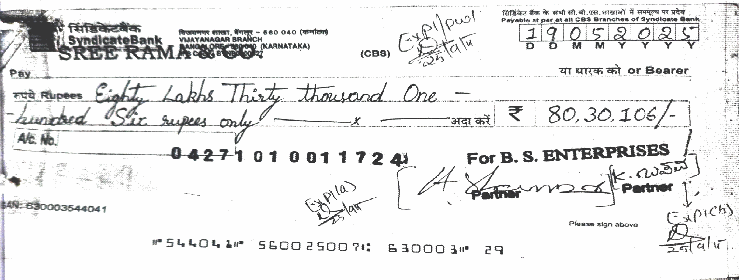
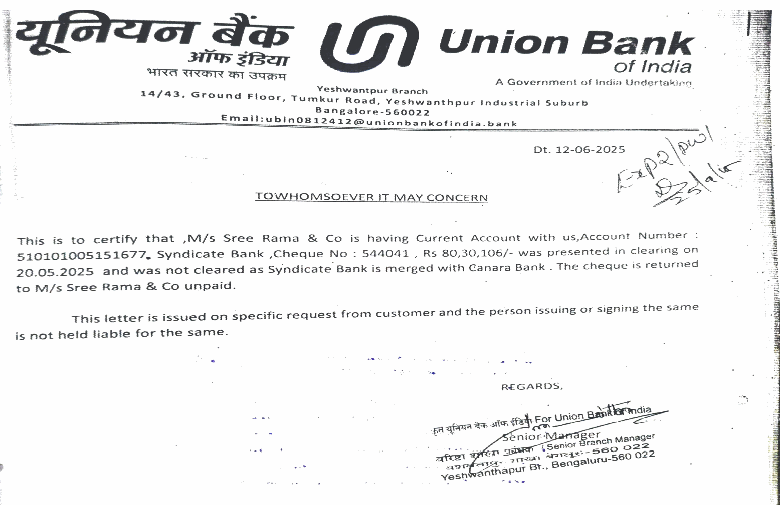
The petitioners are a partnership firm. Petitioner No.1 - accused No.1 is the firm and petitioner Nos.2 and 3 - accused Nos.2 and 3 are its partners. The respondent is the complainant, a proprietorship concern. The two have a transaction. In furtherance of the said transaction, it is the case of the complainant that a cheque is issued by the petitioners amounting to Rs.80,30,106/- and the drawee bank of the cheque being Syndicate Bank. The same when presented gets dishonoured not on account of want of sufficient funds but, on account of merger of the drawee bank – Syndicate Bank with the Canara Bank. It was, therefore, returned unpaid with an endorsement in the form of a letter from Union Bank indicating that 'Syndicate Bank is merged with Canara Bank'. The complainant then initiates proceedings as obtaining in law and finally approaches the concerned Court by filing a private complaint under Section 223 of the BNSS. The concerned Court registers PCR No.13298 of 2025 for offences punishable under Sections 138 and 142 of the Negotiable Instruments Act, 1881 (hereinafter referred to as ‘the Act’ for short). The matter is pending consideration before the concerned Court. The accused have now knocked at the doors of this Court on the score that the cheque so presented before their Bank - Union Bank and now the instrument before the concerned Court is an invalid cheque. Therefore, the petitioners call in question the entire proceedings instituted by the complainant before the concerned Court.
4. The learned counsel appearing for the petitioners submits that there was no transaction between the petitioners and the respondent for the petitioners - accused to hand over a cheque for Rs.80,30,106/- in the year 2025, as the entire amount is for purchase of groceries. The complainant is a distributor in groceries. The learned counsel submits that for transactions the petitioners had given the cheque as security long ago, which is deliberately used now. Even otherwise, the learned counsel submits that legally the said cheque is a valid cheque, which is returned as dishonoured on account of a merger of the banks, will not create a liability under Section 138 of the Act. He would submit that notwithstanding this bar, the concerned Court takes cognizance of the aforesaid offences and issues summons to the petitioners. It is then the subject petition is preferred. He would submit that the petition be allowed and the entire proceedings be held to be a nullity in the light of the instrument itself being a nullity in law.
5. Per contra, the learned counsel appearing for the respondent takes this Court through the statement of objections to contend that whether the Bank has merged with the other Bank and whether the cheque was valid or invalid are all seriously disputed questions of fact. Once signature is admitted, it is for the accused to prove everything before the concerned Court in a full-blown proceeding. The cheque is handed over to the complainant in the month of April, 2025 knowing full well that the Syndicate Bank had been merged with another Bank - Canara Bank. Therefore, it was for the petitioners / accused to hand over a fresh cheque. Even otherwise, all these factors are to be thrashed out before the concerned Court. The learned counsel would seek dismissal of the petition.
6. I have given my anxious consideration to the submissions made by the respective learned counsel a