1. Continuance of Vice-Chancellor challenged via quo warranto — Extension under Section 13(4), VTU Act. (Para 1 , 2 )
 Back
Next 


2026 Supreme(Kar) 565
IN THE HIGH COURT OF KARNATAKA AT BENGALURU
M. NAGAPRASANNA, J.
Dr. Nageswara Rao Tubati, S/o. Late T. Bapaiah - Petitioner
Versus
The State of Karnataka, Rep. by the Principal Secretary, Department of Higher Education - Respondent
Writ Petition No.28442 of 2025 (S - RES)
Decided On : 02-09-2026
Advocates Appeared:
For the Petitioner:Sri M. Narayana Bhat, Advocate a/w Sri A.K. Vasantha.
For the Respondent:Smt. Hemalatha V., AGA, Sri Udaya Holla, Sr. Advocate a/w Sri Santosh S. Nagarale, Sri Aditya Sondhi, Sr. Advocate a/w Sri Abhishek Kumar and Smt. Keerthi K. Reddy, Sri P.S. Rajagopal, Sr. Advocate a/w Sri M.P. Srikanth, Sri Shrikar Jayagovind, Sri Harish Vashisth, Sri Gururaja P.B.
A writ of quo warranto cannot be issued against the extension of a Vice-Chancellor's term if the statute grants such extension to the Chancellor's discretion, as reappointment in immediate continuation does not require repeating the initial selection process (Search Committee) unless specifically mandated by law.
Headnote:(A) Visvesvaraya Technological University Act, 1994 - Sections 13(2), 13(3), 13(4) and 19 - UGC Regulations 2018 - Writ of quo warranto - Challenge to the continuance of a Vice-Chancellor - The jurisdiction of the High Court to issue a writ of quo warranto is limited and can only be exercised when the appointment to a public office is contrary to statutory rules or the holder lacks the prescribed eligibility (Paras 12.5, 12.8).
(B) Appointment vs. Reappointment/Extension - A distinction exists between the initial appointment of a Vice-Chancellor and an extension of tenure in immediate continuation. Where the governing statute permits extension at the discretion of the Chancellor, such a process does not necessarily require the repetition of the procedural rigmarole, such as the constitution of a Search Committee, that was mandatory for the original appointment (Paras 16, 17, 18).
Facts of the case:
A petition was filed seeking a writ of quo warranto to challenge the extension of the term of a Vice-Chancellor of a technological university. The incumbent had been appointed for a three-year term, which was subsequently extended for another three years by the Chancellor under the relevant University Act. The petitioner challenged this continuance on the grounds that the original appointment was void due to the absence of a UGC nominee in the Search Committee and other statutory infractions, despite the initial appointment having been previously upheld by both the High Court and the Supreme Court.
Findings of Court:
The court found that the extension of the term under the statutory provision is an exercise of discretion by the Chancellor and does not demand the resurrection of the entire selection machinery. Since the initial appointment had attained finality through judicial scrutiny, the extension cannot be assailed on grounds relating to the original selection process.
Issues: Whether the extension of the term of a Vice-Chancellor under the statutory provision of the University Act requires following the same procedural requirements, specifically the constitution of a Search Committee, as the initial appointment.
Ratio Decidendi: The court ruled that the statutory provision for extension allows the Chancellor to extend the term at their discretion without summoning a fresh Search Committee or reopening the field for applications. Reappointment in immediate continuation, where the statute does not command a fresh process, does not require the incumbent to pass through the same procedural sieves as the original appointment.
Result: Petition dismissed.
Legal Category Hierarchy
- administrative law
-
constitutional law
- article 14 (Para 1)
- article 226
- education law
- practice and procedure
Table of Contents
2. Petitioner: appointment contrary to UGC Regulations. Respondents: extension a distinct power; initial appointment attained finality. (Para 4 , 6 , 7 , 8 )
3. Reappointment need not follow fresh selection process; prior challenge to initial appointment attained finality. (Para 10 , 12 , 14 , 15 , 16 , 17 , 18 , 19 )
4. Writ of quo warranto requires clear usurpation; extension under statute without fresh process is lawful. (Para 19 , 20 )
5. Petition dismissed; no warrant for quo warranto against continuance of Vice-Chancellor. (Para 20 )
6. What is the scope of the writ of quo warranto?
It lies against a usurper of a public office; requires a clear infringement of law or statutory rules. (Para 12 , 13 )
7. Must a reappointment of a Vice-Chancellor follow the same process as a fresh appointment?
No, if the statute provides for a separate power of extension, a fresh selection process is not required. (Para 16 , 17 , 18 )
8. Can a challenge to a Vice-Chancellor's initial appointment be reopened through a challenge to an extension?
No, grounds relating to the initial appointment, which have attained finality, cannot be re-litigated. (Para 14 , 15 , 16 , 18 , 19 )
ORDER :
The petitioner is before the Court seeking the following prayers: -
(a) "Issue a writ of quo warranto calling upon respondent No.4 to show under what authority he continues to occupy the post of Vice-Chancellor of VTU, Belagavi to meet the ends of justice.
(b) Issue a writ of mandamus or any other appropriate writ, order or direction holding that the appointment of respondent No.4 to the post of Vice-Chancellor of the 5th Respondent as illegal, void ab initio and in violation of the provisions of the UGC Regulations 2018 and Article 14 of the Constitution and other constitutional principles;
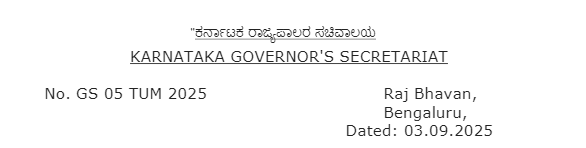
(c) Issue a writ of certiorari or any other appropriate writ, order or direction setting aside the Notification bearing (i) No.GS05 TUM 2025 dated 03-09-2025 marked at Annexure-A and (ii) No.GS 7 TUM 2022 dated 29-09-2022 marked as Annexure-L issued by respondent No.2 as the same are opposed to UGC Regulations 2018 and VTU Act and Article 14 of the Constitution of India to meet the ends of justice;
(d) Issue a writ of mandamus or any other appropriate writ, order or direction directing the respondent No.2 to consider the representation submitted by the petitioner dated 14-08-2025 marked as Annexure-J in accordance with law to meet the ends of justice;
(e) Issue a writ of mandamus or any other appropriate writ, order or Direction Directing the Respondent No.2 to initiate fresh proceedings for appointment of Vice-Chancellor in compliance with UGC Regulations 2018 and VTU Act in exclusion of the candidature of respondent No.4;
(f) Grant such other reliefs as this Hon’ble Court deems just and proper in the interest of justice."
In substance, stripped of its multiplicity of reliefs, the petitioner calls upon this Court to issue the high prerogative writ of quo warranto and, as a necessary sequel, to efface the orders, which sustain the continuance of the 4th respondent in the public office in question.
2. Shorn of the embellishments and the details that do not bear upon the controversy, the facts germane to the lis, in their essential contour, are as follows:
2.1. The petitioner projects himself as a highly decorated academician and as a Professor and Head of the Department of Mechanical Engineering at the Oxford College of Engineering, a position which he claims to have adorned since July, 2010. The petition is replete with averments touching upon the encomiums and academic distinctions said to have come his way.
2.2. The array of parties requires little elaboration: the 1st respondent is the State; the 2nd, the Chancellor of Visvesvaraya Technological University (hereinafter referred to as ‘the University’ sfor short); the 3rd, the Secretary to the Chancellor; the 4th respondent is the incumbent Vice-Chancellor; the University, represented by its Registrar is the 5th respondent; and the University Grants Commission is the 6th respondent.
2.3. The fulcrum of the challenge is, the appointment and, more particularly, the continuance of the 4th respondent as Vice-Chancellor of the University. The 4th respondent had earlier been appointed as the Vice-Chancellor of the Karnataka State Open University on 28-05-2019. That appointment is not the subject of the present lis. Upon completion of his tenure, a Notification dated 10-08-2022 comes to be issued, inviting applications for appointment to the office of the Vice-Chancellor of the University. The 4th respondent emerged from that process and came to be appointed for a term of three years with effect from 29-09-2022. The appointment did not remain unchallenged. One Professor B. Shivaraj invoked the public law remedy of quo warranto in a public interest petition. A Division Bench of this Court, by order dated 07-11-2023, declined the challenge. The matter travelled to the Apex Court, but without success. Thus fell the curtain on the challenge to the initial appointment.
2.4. Section 13 (4) of the Visvesvaraya Technological University Act, 1994 (‘the Act’ for short), however, permits an extension for anot