1. Suit for specific performance of agreement to sell property inherited by a sole heir under Section 14, Hindu Succession Act. (Para 1 , 2 , 3 )
 Back
Next 





2026 Supreme(Kar) 679
IN THE HIGH COURT OF KARNATAKA AT BENGALURU
V SRISHANANDA, J.
Smt. Kempamma W/o Late Boregowda - Appellant
Vs.
Thammanne Gowda S/o Late Singrigowda - Respondent
Regular Second Appeal No. 981 Of 2026 (SP)
Decided On : 09-07-2026
Important Points
Property inherited by a Hindu woman is her absolute property under Section 14 of the Hindu Succession Act, and children have no birthright in it. Revenue records (khatha) do not establish title and cannot be used to avoid specific performance of a registered sale agreement.
Subject
Civil Law - Property Law
Act Referred
Headnote
(A) Hindu Succession Act, 1956 - Sections 14 and 15 - Specific Relief Act, 1963 - Section 10 - Property inherited by a Hindu woman - Absolute ownership - Children's birthright - When a Hindu woman inherits property from her parents, it becomes her absolute property by virtue of Section 14 of the Hindu Succession Act; she has full authority to sell, gift, or mortgage it. Children do not acquire a right by birth in property inherited by their mother from her maternal or paternal side; a child's right to such property only arises after the mother's death if she dies intestate. (Paras 7, 14)
(B) Specific Relief Act, 1963 - Section 10 - Specific performance of contract - Revenue records (Khatha) - Mutation and khatha are revenue records for tax purposes and not documents of title. A seller cannot use their own delay in updating administrative records as a shield to escape a contract where they have already received part payment. If a person contracts to sell property with an imperfect title, the purchaser has the right to compel the seller to make good the contract once they acquire the interest. (Para 7)
(C) Code of Civil Procedure, 1908 - Section 100 - Scope of second appeal - Appeal is not to be admitted for further consideration unless substantial questions of law are established. (Para 13)
Facts of the case:
A suit for specific performance was filed based on a registered agreement to sell executed by a woman and some of her children regarding property she had inherited from her mother. The defendants challenged the decree, contending that the agreement was incapable of performance because all the children and the children of a deceased son were not impleaded as parties. They further argued that because the revenue records (khatha) were still in the name of the deceased grandmother and had not been updated, the defendants lacked the title to execute the agreement.
Findings of Court:
The court found that the property inherited by the woman from her mother became her absolute property under Section 14 of the Hindu Succession Act, making her the sole authority to alienate it. Consequently, her children were not necessary parties to the suit. The court further held that khatha is not a document of title and ownership passes by operation of law at the moment of death, regardless of whether revenue records are officially updated. The registered agreement was held to be valid, and the defendants' plea that the agreement was actually for a loan purpose was rejected for lack of evidence.
Issues: Whether the suit for specific performance was maintainable without impleading all children and grandchildren of the owner, and whether the failure to update revenue records (khatha) rendered the registered sale agreement unenforceable.
Ratio Decidendi: Property inherited by a Hindu woman is her absolute property under Section 14 of the Hindu Succession Act, and children do not possess a birthright in such property. Revenue records serve administrative purposes and do not determine ownership. A registered sale agreement is binding and cannot be contradicted by mere pleadings of a different nature (e.g., a loan agreement) without corroborative evidence.
Result: Admission declined. Appeal dismissed.
Legal Category Hierarchy
-
civil law
- contract law
-
property law
-
inheritance
- hindu succession act
-
title and records
- khatha - revenue record (Para 7)
-
inheritance
- practice and procedure
Advocates:
Advocate Appeared:
For the Appellant :Sri. Raghu K S., Advocate And Sri. Shashank K.C., Advocate
For the Respondent:Sri. Anandarama K., Advocate
Table of Contents
2. Plaintiff argued agreement valid; defendants argued non-joinder of necessary parties and imperfect title rendered performance impossible. (Para 4 , 10 , 11 )
3. Property inherited by woman becomes her absolute property; children acquire no right by birth; khatha is not title. (Para 7 , 14 , 17 )
4. A Hindu woman's inherited property is her absolute property under Section 14; children acquire no right by birth. (Para 7 , 14 )
5. Admission declined; appeal dismissed as no substantial question of law arose. (Para 18 , 19 )
6. Does property inherited by a Hindu woman become her absolute property under Section 14 of the Hindu Succession Act?
Yes. When a Hindu woman inherits property from her parents, it becomes her absolute property with full rights of alienation. (Para 7 , 14 )
7. Do children acquire a right by birth in property inherited by their mother from her maternal side?
No. Children do not acquire a right by birth in such property; their right arises only after the mother's intestate death. (Para 7 , 14 )
8. Is a sale agreement executed by a legal heir with imperfect title enforceable?
Yes. The purchaser can compel the seller to make good the contract once the seller acquires interest; the court can order mutation first. (Para 7 )
9. Is khatha (revenue record) a document of title for property ownership?
No. Khatha is a revenue record for tax purposes and is not a document of title. (Para 7 )
10. Can a suit for specific performance be denied solely because of non-joinder of other children of the female owner?
No. Non-joinder of children is not fatal as they have no right by birth; a separate suit by them does not bar enforcement. (Para 15 , 16 , 17 )
JUDGMENT :
V SRISHANANDA, J.
Heard Sri K.S.Raghu for the appellant and Sri Anandarama K., for the respondent.
2. Defendants in O.S.No.47/2014 are the appellants, challenging the decree of the Trial Court, directing the appellants to execute the sale deed pursuant to the agreement of sale entered into by them with the plaintiff.
3. The facts of the case are as under:
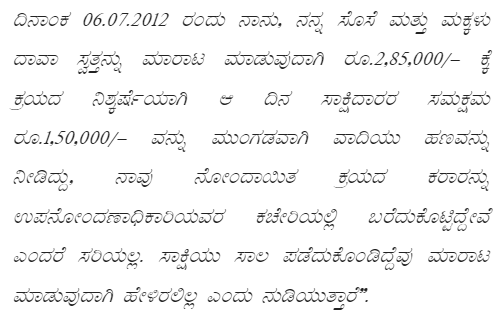
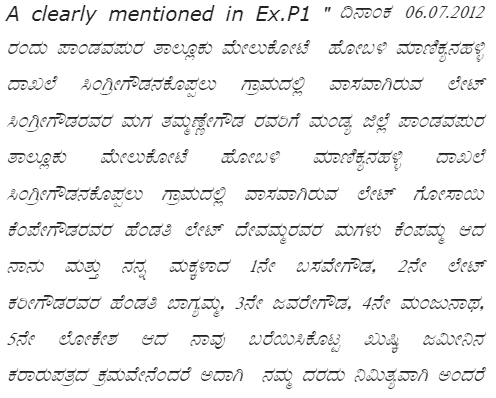
3.1. A suit for specific enforcement of agreement to sell executed by Kempamma and her children (few of them), on 06.07.2012.
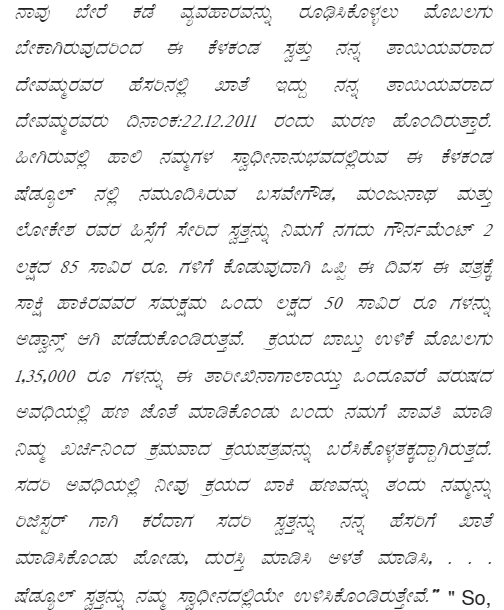
3.2. In the plaint, it is contended that Smt.Devamma, W/o. Gosai Ugregowda @ Gosai Kempegowda, died leaving behind Kempamma as her only heir and she inherited the suit property. Defendant Nos. 2 and 4 to 6 are the sons of defendant No. 1 and defendant No. 3 is none other than the daughter-in-law of the first defendant. According to the plaintiff, all these people constituted undivided joint family and furthermore the first defendant being the only heir of her mother, she had inherited the suit properties after her death on 22.12.2011, but, revenue records still continued in the name of Devamma.
3.3. Further, it is contended that the defendants, being the joint family members, for their legal necessity, agreed to sell the suit property for a valuable consideration of Rs. 2,85,000/- and thus a registered agreement to sell came into existence on 06.07.2012. At the time of the agreement, a sum of Rs.1,50,000/- was paid as the advance sale consideration and it was agreed that the balance amount of Rs.1,35,000/- would be paid at the time of registration of the sale deed. Since there was no compliance on the side of the defendants, plaintiff was constrained to file a suit for specific enforcement of the contract.
4. In the written statement, it is contented that the agreement is incapable of performance as all the children of Kempamma are not made as parties to the suit. So also, the children of one of the sons, namely Karigowda, has not been made as a party though his wife is made as a party - defendant No.2 and thus sought for dismissal of the suit.
5. Learned trial judge, after raising necessary issues recorded the evidence of the parties and on consideration of the material evidence on record, decreed the suit of the plaintiff. Operative portion of the Trial Court order reads as under:
“The suit of the plaintiff for the relief of specific performance of contract is hereby decreed.
The defendants are hereby directed to execute sale deed in pursuance of agreement of sale dated 06.07.2012 in favour of the plaintiff on receipt of balance sale consideration of Rs.1,35,000/- within three months. In the event of failure on the part of defendants, the plaintiff at liberty to get the property registered through the process of law.
Draw decree accordingly”.
6. Being aggrieved by the same, defendants filed an appeal before the I Appellate Court in R.A.No.48/2025.
7. Learned judge in the I Appellate Court, after securing the records, heard the arguments of the parties in detail and on re-appreciation of the material evidence on record, dismissed the appeal of the defendants, inter alia, holding in para Nos. 26 and 27 as under:
- 26. Further it indicates from trial court record that, defendant No.1 has been examined as DW1, she reiterated the content of Written Statement in her chief examination. Ex.D1 to Ex.D3 marked through her on behalf of all the defendants. On perusal of Ex.D1 it indicates that, it is a computerized RTC for the year 2024-25 of bearing Sy.No. 242/2 of Manikyanahalli village, Melukote Hobli, Pandavapura Taluk On perusal of column No.3 and 9 of RTC it indicates that, 1 acre 26 guntas stood in the name of Devamma W/o Gosai Kempegowda. In column No.10, it is specifically mentioned that, MR 35/1995-96 division. Further it indicates from Ex.D2 that, it is a computerized mutation extract MR T99/2017-18. On perusal of its contents it reveals that, one Devamma W/o Gosai Kempegowda had landed property of 1 acre 26 guntas in Sy.No.242/*/2 and one Thammannegowda