
 Back
Back





IN THE HIGH COURT OF CHHATTISGARH, BILASPUR
RAVINDRA KUMAR AGRAWAL, J.
Vijay Kumar Agrawal S/o Late Shankar Lal Agrawal - Appellant
Versus
Parmanand Mishra S/o Raghunandan Mishra – Respondents
ACQA No. 375 of 2019
Decided on : 27-06-2024
Acquittal Appeal - Negotiable Instruments Act - Section 138 - 138 of NI Act, 1881 - Summary of Acts and Sections: The court discussed the provisions of Section 138 of the Negotiable Instruments Act, 1881, and its interpretation in light of the evidence presented. The court also referred to key legal principles established in previous judgments, such as the presumption under Section 139 of the Act and the requirement of a legally recoverable debt for the offence to be made out.
Fact of the Case:
The case involved a dispute over two cheques given by the accused to the complainant, which were subsequently dishonored. The complainant filed a complaint under Section 138 of the Negotiable Instruments Act, leading to the acquittal of the accused by the trial court. The appeal challenged this acquittal.
Finding of the Court:
The court found that the evidence presented by the complainant established that the accused had given the cheques to the complainant, and the accused's defense of the cheques being given as security was not substantiated. The court also noted discrepancies in the complaint but held that they did not affect the merits of the case. As a result, the court set aside the acquittal and convicted the accused under Section 138 of the NI Act.
Issues: The key issues revolved around the nature of the transaction, the validity of the cheques, and the sufficiency of the evidence to establish the offence under Section 138 of the NI Act.
Ratio Decidendi: The court relied on the principles established in previous judgments, emphasizing the requirement of a legally recoverable debt for the offence under Section 138 of the NI Act. The court also considered the presumption under Section 139 of the Act and the significance of the evidence presented in rebutting this presumption.
Final Decision: The acquittal appeal was allowed, and the accused was convicted under Section 138 of the NI Act. The accused was sentenced to pay a fine of Rs.1,00,000, with a provision for simple imprisonment in default of payment.
ORDER :
1. Challenge in this appeal is the judgment of acquittal dated 24.01.2014, passed by learned Judicial Magistrate First Class, Raigarh, in Criminal Case No. 61 of 2012, whereby the Respondent No.1 has been acquitted from the offence under Section 138 of the Negotiable Instruments Act, 1881 (in short “NI Act”).
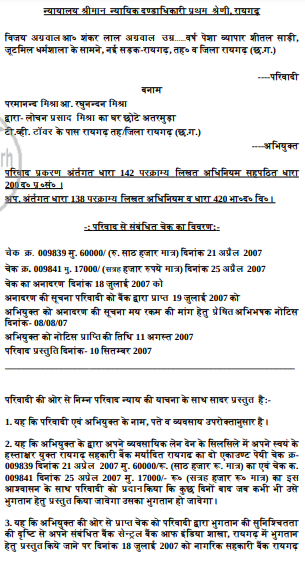
2. The brief facts of the case are that the Appellant/complainant and Respondent No.1/accused are well acquainted and they are having business transactions with each other. On account of necessity of fund for the business transaction, Respondent No.1/accused has borrowed Rs.77,000/- from the Appellant with the assurance to refund it in near future. When the amount was not repaid, on the demand of Appellant/complainant, Respondent No.1/accused had given him two cheques, bearing Cheque No. 009839 dated 21.04.2007, amounting to Rs.60,000/- and Cheque No. 009841 dated 25.04.2007, amounting to Rs. 17,000/-, which was of the account of Respondent No.1 running at Raigarh Nagrik Sahkari Bank Maryadit, Raigarh. When the said cheques were deposited in the account of Appellant/complainant, the same was dishonored by the Payee Bank on 18.07.2007 for want of sufficient balance in the account of Respondent No.1/accused.
3. On 08.08.2007, a demand notice was issued to the Respondent No.1/accused by the Appellant through his counsel. On 11.08.2007, the demand notice has been served upon the Respondent No.1/accused, despite that he has not paid the amount of the above two cheques and ultimately a complaint case under Section 142 of NI Act read with Section 200 of CrPC for the offence under Section 138 of NI Act and Section 420 of IPC has been filed. The complaint case has been filed on 10.09.2007, which has been registered on 27.10.2007, and summons was issued to Respondent No.1/accused.
4. On 21.10.2008, Respondent No.1/accused made his appearance and he has been released on bail. On 15.07.2009, the details of offence have been explained and thereafter, the evidence of the Appellant/complainant has been recorded. After recording of the Appellant's evidence, the statement under Section 313 of CrPC of Respondent No.1/accused has also been recorded, in which he denied the offence and submitted that he is innocent.
5. After conclusion of the trial and appreciation of oral and documentary evidence led by the parties, the learned Trial Court has acquitted Respondent No.1/accused from the alleged offence, hence this acquittal appeal.
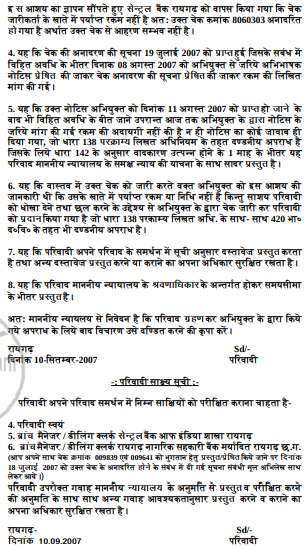
6. Learned counsel for the Appellant/complainant would submit that learned Trial Court has erred in acquitting Respondent No.1/accused. The evidence available on record has not been considered in its proper perspective. The statutory presumptions available in the case has not been considered by the learned Trial Court. He would further submit that learned Trial Court has considered para 3 of the complaint, in which the number of the cheque is mentioned as 8060303 in place of 009839 and 009841, whereas the same is only a typographical mistake, which has never been challenged by Respondent No.1. Except in para 3 of the complaint, the number of two cheques have been correctly mentioned in para 2 of his complaint as well as in his affidavit, filed under Section 145 of NI Act. Even the Appellant/complainant relied upon the documents i.e. the two cheques (exhibit P/1 and P/2), the cheque deposition slips (exhibit P/3 and P/4), and also the cheque return memo issued by the Bank and the legal demand notice issued to Respondent No.1/accused on 08.08.2007, and in all these documents, the number of both the cheques have been correctly mentioned. Therefore, the judgment passed by learned Trial Court is erroneous. He would further submit that the learned trial Court should have consider that merely wrong mentioning of cheque number in one place of the complaint does not affect the genuineness of the complaint, particularly in view of the fact that in all other places the number of cheques have been correctly mentioned. He wou
AI
The central legal point established in the judgment is the requirement of a legally recoverable debt for the offence under Section 138 of the Negotiable Instruments Act, along with the significance o....


Presumption under Section 139 of the Negotiable Instruments Act requires the accused to present credible evidence to rebut the holder's claim of legal liability regarding the cheque issued.

Dishonor of cheque - Once the execution of cheque is admitted Section 139 of the Act mandates a presumption that the cheque was for the discharge of any debt or other liability

The presumption under Section 139 of the NI Act mandates that a cheque is presumed to be issued for discharge of a debt unless the accused proves otherwise.
The issuance of a cheque signifies a legally enforceable debt under Section 138 of the N.I. Act, and the burden to prove otherwise lies with the accused, not the complainant.


Once there is no denial of issuance of cheque and signatures thereupon, presumption as available under Ss.118 and 139 comes into play.
The presumption of issuance under Section 139 of the Negotiable Instruments Act requires the accused to prove the contrary if the cheque's signature is admitted, which was not done in this case.



An indispensable Tool for Legal Professionals, Endorsed by Various High Court and Judicial Officers
Please visit our Training & Support
Center or Contact Us for assistance

Scan Me!
India’s Legal research and Law Firm App, Download now!


For Daily Legal Updates, Join us on :



 Back to top


