Back





2026 Supreme(Guj) 1269
IN THE HIGH COURT OF GUJARAT AT AHMEDABAD
M.K. THAKKER, J.
Ghanshyambhai Ratibhai Barvaliya - Appellant
Versus
Khimajibhai Damjibhai Navadiya - Defendant
R/First Appeal No. 4419 of 2025 With Civil Application (For Interim Relief) No. 1 of 2025 With Civil Application (For Direction) No. 2 of 2025
Decided On : 01-04-2026
Important Points
Subject
Civil Law - Property and Contract Law
Act Referred
Headnote
(B) Appeals - Scope of review - Finality of prior judgment - A party cannot escape the consequences of a prior judicial decision that has attained finality and remained unchallenged, particularly where the issue of receipt of payment was settled against them. (Paras 6, 7)
Facts of the case:
A suit was initiated for the specific performance of an agreement to sale or, alternatively, for the recovery of a significant sum paid by the purchaser. The seller defended the claim by alleging that the document was forged and that their signature on specific pages was obtained under the guise of an entirely different financial transaction. The trial court rejected these contentions, holding that the consideration had indeed been received, and ordered a refund. The seller appealed this decision.
Findings of Court:
The court observed that the claimant was in possession of the original title documents, which negated the seller's claim regarding their loss. Noting the seller's admission of signing the last page of the agreement and the failure of the seller to appeal against a previous judgment that had definitively established the receipt of funds, the court concluded that the refund order was justified.
Issues: Whether an unregistered agreement is admissible for collateral purposes to establish the transfer of consideration and whether the trial court correctly ordered a refund in view of the appellant's failure to contest prior judicial findings.
Ratio Decidendi: The court affirmed that while an unregistered agreement cannot sustain a claim for specific performance, it is a valid piece of evidence for collateral purposes to prove the exchange of monetary consideration. The appellant’s failure to challenge a prior court ruling regarding the payment, along with the claimant's established possession of original title deeds, rendered the refund order legally sound.
Result: Appeal dismissed.
For the Appellant : Mr. Parth B. Thummar.
For the Defendant : Mr. Manan A. Shah.
JUDGMENT :
1. The present appeal is filed under Section 96 of the Code of Civil Procedure, challenging the judgment and order dated 31.12.2022 and the decree dated 03.01.2023 passed by the learned 10th Additional Senior Civil Judge in Special Civil Suit No. 323 of 2016, whereby the suit filed by the present respondent–original plaintiff came to be partly decreed, directing the present appellant to pay an amount of Rs. 40,00,000/-, which had been paid towards the sale consideration under the agreement to sale.
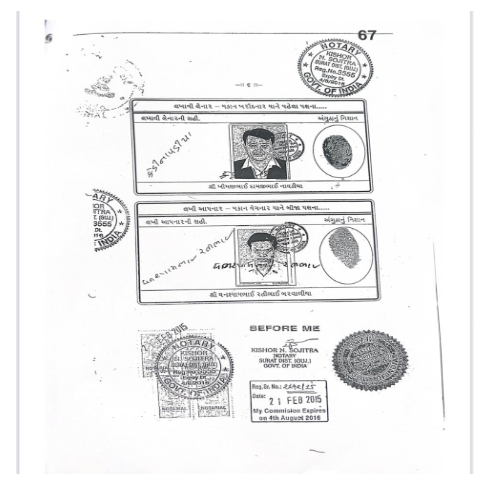
1.1. At the outset, for the sake of convenience, the parties shall be referred to as per their original status, i.e., the present appellant as the original defendant and the respondent as the original plaintiff. According to the case of the plaintiff as set out in the plaint, on 23.06.2005, the defendant purchased an open plot vide registered Sale Deed No. 1901. Thereafter, the defendant constructed a house on the said plot and has been residing therein since then. In the year 2015, the defendant decided to sell the said property and came into contact with the plaintiff on 10.02.2015. On that day, the plaintiff claims to have paid an amount of Rs. 10,00,000/- to the defendant towards part sale consideration, the total agreed sale consideration being Rs. 40,00,000/-. It is further the case of the plaintiff that on 15.02.2015, 19.02.2015 and 21.02.2015, he paid an additional sum of Rs. 10,00,000/- each to the defendant. On 21.02.2015, a sale agreement-cum-possession receipt is stated to have been executed between the parties before Notary Mr. Kishorbhai Nathabhai Sojitra. As per the said agreement, possession of the property was handed over to the plaintiff, however, since the defendant was in search of an alternative residence, he continued to retain actual possession temporarily. It is further stated that the original title documents of the property were handed over to the plaintiff, who thereafter got his name entered in the records of the Surat Municipal Corporation.
1.2. The plaintiff further asserts that between June 2015 and December 2015, he repeatedly requested the defendant to execute the sale deed. However, on 21.01.2016, the defendant issued a public notice in a newspaper declaring the loss of the original sale deed of the property and further stating that the agreement to sale executed between the parties was illegal. In the aforesaid background, the plaintiff instituted Special Civil Suit No. 323 of 2015, seeking specific performance of the agreement to sale dated 21.02.2015, and in the alternative, refund of Rs. 40,00,000/- with interest, along with loss on interest and profit and loss, aggregating to Rs. 90,00,000/- with interest at the rate of 18% per annum from the date of filing of the suit till realization.
1.3. Upon issuance of summons, the defendant appeared before the learned trial Court and filed a written statement below Exh. 12, contending inter alia that his brother-in-law, namely Mr. Sureshbhai Ravjibhai Dobariya, who was facing financial difficulties, had requested him to act as a witness to a mortgage deed. For that purpose, the defendant accompanied him before a Notary Public. It is alleged that the defendant signed only two pages bearing his photograph and did not sign the remaining pages. It is further contended that after the death of the said Mr. Sureshbhai Ravjibhai Dobariya by suicide, a false and fabricated agreement to sale came to be created in order to recover the alleged amount advanced to him, by projecting as if the plaintiff had entered into an agreement to purchase the property. Upon completion of pleadings, the learned trial Court framed the following issues and answered the same accordingly:-
(1) Whether the Plaintiff proves that the Defendant in this case, having contacted the Plaintiff on 10/02/2015 and after deciding to sell the suit property had accepted Rupees Ten Lakh from the Plaintiff as earnest money and fixed the value of the suit property at Rs. 40 Lakhs?
In Affirmative
(2