1. Claimants sought enhancement of motor accident compensation, alleging that the Tribunal incorrectly ignored income tax returns while calculating the deceased's monthly income under the Motor Vehicles Act. (Para 1 , 2 )
 Back
Next 





2026 Supreme(Guj) 1814
IN THE HIGH COURT OF GUJARAT AT AHMEDABAD
J. C. DOSHI, J.
Heenaben, Wd/o Rajubhai Vadilal Shah And Ors. – Appellants
Versus
Sarosh Jahangirji Dumasiya And Anr. – Respondents
R/First Appeal No. 537 Of 2016
Decided On : 18-09-2026
Important Points
Posthumously filed Income Tax Returns can be considered to determine the income of the deceased for compensation under the Motor Vehicles Act, provided they are consistent with prior returns and not manufactured to inflate the claim.
Subject
Motor Accident Claims - Quantum of Compensation
Act Referred
Headnote
(A) Motor Vehicles Act, 1988 - Sections 166, 168 and 173 - Quantum of compensation - Determination of income - Income Tax Returns (ITRs) as statutory documents - For self-employed individuals, the average income specified in the ITRs of up to the previous three years should be taken as a reference point for assessing annual income - Posthumously filed ITRs can be taken into consideration for calculating income if they do not show a substantial hike and are consistent with previous income, indicating they were not manufactured for the oblique purpose of establishing inflated income (Paras 8, 10 and 12).
(B) Just and Fair Compensation - MV Act is a beneficial piece of legislation - Compensation should be based on principles of fairness, reasonableness, and equability - Tribunals must avoid undue parsimony or niggardliness in awarding compensation to ensure that innocent victims do not suffer (Paras 5, 6 and 7).
Facts of the case:
Claimants filed a petition for compensation following a fatal accident where a transport bus collided with a scooter, resulting in the death of the rider. The Tribunal awarded compensation by assessing the monthly income of the deceased at Rs. 3,000, ignoring the income tax returns submitted by the claimants. The claimants appealed for enhancement of the compensation on the grounds that the actual income was significantly higher as per the statutory returns.
Findings of Court:
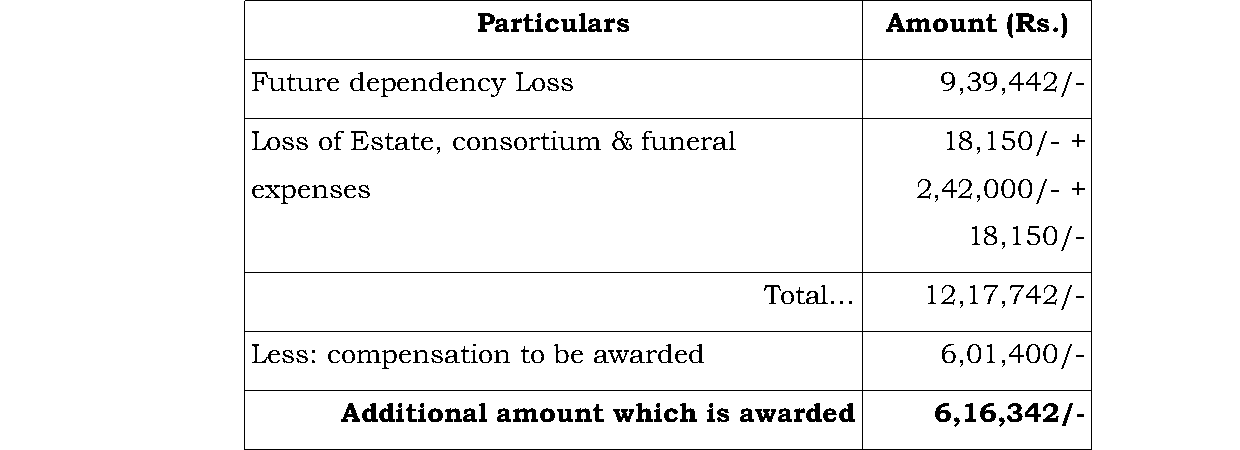
The court found that the income tax returns for the three preceding years provided a consistent and reliable benchmark for the deceased's income. The average net income from these returns was adopted. The court further applied a 25% increase for future prospects (given the age of 45), a deduction of 1/4th for the five dependents, and a multiplier of 14. Additional compensation was awarded for loss of estate, funeral expenses, and consortium for each dependent.
Issues: Whether the compensation awarded by the Tribunal was just and reasonable and whether posthumously filed income tax returns could be legally relied upon to determine the annual income of the deceased.
Ratio Decidendi: Statutory documents like ITRs are critical reference points for calculating just compensation. Posthumous filing of returns does not automatically disqualify them from evidence; if the returns are consistent with previous financial patterns and not superficially inflated, they should be used to ensure the dependents are restored to a financial position similar to what they would have been had the accident not occurred.
Result: Appeal allowed. Compensation enhanced to Rs. 6,16,342/- with 9% p.a. interest.
Legal Category Hierarchy
Advocates Appeared:
For the Appellant : Mr.Hiren M Modi
For the Respondent: Mr Matafer R Pande, Ms Hina Desai, Riddhish V Modi
Table of Contents
2. Claimants argued that the Tribunal erroneously fixed lower income by omitting income tax returns, while opposing counsel could not provide a substantive justification for denying compensation enhancement. (Para 3 , 4 )
3. The Tribunal is mandated to award just, fair, and equitable compensation based on a pragmatic view, avoiding niggardliness and ensuring victims are adequately restored to their pre-accident financial position. (Para 5 , 6 , 7 )
4. Statutory income tax returns serve as an essential reference point for calculating annual income, with business income requiring an average of the preceding three years. (Para 8 , 10 , 11 )
5. The appeal is allowed, and the insurer is directed to pay enhanced compensation calculated based on an averaged annual income with interest, as per established legal principles. (Para 13 , 14 , 15 )
6. Can income tax returns filed posthumously be considered for calculating compensation in motor accident claims?
Yes, posthumously filed income tax returns can be considered, provided they are consistent with previous income and are not manufactured solely to establish an inflated income, as the Act is beneficial legislation aimed at providing stability. (Para 10 , 11 , 12 )
7. How should the annual income of self-employed individuals be assessed under the Motor Vehicles Act?
For self-employed individuals, the average of the income specified in income tax returns of up to the previous three years is to be taken as the reference point, considering business fluctuations and potential growth patterns. (Para 8 , 12 )
8. What is the standard for determining just and fair compensation in fatal motor accident cases?
Compensation must be a fair and reasonable estimate to ease the dependents' financial burden, aiming to place them in a position financially similar to what it would have been had the accident not occurred, without being either arbitrary or niggardly. (Para 5 , 8 )
JUDGMENT :
J. C. DOSHI, J.
1. The present First Appeal, under Section 173 of Motor Vehicles Act, 1988 (hereinafter referred to as the ‘MV Act’), is preferred by the appellants – original claimants being aggrieved and dissatisfied with the judgment and award dated 17.12.2015 passed by the Motor Accident Claims Tribunal (Aux.), Surat in Motor Accident Claim Petition No.217 of 2002, by which the learned Tribunal has granted the compensation of Rs.6,01,400/- with interest at the rate of 9% per annum from the date of the petitioner till realization. The claimants being aggrieved have preferred this appeal for enhancement of the compensation.
2. Brief facts of the case are as under:
2.1 The accident occurred on 17.11.2001 at about 3:45 pm, deceased Rajubhai Vadilal Shah was approaching from Nansura Pipleshwar Mahadev Temple to Timaliyawad by driving his scooter and by following rules of traffic. When he reached near the place of accident, one ST bus bearing registration No. GJ-18-V-3683 driven by opponent No.1, owned and managed by the opponent No.2 came from the back side in a rash and negligent manner and dashed the scooter, and as a result, the scooter of the deceased fell down and received severe head injuries and succumbed to the injuries on the spot.
2.2 The FIR of the incident was registered at Athwalines Police Station vide CR No. I-230 of 2001 against the ST driver.
2.3 Claimant being widow, children and mother, who were dependent on the deceased, filed the claim petition under Section 166 of the ‘MV Act’ claiming the total compensation of Rs.20,00,000/- along with interest at the rate of 12% per annum.
2.4 The opponents, upon issuance of notice, appeared before the Tribunal and contested the claim petition by filing written statement.
2.5 During this factual aspect of the proceedings before the learned Tribunal, to assess the compensation, the claimant has produced the income tax returns for the year from 1992 to 2002 to establish the income of the deceased. The learned Tribunal has omitted to take the income tax returns of the deceased to calculate the income of the deceased and it took up Rs.3,000/- as the monthly income and assessed the compensation of Rs.6,01,400/- and granted the same along with 9% interest from the date of the petition till realization.
2.6 Being aggrieved, the claimants have preferred this appeal.
3. Learned advocate Mr. Hiren Modi for the appellants - claimants has submitted that the Tribunal has committed an error in not properly calculating the amount of compensation, more particularly in taking up Rs.3,000/- as the monthly income of the deceased and omitting to take into consideration the income tax returns of the deceased produced by the claimants. He has submitted that amount of award is on lower side as the Tribunal has not properly considered the various aspects; like prospective income of the deceased, negligence, liability and family circumstances, etc.
3.1 Learned advocate for the appellants relied upon the judgment of the Supreme Court in the case of Sayar & Ors. v. Ramkaran & Ors., rendered in SLP (C) No.24501 of 2025 to submit that out of the three last income tax returns placed on record, two were filed posthumously by looking to the net income of the deceased remained consistent in pre or post death, has taken the income tax returns to assess the income of the deceased.
3.2 Mainly upon above submission, he has submitted that the compensation is required to be enhanced by modifying the award impugned accordingly, and this appeal may be allowed.
4. Per contra, learned advocate Ms Hina Desai for respondent – Insurance Company could not point out the case for denying the enhancement of the compensation granted by the learned Tribunal. More particularly, when the GSRTC has not contested the claim petition by filing the written statement.
5. Apt to note that the Motor Vehicle Act, 1988 is a beneficial piece of Legislation. The concept of just and fair compensation is integral and seminal to the ‘MV Act’