1. Challenge to ex parte and subsequent opinions of Foreigners Tribunals declaring the petitioner a foreigner — dispute over service of notice and applicability of res judicata. (Para 3 , 18 )
 Back
Next 





2026 Supreme(Gau) 2207
IN THE GAUHATI HIGH COURT (HIGH COURT OF ASSAM, NAGALAND, MIZORAM AND ARUNACHAL PRADESH)
KALYAN RAI SURANA, SUSMITA PHUKAN KHAUND, JJ.
Begum Alias Begum Nessa, W/o. Jomer Ali, D/o. Fotik Mollah - Petitioner
Versus
The Union of India, Represented by the Secretary to the Govt. of India, Ministry of Home Affairs & Ors. - Respondents
WP(C) No. 850 of 2026, WP(C) No. 2125 of 2026
Decided On : 05-11-2026
Important Points
Ex parte opinions by Foreigners Tribunals are unsustainable if notice is not served at the last residence per the 1964 Order. Additionally, as these opinions are quasi-judicial, the principle of res judicata applies to subsequent proceedings involving the same person.
Subject
Constitutional Law - Citizenship and Foreigners Act
Act Referred
CONSTITUTION OF INDIA : Art.226
PASSPORT ACT : S.3
FOREIGNERS ACT : S.14(a)(b)
Headnote
(A) Foreigners (Tribunals) Order, 1964 - Paragraph 3(5)(f) - Service of notice - Ex parte opinion passed by Tribunal - Notice served by hanging it on the wall of a school - Such service is not in accordance with the Order which requires notice to be served at the place of last residence of the proceedee - If notice is not duly served in accordance with law, the ex parte opinion is not sustainable and is liable to be set aside. (Para 11)
(B) Foreigners Tribunal - Principles of res judicata - Opinion passed by the Foreigners Tribunal is a quasi-judicial order and the principles of res judicata apply - If the proceedee in two different proceedings is the same person, subsequent proceedings are hit by res judicata to avoid conflicting orders. (Paras 25, 26, 31)
Facts of the case:
The petitioner challenged two separate opinions from two different Foreigners Tribunals declaring her a foreigner. In the first case, an ex parte opinion was passed. The petitioner claimed she was never served with notice. In the second case, the petitioner contested the proceeding and was again declared a foreigner. The petitioner argued that the second proceeding was hit by res judicata due to the first proceeding.
Findings of Court:
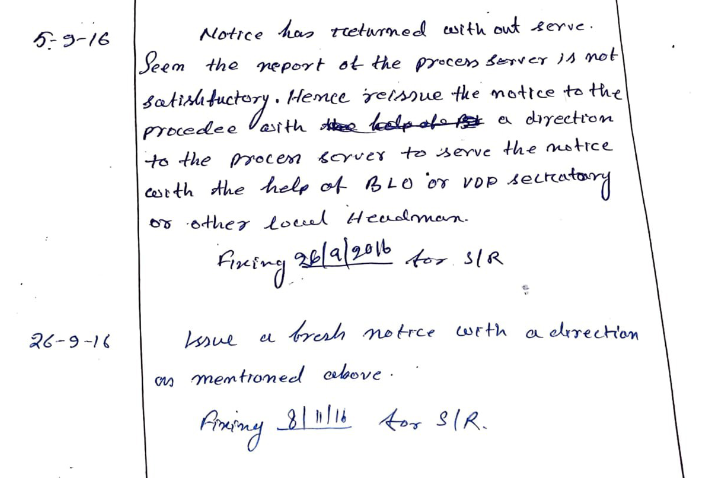
In the first proceeding, the court found that the service of notice was flawed as the return of notice was recorded on a date prior to its actual return, and the subsequent service by hanging the notice on a school wall did not comply with the requirement to serve it at the last residence. In the second proceeding, the court found that since the first proceeding was prior in time, the principle of res judicata would apply if the proceedee is the same person.
Issues: Whether the ex parte opinion in the first proceeding was passed after due service of notice and whether the second proceeding is hit by the principle of res judicata.
Ratio Decidendi: Service of notice must strictly adhere to the Foreigners (Tribunals) Order, 1964; failure to serve notice at the last residence renders an ex parte opinion unsustainable. Furthermore, as Foreigners Tribunal opinions are quasi-judicial, res judicata applies to prevent multiple proceedings against the same person and to avoid conflicting decisions.
Result: Ex parte opinion set aside and quashed; matter remanded to the Tribunal; second proceeding transferred to the first Tribunal to determine identity and apply res judicata.
Legal Category Hierarchy
- constitutional law
- administrative law
- practice and procedure
- crime and sentencing
Advocates Appeared:
For the Petitioner: Mr. J. Ahmed, Ms. M. Das, Mr. S. Mollah.
For the Respondents: Dy.S.G.I., SC, ECI, SC, NRC, GA, Assam, SC, F.T., Mr. N. Upadhay, CGC, Ms. S. Katakey, SC, ECI, Ms. A. Verma, SC, FT, Border matters and NRC., Mr. P. Sarmah, Addl. Sr. G.A.
Table of Contents
2. Petitioner claims lack of proper notice in first proceeding and res judicata in second; State contends notice was served and second opinion is valid on merits. (Para 5 , 6 , 7 , 22 , 23 )
3. Notice service failed to comply with the Foreigners (Tribunals) Order, 1964; Foreigners Tribunal opinions are quasi-judicial, making them subject to the principle of res judicata. (Para 8 , 10 , 11 , 24 , 25 )
4. Notice must be served at the last residence per the Foreigners (Tribunals) Order, 1964; quasi-judicial orders of Foreigners Tribunals are hit by res judicata. (Para 11 , 25 )
5. First ex parte opinion quashed and remanded; second proceeding transferred to the first Tribunal to determine identity and apply res judicata. (Para 12 , 15 , 27 , 31 , 34 )
6. What is the legal requirement for serving notice in Foreigners Tribunal proceedings?
Notice must be served in accordance with paragraph 3(5)(f) of the Foreigners (Tribunals) Order, 1964, which requires the notice to be served at the last residence of the petitioner. Service by hanging a notice on a school wall is not sustainable. (Para 11 )
7. Does the principle of res judicata apply to opinions passed by Foreigners Tribunals?
Yes, opinions passed by Foreigners Tribunals are quasi-judicial orders, and therefore the principles of res judicata apply to prevent conflicting orders and multiple proceedings against the same person. (Para 25 , 26 , 31 )
8. What is the legal status of a person whose ex parte foreigner opinion is set aside?
Once an ex parte opinion declaring a person a foreigner is set aside, the person cannot be termed an illegal foreigner until a fresh opinion is passed by the learned Tribunal. (Para 14 )
JUDGMENT :
K.R. Surana, J.
Heard Mr. J. Ahmed, learned counsel for the petitioner. Also heard Mr. N. Upadhay, learned CGC; Ms. S. Katakey, learned standing counsel for the ECI; Ms. A. Verma, learned standing counsel for the Border and FT matters; and Mr. P. Sarmah, learned Additional Sr. Govt. Advocate.
2. As the learned counsel for the petitioner has submitted that the petitioner has suffered 2 (two) opinions, i.e. ex parte opinion dated 07.09.2017, passed by the learned Member, Foreigners Tribunal No. 8th at Goalpara, in Case No. F.T.(8th)-GLP/571/16, arising out of Ref:- E.R.O. Case No. 57 15/38,; and the opinion dated 31.10.2023, passed by the learned Member, Foreigners Tribunal- 4th, Goalpara, in F.T. Case No. FT(G-4)339/16, arising out of Ref. E.R.O. Case no. 773 93/38
WP(C) 850/2026
3. By filing this writ petition under Article 226 of the Constitution of India, the petitioner has assailed the impugned ex parte opinion dated 07.09.2017, passed by the learned Member, Foreigners Tribunal No. 8th at Goalpara, in Case No. F.T.(8th)-GLP/571/16, arising out of Ref:- E.R.O. Case No. 57 15/38, thereby declaring the petitioner to be a foreigner of post 25.03.1971 stream.
4. The learned counsel for the petitioner submitted that on 02.11.2025, the petitioner was arrested by the police in connection with PRC Case No. 1532/2022, under Section 3 of the Passport Act, 1920 , read with Section 14(A)(b) of the Foreigners Act, 1946, and since her arrest, she has been kept in detention and is presently lodged at District Jail, Goalpara.
5. The learned counsel for the petitioner has submitted that after the arrest of the petitioner on 02.11.2025, the petitioner and her family members came to know about the passing of the ex parte opinion dated 07.09.2017, passed in Case No. F.T.(8th)-GLP/571/16. Thereafter, the family members of the petitioner applied for a certified copy on 04.11.2025, which was obtained on 10.11.2025. It is submitted that the process server initially could not find the petitioner for service of process, and thereafter, the process issued to the petitioner was hung at a conspicuous place, which is stated to be a shop. The matter was adjourned on 6 (six) occasions, i.e. 05.09.2016, 26.09.2016, 08.11.2016, 12.12.2016, 25.07.2017 and 17.08.2017. As the petitioner did not appear, the learned Tribunal passed the ex parte opinion against the petitioner, declaring her to be a foreigner. Accordingly, it is submitted that the petitioner was never served with notice and, therefore, the proceeding is required to be interfered with.
6. The learned counsel for the petitioner submitted that the petitioner has sufficient documents to prove her Indian citizenship. The learned counsel for the petitioner has relied on the statements made in paragraphs 13 to 29 of the writ petition. It is submitted that the petitioner is a citizen of India and her parents and grandparents were all citizens of India and in this regard, the petitioner had given a description of her parental family and the family tree of her projected grandfather. It is submitted that, if given an opportunity, the petitioner would be able to demonstrate that the names of her grandparents appeared in the voter list of 1966 and the names of her parents appeared along with those of her grandmother, uncle and aunt in the voter list of 1970. It is submitted that the father of the petitioner had shifted his residence on 2 (two) occasions and the names of her brothers appeared along with that of her father, who had died in the year 2016, and thereafter their names appeared along with her mother. The petitioner’s own name appeared in the voters list of 2005 along with her husband's family. It is submitted that, notwithstanding a slight discrepancy in age and the spelling of the name, the said documents are sufficient to prove that the petitioner is a citizen of India.
7. Per contra, the learned standing counsel for the FT and Border matters has sub