Back


2026 Supreme(Ker) 1047
IN THE HIGH COURT OF KERALA AT ERNAKULAM
SATHISH NINAN, P. KRISHNA KUMAR, JJ.
The Eruvessy Grama Panchayath, Represented By Its Secretary - Appellant
Versus
Tankappan S/o. Kesavan - Respondent
RSA No. 16 of 2018
Decided On : 28-07-2026
Important Points
Subject
Tort Law - Negligence and Public Authority Liability
Act Referred
KERALA PANCHAYAT RAJ ACT : S.166, S.166(1), S.249(1)(b), S.254(2)(ii)
Kerala Panchayat Raj Licensing of Pigs and Dogs Rules : R.6
PREVENTION OF CRUELTY TO ANIMALS ACT : S.38
KERALA MUNICIPALITIES ACT : S.249, S.392(3)
GENERAL CLAUSES ACT : S.3(2)
TRAVANCORE COCHIN INTERPRETATION AND GENERAL CLAUSES ACT : S.2
LIMITATION ACT : Art.113, Art.120, Art.2, Art.72
Headnote
(B) Statutory liability - The breach of a duty created by statute, if it results in damage to an individual, prima facie constitutes an actionable tort for which damages may be recovered. The existence of a duty of care towards the public is the primary foundation for such liability. (Paras 25, 26)
(C) Limitation of suits - Statutory provisions providing a shorter period of limitation for suits against local authorities apply only to acts done or purported to be done in official capacity. Such protection does not extend to nonfeasance or the omission to perform mandatory statutory duties, which are governed by the residuary limitation period. (Paras 35, 37, 43)
Facts of the case:
A resident sustained injuries from a stray dog attack within the territorial limits of a local authority. The injured party sued for damages, alleging that the authority failed to perform its mandatory statutory duties to license dogs, control stray populations, and establish proper monitoring mechanisms. The authority argued that in the absence of specific complaints, there was no failure of duty and that the suit was barred by the special limitation period prescribed under local legislation.
Findings of Court:
The court upheld the lower courts' findings that the local authority failed to discharge its mandatory statutory functions. It was established that the failure to constitute a monitoring committee, conduct sterilization programs, and regulate dog populations directly contributed to the foreseeable harm suffered by the plaintiff, rendering the authority liable in tort.
Issues: Whether the local authority is liable in tort for injuries caused by stray animals due to the failure to perform mandatory statutory duties and whether the suit is subject to a truncated period of limitation under local law.
Ratio Decidendi: The statutory obligations imposed on local authorities to manage and control stray animals are mandatory and intended for public protection. A failure to execute these duties causing foreseeable harm to an individual constitutes an actionable tort. Furthermore, limitations protecting public officials in the performance of official acts do not apply to total omissions or nonfeasance; consequently, general limitation law applies to claims for damages arising from such failures.
Result: Appeal dismissed.
For the Appellant : Sri. P.B. Ajoy.
For the Respondent: Sri. A.C. Venugopal, Smt. Vidhya A.C., Sri. P.G. Jayasankar, Amicus Curiae.
JUDGMENT :
P. Krishna Kumar, J.
The respondent herein sued the appellant Grama Panchayat seeking damages, alleging that he sustained physical injuries in a stray dog attack. The trial court and the first appellate court concurrently held the appellant Grama Panchayat liable for damages. Hence, this second appeal.
2. The second appeal was admitted on the following substantial questions of law:
A. Have not the courts below erred substantially in law in finding that the suit is not barred by limitation by applying Article 113 of the Limitation Act?
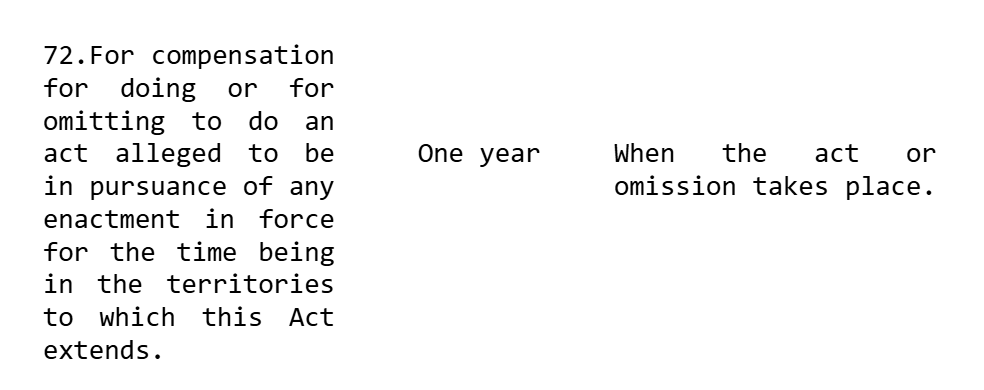
B. Have not the courts below erred in law in failing to see that the proper law of limitation governing the instant case is either Section 249(1)(b) of the Panchayati Raj Act, 1994 or Article 72 of the Limitation Act, 1963, as the case may be?
C. Have not the courts below erred substantially in law in finding that Section 254 of the Kerala Panchayat Raj Act, 1994 read with Kerala Panchayat Raj (Licensing of Pigs and Dogs) Rules, 1998 imposes a statutory duty on the defendant to seize and destroy stray dogs without any complaint?
D. Has not the lower appellate court erred substantially in law in finding that Section 38 of the Prevention of Cruelty to Animals Act, 1960 read with the Animal Birth Control (Dogs) Rules, 2001 imposes a statutory duty on the defendant to seize and destroy stray dogs without any complaint?
E. Have not the courts below erred substantially in law in finding that an isolated incident of a dog bite is sufficient to hold that there was a breach/failure on the part of the defendant to discharge the statutory duty cast on it under the Kerala Panchayat Raj (Licensing of Pigs and Dogs) Rules, 1998 and the Animal Birth Control (Dogs) Rules, 2001?
F. Have not the courts below erred substantially in law in finding that an isolated incident of dog bite was foreseeable by the defendant in the absence of a complaint?
G. Have not the courts below erred substantially in law in quantifying the damages caused to the plaintiff without any evidence to prove the same?
3. In Porathissery Grama Panchayath v. Anthony and Another [2016 (4) KHC 409], a learned Single Judge of this Court held that the Grama Panchayats have a duty to take adequate measures within their territorial limits to prevent the danger of stray dogs biting persons and that they are liable to pay damages to the victims on account of the breach of such statutory obligation. In Corporation of Calicut v. Veluthedath Bindu (A.S. No.307/1997, judgment dated 09.10.2007), a learned Single Judge held that, based on an isolated incident of a stray dog bite, it could not be held that there was a failure to discharge the statutory duty cast upon the Corporation, amounting to tortious liability. Thus, the Court set aside the decree awarding damages to the victim. Noticing the above diverse views, a learned Single Judge referred the case for consideration by a Division Bench, and accordingly, this second appeal has come up before us.
4. For the sake of convenience, the parties shall hereinafter be referred to as they were arrayed in the suit. The plaintiff is a permanent resident within the limits of the defendant Panchayat. On 23.09.2007 at about 5.30 p.m., while he was walking along the Hill Highway at Pooparamba within the territorial limits of the said Panchayat, a stray dog bit him, causing serious wounds on his left leg. The plaintiff was taken to the Taluk Hospital, Thaliparamba, where he was treated for the injuries sustained and administered anti-rabies injections. Claiming that the plaintiff suffered both physical injuries and mental agony, the suit in question was laid alleging that the incident occurred solely due to the breach of the statutory duty of the Panchayat to control and seize stray dogs.
5. The defendant refuted the above allegations. It was stated that the Panchayat had taken all necessary steps and the prescribed procedures under law, to control stray dogs within the limits of Eruvessy Grama Panchayat and that there