Back


2026 Supreme(Ker) 1081
IN THE HIGH COURT OF KERALA AT ERNAKULAM
P.V.KUNHIKRISHNAN, J.
Gopinath R – Petitioner
Versus
Ombudsman For Local Self Government Institutions – Respondent
Wp(C) No. 24843 Of 2025
Decided On : 18-06-2026
For The Petitioner: By Adv Sri.H.Praveen (Kottarakara)
For The Respondent: Advs., Sri.G.P.Shinod, Shri.Sreehari Indukaladharan, Sri.Govind Padmanaabhan, Shri.Ajit G Anjarlekar, Shri.Atul Mathews, Smt.Gayathri S.B., Sr.Gp.Sri.Kabeer
Courts will not entertain trivial neighborhood disputes regarding alleged hazardous trees when local authorities have already implemented reasonable safety measures, as such matters lack the bona fide legal necessity required to burden an already overtaxed judicial system.
Headnote:(A) Local Authorities Act - Section 238 - Removal of dangerous trees - Scope of judicial intervention - Whether a court should adjudicate regarding an alleged hazardous tree in a neighbor's property when local authorities have already assessed the risk and issued remedial directions - Held, no imminent danger present according to the expert report - Courts tasked with resolving genuine legal grievances rather than settling trivial neighborly ego clashes or validating exaggerated apprehensions - Necessity for mutual goodwill and neighborly accommodation. (Paras 9, 10)
(B) Judicial Discretion and Costs - Waste of judicial time - Courts burdened with significant litigation should not be utilized for minor private disputes - Power to impose costs exists to deter frivolous petitions but may be waived in the interest of encouragement for personal reconciliation. (Paras 9, 11)
Facts of the case:
Two neighbors were involved in a protracted dispute regarding a tree situated in one's property. The petitioner sought intervention against the other, alleging a threat to property and personal safety, despite previous complaints having been addressed by local administrative bodies and a statutory ombudsman. A court-appointed commission report confirmed that with active maintenance and minor protective modifications, the tree posed no imminent threat.
Findings of Court:
The court found that the dispute was largely motivated by strained personal relations rather than an actual hazard. It determined that existing orders by local authorities and the ombudsman were sufficient to safeguard the petitioner's rights, rendering further judicial interference unnecessary.
Issues: The main issues were whether a tree represented a danger justifying state intervention under statutory provisions, and whether judicial proceedings could be effectively used as a surrogate for domestic dispute resolution between neighbors.
Ratio Decidendi: Courts must decline to entertain disputes that do not demonstrate a bona fide legal threat to person or property. Where local authorities have already exercised jurisdiction and provided reasonable remedial measures, the court should not substitute its wisdom unless a clear case of perversity or failure of duty is established.
Result: Petition disposed of.
JUDGMENT :
P.V.KUNHIKRISHNAN, J.
The petitioner and the 9th respondent are neighbours and owners of a small extent of property. A coconut tree is on the property of the 9th respondent. Now, the petitioner and the 9th respondent are fighting each other because of this coconut tree. If a coconut tree has the capacity to laugh, the coconut tree might have laughed towards these fighting neighbours. If it had the capacity to fall after a wind, it might have done so to prevent neighbours from fighting over its existence. The ego seems far less flexible than the coconut tree in question. Two grown neighbours, unable to bend their egos as easily as a coconut tree bends to the wind, is the situation. Now, these two neighbours, who are grown-up people, dragged this Court to a quarrel over a harmless palm in the 'paramba' of the 9th respondent. That is the one and only coconut tree in the property of the 9th respondent. What should have been resolved over a shared cup of tea or coffee has instead ripened into a full-blown litigation, as if every swaying frond were a legal threat and every coconut an impending exhibit. If the tree itself could think, as I mentioned earlier, it might well wonder how its quiet existence has become the subject of wasting unnecessary judicial time of this court. I will narrate the facts in the following paragraphs.
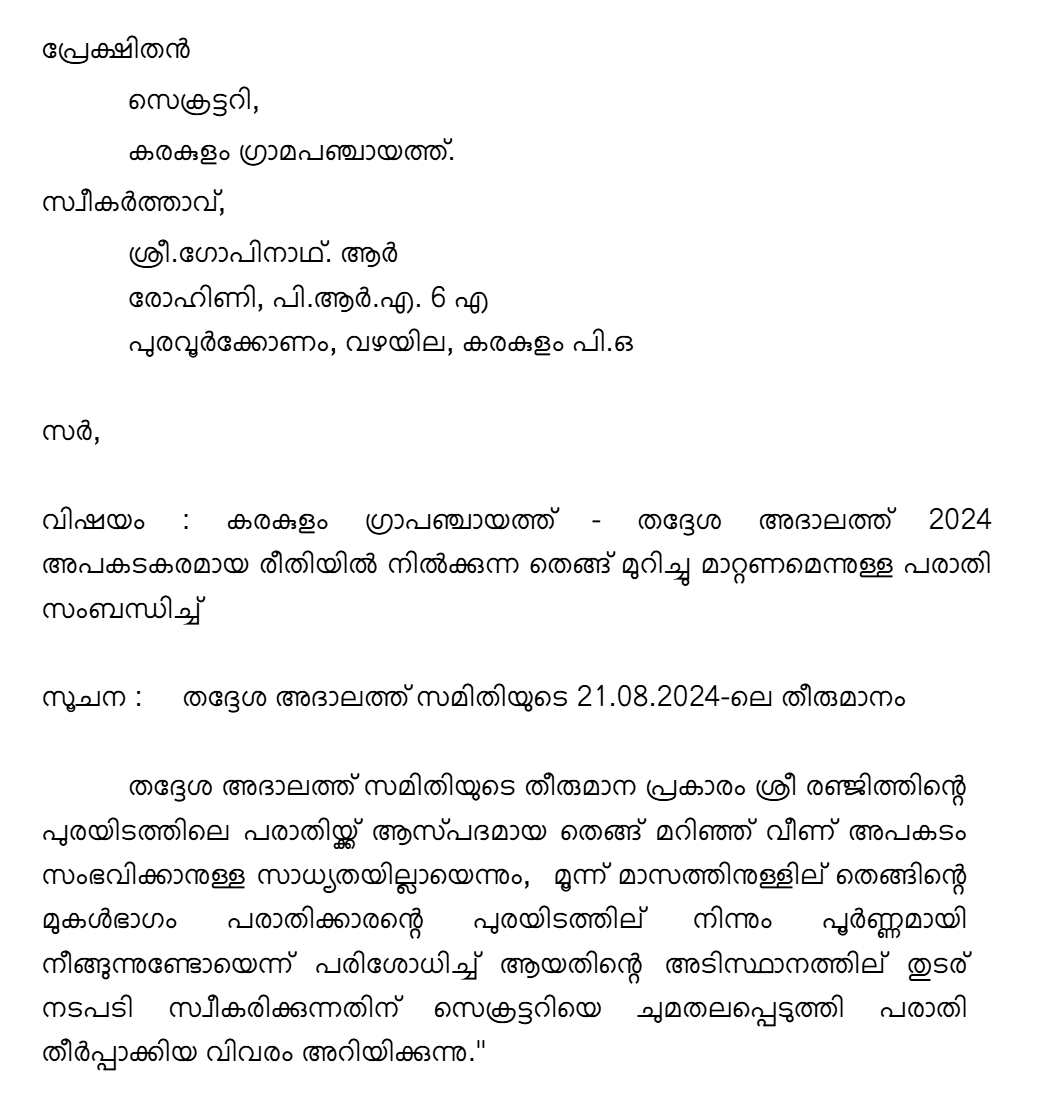
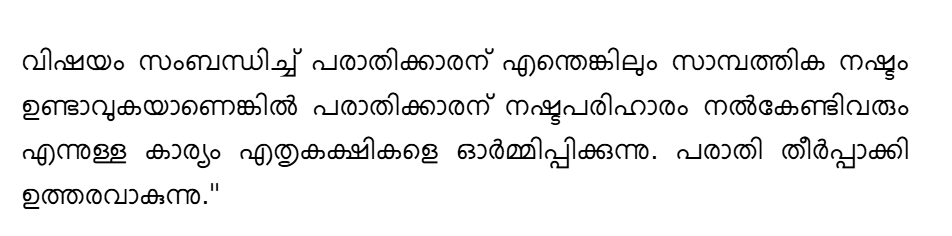
2. The petitioner is in possession and enjoyment of 2.23 Ares of land in Re. Sy. No.486/6-1-3 in Karakulam Village, Nedumangadu Taluk in Thiruvananthapuram District. He constructed a beautiful concrete residential house on his property, as evident by the photographs produced in this writ petition. Similarly, the 9th respondent, who is residing on the western side, also constructed a very good concrete residential building. In the property of the 9th respondent, a coconut tree is also situated. According to the petitioner, this coconut tree is causing severe damage to the petitioner and his family. The petitioner submitted Ext.P2 complaint to the 8th respondent, but there was no response; hence, he approached the 5th respondent with a complaint, as evident from Ext.P3. The 5th respondent called for a report from the Village Officer, Karakulam, and subsequently a report was filed by the Village Officer, Karakulam, as evident by Ext.P4. Even then, there was no action, is the submission. Thereafter, the petitioner obtained Ext.P5 proceedings of the Panchayat, in which it is stated that there is no danger to the petitioner because of the coconut tree, and the leaning of the coconut tree towards the property of the petitioner can be cured by tying the coconut tree using an iron string towards the side of the 9th respondent's property. The petitioner is not satisfied with the same. Petitioner also obtained Ext.P6 information under the Right to Information Act. It is submitted that thereafter again the nuisance from the part of the 9th respondent continued, and as directed by the 8th respondent, Panchayat, the 9th respondent tied the coconut tree to the beam of his house and a protective net was placed to prevent the falling of coconuts to the petitioner's property. But again, the coconuts are falling on the upper portion of the car porch of the 9th respondent after bouncing, and they are falling towards the petitioner's property and causing heavy damage to his two cars parked on the eastern boundary of his property. According to the petitioner, even though he approached the Revenue Department, the Panchayat, etc., there was no response; hence, the petitioner approached the Ombudsman for Local Self Government Institutions, as evident from Ext.P7. The 8th respondent submitted a report to the Ombudsman, as evidenced by Ext. P8. Thereafter, the Ombudsman also disposed of the case in accordance with Ext.P9. Even then, the petitioner remains unsatisfied. Hence, this writ petition is filed.
3. Heard counsel for the petitioner and the Government Pleader. I also heard the counsel appearing for the Panchayat and the 9t