
 Back
Back





RAJASTHAN HIGH COURT BENCH AT JAIPUR
Sameer Jain, J.
Jai Narayan - Appellant
Versus
Moolchand & Ors. - Respondents
S.B. Civil Writ Petition No. 22763 of 2018
Decided On : 10-01-2023
[EVIDENCE] - [SIGNATURE COMPARISON] - [The court upheld the trial court's dismissal of the petitioner's application to compare signatures under Section 45 of the Evidence Act, emphasizing the importance of timely submissions and the supervisory nature of its jurisdiction under Article 227 of the Constitution.]
Fact of the Case:
The petitioner filed a writ petition challenging the trial court's order that dismissed their application to compare the signature of a witness with an admitted signature, claiming it was necessary for justice.
Finding of the Court:
The court found that the trial court had made a well-reasoned decision, noting that a similar application had previously been dismissed and that the current application was filed at a belated stage, suggesting an intent to delay proceedings.
Issues: Whether the trial court erred in dismissing the application to compare signatures under Section 45 of the Evidence Act and whether the High Court should intervene in the trial court's decision.
Ratio Decidendi: The High Court reiterated that its supervisory jurisdiction under Article 227 is not to correct mere errors but to ensure subordinate courts act within their authority. The belated filing of the application indicated an attempt to delay proceedings.
Result: The writ petition was dismissed, and the trial court was directed to expedite the proceedings.
ORDER
1. The present writ petition is filed assailing the impugned order dated 31.08.2018 in Civil Case No. 244/02 whereby the application filed by the petitioner-plaintiff, to compare and examine the signature of DW-4 Roshan Lal on Exhibit-1 with his admitted signature, under Section 45 of Evidence Act, 1872 was dismissed.
2. Learned counsel for the petitioner submit that the learned Trial Court has committed a grave error by wrongly considering the provisions of the law in respect of Section 45 of the Indian Evidence Act, 1872, and by not appreciating the true spirit of the legislature behind the said section - since the documents required to be compared and examined by an expert for proving the case and to establish the true facts - has caused great prejudice to the petitioner-plaintiff. Learned counsel contends that such examination was necessarily required to be conducted in the interest of justice.
3. Per contra, learned counsel for the respondent submits that the learned Trial Court has passed a well reasoned speaking order after due consideration of the facts and material on record, which must be allowed to rest. Learned counsel further submits that the application was filed by the petitioner-plaintiff at a belated stage only to delay the proceedings.
4. Heard the arguments advanced by both the sides, scanned the record of the writ petition and considered the judgments cited at Bar.
5. On perusal of record, it is observed that a similar application under Section 45 of Indian Evidence Act, 1872 was also filed by the petitioner-plaintiff at a previous occasion which was dismissed vide order dated 22.01.2018. The said order was not assailed and has attained finality. The learned trial Court has also passed a well reasoned speaking order, the relevant part of which is reiterated below:-
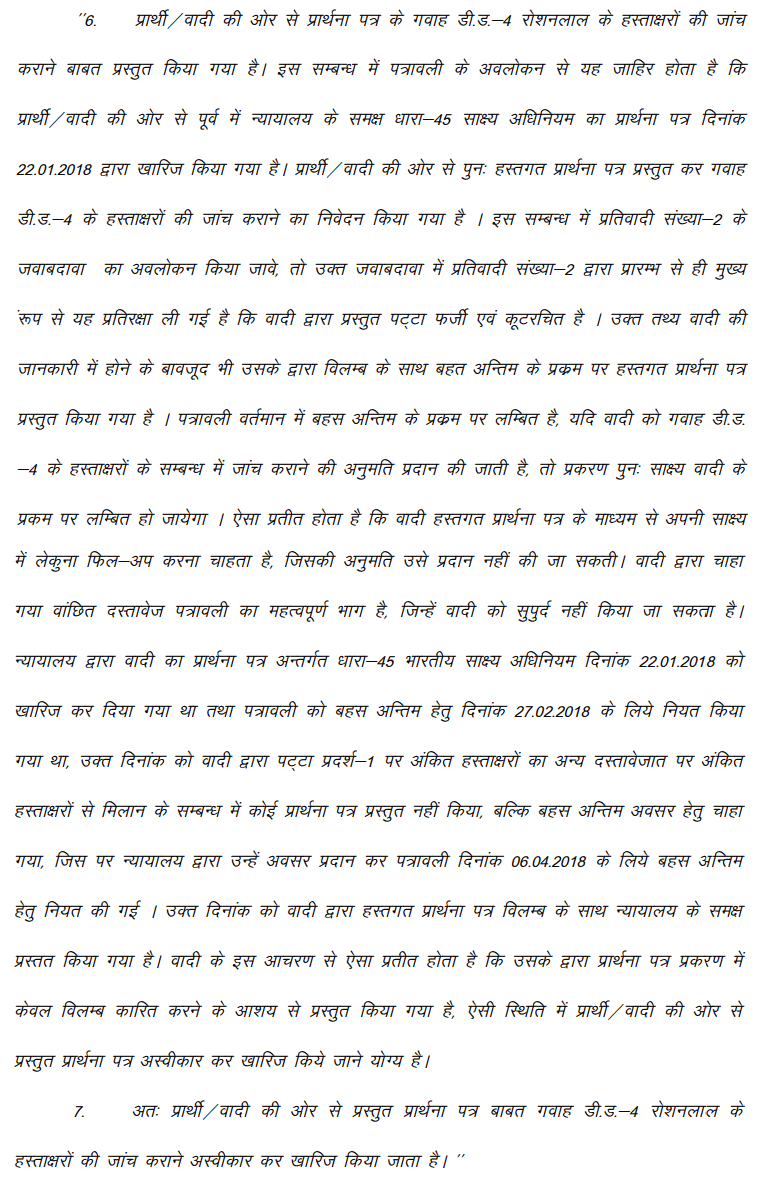
This Court is in complete agreement with the reasoning given by the learned trial Court. It is well settled that while exercising supervisory jurisdiction under Article 227 of Constitution of India, the High Court cannot convert itself into a Court of appeal. It is equally well settled, that the supervisory jurisdiction extends to keeping the subordinate tribunals within the limits of their authority and seeing that they obey the law. It has been held, that though the powers Under Article 227 are wide, they must be exercised sparingly and only to keep subordinate courts and Tribunals within the bounds of their authority and not to correct mere errors. Reliance in this respect can be placed on a Mohd. Inam vs. Sanjay Kumar Singhal and Ors.: (2020) 7 SCC 327. It is also noted that nobody precluded the petitioner to raise the said plea at the appropriate time and the same was only filed at a belated stage i.e. at the time of final arguments, which gives the impression that the same was filed only to delay the proceedings.
6. In view of the above, this Court is not inclined to interfere with a well reasoned speaking order by exercising power under Article 227 of the Constitution of India.
7. Accordingly, the writ petition is dismissed. Pending applications, if any, stands disposed of. Learned trial Court is directed to dispose of the proceedings as expeditiously as possible.
AI

The plaintiff must provide direct evidence to prove the execution of an agreement, and signature comparison is a supplementary method only when direct evidence is unavailable.

The Court's discretion in rejecting an application under Section 45 of the Indian Evidence Act, 1872 is based on judicious discretion and does not warrant interference under Article 227 of the Consti....

The opinion of a handwriting expert is not binding on the court, and inconsistencies in signature usage can undermine claims of forgery.

The court reaffirmed that expert evidence, particularly in handwriting cases, should be approached with caution and is not conclusive without corroboration.


The handwriting expert's opinion is not a perfect conclusive evidence, and filing such an application at a belated stage may lead to multiplying the proceedings without substantial need.

Expert opinion applications under the Indian Evidence Act can be filed at any stage, and the trial court should not assess document merits before completing the trial.

The allowance of pre-trial applications to send disputed documents for Expert opinion is improper and constitutes a material irregularity.

The court ruled that additional evidence at the appellate stage is only permitted under exceptional circumstances, emphasizing diligence in trial procedures.



An indispensable Tool for Legal Professionals, Endorsed by Various High Court and Judicial Officers
Please visit our Training & Support
Center or Contact Us for assistance

Scan Me!
India’s Legal research and Law Firm App, Download now!


For Daily Legal Updates, Join us on :



 Back to top


