Back





2026 Supreme(Raj) 774
HIGH COURT OF JUDICATURE FOR RAJASTHAN AT JODHPUR
Farjand Ali, J.
Sayabh Khan S/o Dhadhal Khan - Petitioner
Versus
State Of Rajasthan, Through Pp - Respondent
S.B. Criminal Revision Petition No. 1363 of 2026
Decided On : 30-09-2026
Important Points
Subject
Criminal Law - Criminal Procedure
Act Referred
BHARATIYA NYAYA SANHITA: S.137(2), S.74, S.78(2)
PROTECTION OF CHILDREN FROM SEXUAL OFFENCES ACT: S.11, S.12, S.7, S.8
JUVENILE JUSTICE CARE AND PROTECTION OF CHILDREN ACT: S.84
Headnote
(B) Prima facie satisfaction - The expression "prima facie" cannot be reduced to a ritualistic incantation; it must have some identifiable factual foundation in the material. The power to frame charge is a judicial power and its exercise necessarily presupposes application of mind to the material placed before the Court. (Para 6)
(C) Mechanical framing of charge - Although a detailed order is not required at the stage of framing of charge, the order must reflect conscious application of judicial mind and cannot be cryptic, mechanical or non-speaking. There must be a discernible nexus between the material examined and the statutory ingredients of each specific offence framed. (Paras 13, 18, 19)
Facts of the case:
Charges were framed against the petitioner for offences relating to kidnapping, stalking, outraging the modesty of a woman, and sexual offences under the POCSO and JJ Acts. The prosecution alleged that a minor girl had left her home and was found travelling with the petitioner. However, statements recorded during investigation and before a Magistrate revealed that the minor had voluntarily accompanied the petitioner for the purpose of marriage and explicitly stated that no sexual assault, threat, intoxication, or wrong act had ever occurred. The trial court proceeded to frame charges without recording any discernible reasoning as to what particular material constituted the prima facie basis for each distinct offence.
Findings of Court:
The impugned order is unsustainable as it does not identify the factual substratum corresponding to the statutory ingredients of the offences. For charges under sections relating to outraging modesty and stalking, the prosecutrix's own statements positively negated the essential elements of coercion or unauthorized monitoring. Regarding kidnapping, the record showed the minor initiated the journey. The trial court failed to identify any independent material that could supply the missing factual foundation, rendering the order a mechanical exercise of jurisdiction.
Issues: Whether the trial court's order framing charges was legally sustainable when the available material, particularly the statements of the victim, negated the foundational ingredients of the alleged offences, and whether the order's cryptic nature indicated a lack of judicial application of mind.
Ratio Decidendi: The framing of a charge requires a judicial determination that the material on record, taken at face value, discloses the essential ingredients of the offence. A general conclusion that a "prima facie case" exists, without correlating specific material to the statutory requirements of each charge, is insufficient. An order that fails to address material contradictions or negations in the evidence that go to the root of the offence is mechanical and cannot be sustained.
Result: Criminal revision petition allowed; impugned order quashed; petitioner discharged from the offences.
For the Petitioner: Mr. Bhagirath Bishnoi
For the Respondent: Mr. Nishant Bora, Mr. Ramesh Dewasi, Dy.G.A.
ORDER :
FARJAND ALI, J.
1. The present criminal revision petition under Section 442 of the Bharatiya Nagarik Suraksha Sanhita, 2023 has been preferred by the accused-petitioner assailing the order dated 22.06.2026 passed by the learned Sessions Judge, Jaisalmer in Sessions Case No.09/2026 arising out of FIR No.17/2026 registered at Police Station Khuhadi, District Jaisalmer, whereby charges have been framed against the petitioner for the offences under Sections 137(2), 74 and 78(2) of the Bharatiya Nyaya Sanhita, 2023, Sections 7 /8 and 11/12 of the Protection of Children from Sexual Offences Act, 2012 and Section 84 of the Juvenile Justice (Care and Protection of Children) Act, 2015.
2. The gravamen of the grievance raised on behalf of the petitioner is that the learned Court below has proceeded to frame the aforesaid charges in a mechanical manner, without adverting to the material collected during investigation and, more particularly, without examining whether the statements of the prosecutrix themselves disclose the foundational ingredients of the offences for which the petitioner has been called upon to face trial. It is contended that the order dated 22.06.2026 does not disclose any discernible reasoning as to what particular material constituted the prima facie basis for each of the distinct offences framed against the petitioner.
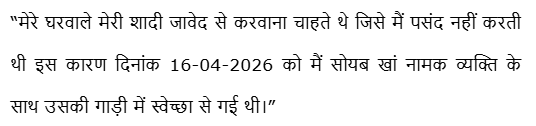
3. The prosecution case, in brief, is that FIR No.17/2026 came to be registered at Police Station Khuhadi, District Jaisalmer, on 17.04.2026 on the allegation that the minor daughter of the complainant, Shivani, aged about 15 years, had left her house during the intervening night of 16/17.04.2026 and was subsequently found travelling with the present petitioner. During investigation, the prosecutrix was recovered and her statement under Section 180 BNSS was recorded on 17.04.2026, while her statement under Section 183 BNSS was thereafter recorded before the learned Additional Judicial Magistrate, Jaisalmer on 18.04.2026. In her police statement, she stated, inter alia, that she had known the petitioner for about eight months, used to communicate with him through Snapchat, that on the intervening night of 16.04.2026 she herself asked the petitioner to go to Ajmer for the purpose of marriage, thereafter voluntarily went to his house and accompanied him in his vehicle, and that during the journey the petitioner neither committed any wrong act with her nor did any physical or sexual relationship take place between them. In her statement recorded before the learned Magistrate under Section 183 BNSS, she further stated that her family members desired to marry her with one Javed, whom she did not like, and that for this reason she voluntarily went with the petitioner in his vehicle on 16.04.2026; she specifically stated that the petitioner neither threatened nor intimidated her nor committed any wrong act with her. The record further records that, being below eighteen years of age and having no guardian accompanying her, she desired to give her statement in the presence of a woman constable; that she was separately afforded sufficient time to think and understand; that she thereafter voluntarily gave her statement without fear or pressure; and that the statement, after being read over and explained to her, was admitted by her to be correct and was signed by her. The investigation culminated in submission of charge-sheet against the petitioner and, vide order dated 22.06.2026, the learned Court below proceeded to frame the aforesaid charges. Aggreived thereby, the instant petition is filed.
OBSERVATIONS
4. Heard learned counsels present for the parties and perused the material available on record.
5. Before adverting to the individual offences, it would be apposite to reiterate the limited but meaningful scrutiny which a Court is required to undertake at the stage of consideration of charge. The Court is neither expected to conduct a meticulous appreciation of evidence nor to undertake a mini-trial. At the s