1. Appeal against dismissal of application to set aside ex-parte decree on ground of invalid service of summons. (Para 1 , 2 )
 Back
Next 


2026 Supreme(Raj) 776
HIGH COURT OF JUDICATURE FOR RAJASTHAN AT JODHPUR
FARJAND ALI, J.
Kanta Devi W/o Late Shri Vinod Kumar - Appellant
Versus
Parsaram S/o Shri Hariram - Respondent
S.B. Civil Miscellaneous Appeal No. 2623 Of 2024
Decided On : 17-09-2026
Important Points
Substituted service under Order V Rule 20 CPC requires the court to record judicial satisfaction that the defendant is deliberately evading service or ordinary service is impracticable; mere failure of an initial attempt or a locked house does not justify substitute service without further reasonable effort.
Subject
Civil Law - Civil Procedure
Act Referred
Headnote
(A) Code of Civil Procedure, 1908 - Order IX Rule 13, Order V Rule 20 and Section 151 - Setting aside ex parte decree - Substituted service - Judicial satisfaction - An ex parte decree can be set aside if the defendant establishes that the summons was not duly served or that they were prevented by sufficient cause from appearing (Paras 4, 4.1) - Substituted service is an exception and requires the Court to examine the circumstances of the failure of ordinary service and satisfy itself that statutory conditions exist (Para 4.5) - A locked house does not establish deliberate evasion of service; absence from an address is not equivalent to evasion (Paras 4.6, 4.10) - If the process server's report provides a lead to the defendant's whereabouts, the Court should require further efforts for ordinary service before directing substituted service (Paras 4.7, 4.8)
(B) Substituted service via publication - The Court must record satisfaction on three aspects: whether the defendant is deliberately avoiding service, whether summons cannot reasonably be served in the ordinary manner, and whether ordinary service was attempted with reasonable diligence (Para 5) - Publication is not an end in itself; the chosen newspaper must have meaningful circulation in the locality where the defendant is known to reside to be legally effective (Paras 5.2, 5.4)
Facts of the case:
In a suit for specific performance of an agreement to sell agricultural land, the summons were returned unserved as the house was found locked. The process server's report indicated the defendants resided in another city, though a complete address was not available. The trial court allowed an application for substituted service via newspaper publication. None of the defendants appeared, and an ex parte decree was passed. The defendants later filed an application under Order IX Rule 13 CPC to set aside the decree, which was dismissed by the lower court.
Findings of Court:
The trial court failed to record a clear satisfaction that the defendants were deliberately evading service; the report merely suggested they resided elsewhere. The court mechanically allowed the publication application without exploring the available lead regarding the defendants' residence or ensuring the newspaper had relevant circulation in the defendants' locality. The defect in service goes to the root of the defendants' opportunity to contest the suit.
Issues: Whether the resort to substituted service via newspaper publication was legally sufficient when the trial court had not recorded judicial satisfaction that ordinary service was impracticable or that the defendants were deliberately evading service.
Ratio Decidendi: Substituted service under Order V Rule 20 CPC is a conditional power, not an unstructured discretion. The court must analytically address and record its satisfaction that ordinary service is unfeasible or that the defendant is keeping out of the way to evade service. A formal act of publication does not cure a failure of ordinary service if the statutory prerequisites for substituted service are not met and the mode of publication is not reasonably calculated to bring the proceedings to the defendant's notice.
Result: Appeal allowed; order dated 29.08.2024 quashed; ex parte judgment and decree dated 23.08.2017 set aside; suit restored to its original number.
Legal Category Hierarchy
- practice and procedure
-
contract and specific relief
-
specific performance
- agreement to sell
-
specific performance
-
property law
-
immovable property
- perpetual injunction
-
immovable property
Advocates:
Advocate Appeared:
For the Appellants : Mr. Narendra Thanvi, Mr. Mahendra Thanvi, Mr. Chetan Singh Bhati
For the Respondents: Mr. Muktesh Maheshwari, Mr. Gaurav Choudhary
Advocate Appeared:
For the Appellants : Mr. Narendra Thanvi, Mr. Mahendra Thanvi, Mr. Chetan Singh Bhati
For the Respondents: Mr. Muktesh Maheshwari, Mr. Gaurav Choudhary
Table of Contents
2. Appellants contended summons not duly served; respondents supported ex-parte decree based on substituted service publication. (Para 2 )
3. Substituted service requires judicial satisfaction of deliberate evasion; incomplete address and locked house insufficient to justify substitution of ordinary service. (Para 5 )
4. Substituted service under Order V Rule 20 CPC requires court's satisfaction of deliberate evasion or impracticability of ordinary service before resorting to exceptional mode. (Para 5 )
5. Appeal allowed; ex-parte decree set aside; suit restored to original stage for fresh hearing. (Para 7 , 8 )
6. What conditions must be satisfied before a court can order substituted service under Order V Rule 20 CPC?
The court must be satisfied that the defendant is deliberately evading service or that ordinary service cannot reasonably be effected despite diligent attempts. This satisfaction must be judicially recorded. (Para 5 )
ORDER :
FARJAND ALI, J.
1. The instant civil miscellaneous appeal is directed against the order dated 29.08.2024 passed by the learned District Judge, Churu in Civil Misc. Restoration Case No.18/2013, Kanta Devi & Ors. v. Parsaram & Anr., whereby the application preferred by the appellants under Order IX Rule 13 read with Section 151 of the Code of Civil Procedure, 1908 (for short, “the CPC”), seeking setting aside of the ex parte judgment and decree, has been dismissed.
2. The controversy lies within a narrow compass. The appellants-defendants contend that they were never duly served with the summons of the suit and that the learned trial Court, without recording the satisfaction required in law for resorting to substituted service, proceeded to direct publication of the summons in a newspaper and thereafter proceeded against them ex parte. Their case is that they acquired knowledge of the decree only when proceedings for its execution were initiated. The question, therefore, is whether the mode of service adopted by the learned trial Court was sufficient in law to constitute due service and, consequently, whether the ex parte decree could legitimately be allowed to stand.
2.1. The relevant facts, in brief, are that respondent-plaintiff Parsaram instituted Civil Regular Suit No.116/2013 before the learned District Judge seeking specific performance of an agreement to sell in respect of agricultural land situated at Village Mehrasar Upadhiyan against the present appellants and respondent No.2.
2.2. Vide order dated 11.10.2013, the learned trial Court directed issuance of summons to the defendants and fixed 01.11.2013 for their appearance. Summons were accordingly issued to defendant Nos.1 to 4. The summons, however, were returned unserved. The report of the process server recorded that the defendants were not residing at Chirawa and that the house was found locked. Upon inquiry, the process server was informed that defendant Kanta Devi was residing somewhere in Jaipur, though she occasionally visited the village. The report further contained the information that she was residing in Shankar Vihar Colony, Jaipur, but that her complete address was not available.
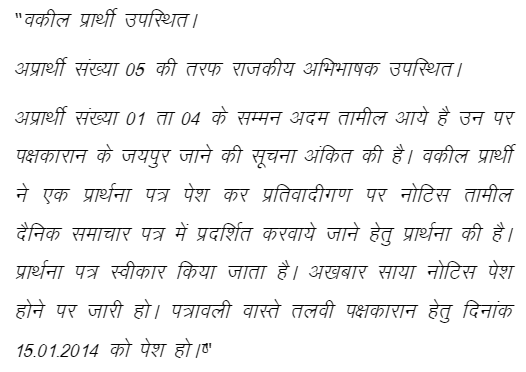
2.3. Upon receipt of the summons with the aforesaid report, the learned trial Court again directed issuance of summons vide order dated 01.11.2013. On 16.11.2013, the order-sheet recorded the non-receipt of duly served summons and the matter was adjourned to 06.12.2013. On 06.12.2013, it was again recorded that the summons had returned unserved and that the defendants had gone to Jaipur.
2.4. At this juncture, learned counsel for the plaintiff moved an application seeking substituted service through publication in a daily newspaper. The application was allowed and the learned trial Court directed publication of notice. The subsequent order-sheet records publication of the notice and receipt of a copy of the newspaper on the record. Thereafter, when the matter was taken up, none appeared on behalf of defendant Nos.1 to 4 and, after calls were made, they were proceeded against ex parte. Ex parte evidence was subsequently recorded.
2.5. The suit was contested by defendant No.5, stated to be the concerned Sub-Registrar/Registrar. Ultimately, the suit came to be decreed in favour of the plaintiff. By the decree, the plaintiff was held entitled to obtain execution of the sale deed upon payment of the remaining sale consideration to defendant Nos.1 to 4 within the stipulated period. Provision was also made for deposit of the balance consideration before the trial Court in the event of failure on the part of the defendants to execute the sale deed. A decree of perpetual injunction was further granted restraining the defendants from interfering with the plaintiff's possession and cultivation over the suit property and from transferring or alienating the same.
2.6. It was thereafter, upon receiving notice in the execution proceedings, that the appellants claim to have learnt of the judgment