


1. Dispute over inheritance in polyandrous marriage – plaintiffs claim share of deceased co-husband's property under customary law. (Para 3 )
 Back
Next 





2026 Supreme(HP) 654
IN THE HIGH COURT OF HIMACHAL PRADESH, SHIMLA
RAKESH KAINTHLA, J.
Shamsher Singh & Ors. - Appellants
Versus
Chain Ram & Ors. – Respondents
RSA No. 66 of 2008
Decided On : 24-07-2026
Important Points
In polyandrous marriages governed by local custom, the surviving brother inherits the deceased brother's property; children have no right to inherit until all brothers are dead.
Subject
Civil Law - Property and Succession
Act Referred
CIVIL PROCEDURE CODE : S.80
Headnote
(A) Customary Law - Succession in Polyandrous Marriages - Property of deceased husband passes to surviving brother(s), not to children, until all brothers are deceased - Concept of coparcenership does not apply to Joridari system - Brother succeeds brother; sons inherit only after all brothers die - Mutation of inheritance in favour of surviving husband is valid. (Paras 20-25)
(B) Hindu Succession Act, 1956 - Not applicable to succession occurring before its enactment - Case governed by local custom or traditional Hindu law - Customary law prevails over Mitakshara law in matters of inheritance in polyandrous regions. (Paras 19, 23-24)
(C) Partition - Minors represented by mother - Validity - One-sided partition not automatically void if mother acted on their behalf - However, where plaintiffs had no subsisting right in the property during lifetime of surviving brother, challenge to partition is without basis. (Paras 27-31)
Facts of the case:
The plaintiffs (sons of Kali Ram) filed a suit seeking declaration that they were entitled to the entire share of Madan Singh (deceased co-husband of common wife Naro Devi) and 1/5th share of Devi Saran (the surviving co-husband). The suit property was joint property of Madan Singh and Devi Saran, who had a common wife Naro Devi under a polyandrous arrangement. Madan Singh died in 1935. Mutation of inheritance was attested in favour of Devi Saran. A family partition had taken place, represented by plaintiffs' mother. The trial court dismissed the suit, holding that the partition was valid and the suit was barred by limitation. The first appellate court affirmed. The plaintiffs appealed to the High Court.
Findings of Court:
The High Court held that the matter is governed by customary law of polyandry, not by Mitakshara law. Under this custom, on the death of a brother, his property passes to the surviving brother(s); the children have no right to inherit until all brothers are deceased. Therefore, during the lifetime of Devi Saran, the plaintiffs had no subsisting right in the property of Madan Singh. Consequently, the suit challenging the partition and claiming a share was without any basis. The appeal was dismissed.
Issues: The main issues were: (i) What is the rule of succession in case of children of a polyandrous marriage? (ii) Whether the plaintiffs were entitled to any share in the suit property during the lifetime of the surviving brother? (iii) Whether the partition effected when the plaintiffs were minors was binding on them?
Ratio Decidendi: In a polyandrous family governed by local custom, the surviving brother inherits the property of a deceased brother. The children of the common wife do not acquire any right to inherit until all brothers of the deceased are dead. This customary rule displaces the Mitakshara concept of coparcenership. Hence, a suit by children claiming a share during the lifetime of the surviving brother is not maintainable. Result : Appeal dismissed.
Legal Category Hierarchy
Advocates Appeared:
For the Appellants :Mr Ajay Kumar, Senior Counsel with Mr Vinay Thakur, Advocate.
For the Respondents:M/s Mohinder Verma & Sumit Sharma, Advocates
Table of Contents
2. Plaintiffs argued partition void due to minority; defendants argued suit barred by limitation and inheritance governed by custom. (Para 16 , 17 )
3. Appeal dismissed – lower court judgments upholding customary succession affirmed. (Para 32 , 33 )
4. What is the rule of succession in a polyandrous marriage under customary law in Himachal Pradesh?
The surviving brother inherits the property of the deceased brother; children do not inherit until all brothers are dead. (Para 22 , 23 , 24 , 25 , 30 )
5. Does the Mitakshara law of coparcenary apply to polyandrous families?
No, local custom prevails over Mitakshara law; the concept of coparcenary does not exist in the Joridari system of polyandry. (Para 26 )
6. Can minors challenge a partition of property in a polyandrous family during the lifetime of a surviving brother?
No, because the minors have no right to inherit the property until all brothers of the co-marriage are deceased, so the partition does not affect any right. (Para 31 )
JUDGMENT :
Rakesh Kainthla, J.
The present appeal is directed against the judgment and decree dated 17.08.2007 passed by the learned Additional District Judge, Shimla Camp at Rohru (learned Appellate Court) vide which the judgment and decree dated 09.03.1992 passed by the learned Sub Judge-II Rohru, District Shimla, H.P. were upheld. (The parties shall hereinafter be referred to in the same manner as they were arrayed before the learned Trial Court for convenience).
2. Briefly stated, the facts giving rise to the present appeal are that the plaintiffs filed a civil suit before the learned Trial Court for seeking a relief of declaration that they are entitled to Madan Singh’s share exclusively and 1/5th share from the property of defendant no. 1, and the family arrangement is null and void. A consequential relief of permanent prohibitory injunction for restraining the defendant from interfering with the possession of the plaintiffs or alienating their share was also sought. It was pleaded that the suit land mentioned in the head note and para 1 of the plaint is the joint Hindu property of the plaintiff and defendants No.1 to 3. Bragi was the common ancestor of the parties. The relationship between the parties is as follows:
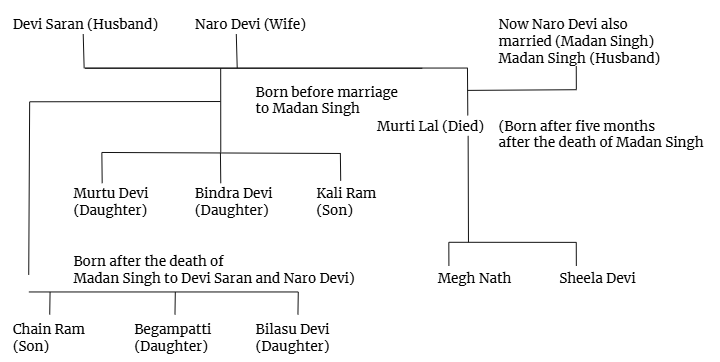
3. Smt. Naro Devi was the common wife of Devi Saran, defendant no. 1, and Madan Singh. Kali Ram, the father of the plaintiffs, was born to them. Madan Singh executed an izadinama in favour of defendant no. 1 regarding his property, and both of them became joint owners. Madan Singh died, leaving Kali Ram as the only heir. However, the mutation of inheritance was sanctioned in the name of Devi Saran, defendant no. 1. The plaintiffs are the sons of Kali Ram and are entitled to the whole share of Madan Singh through Kali Ram. Defendant nos. 2 & 3 were born to defendant no. 1 after the death of Madan Singh. The plaintiffs are entitled to an equal share with defendant no. 1. The plaintiffs were minors at the time of their father’s death. Defendant no. 1, taking advantage of the minority of the plaintiffs, manipulated a family arrangement by giving them some fields much less than their share. They approached defendant nos. 1 & 2 to provide their share, but in vain. Hence, the suit was filed for seeking the reliefs mentioned above.
4. The suit was opposed by filing a written statement taking preliminary objections regarding the lack of maintainability, the suit being bad for non-joinder of a necessary party, the suit having not been properly valued for court fees and jurisdiction, the plaintiffs being estopped from filing the suit by their act, conduct, deed, etc., and the suit being barred by limitation. It was asserted that the partition had taken place 18 years before filing the present suit. The plaintiffs’ mother represented them and herself in the partition. She put the thumb impression on the partition list after being satisfied with the partition. The plaintiffs and their mother started residing separately after the partition. It was specifically denied that the suit land is ancestral joint Hindu family property of the parties. It was asserted that Naro Devi was married exclusively to Devi Saran, and that Madan Singh was made the joint husband of Naro Devi by defendant no. 1 with him. Kali Ram, Murtu Devi, Bindra Devi, and Murti Lal, defendant No. 2, were also born to Madan Singh and Naro Devi. The suit land was partitioned with the consent of the parties, and the present suit is not maintainable. The mutation of inheritance was sanctioned in favour of defendant no. 1 as per the custom. Therefore, it was prayed that the present suit be dismissed.
5. A replication denying the contents of the written statement and afÏrming those of the plaint was filed.
6. The following issues were framed by the learned Trial Court on 06.08.1988, and one additional issue was framed on 9.10.1990:
1. Whether the suit is bad for non-joinder of necessary parties as alleged? OPD.
2. Whether the suit is properly valued for the purpose of Co









