Back
Back





2024 Supreme(Jhk) 114
IN THE HIGH COURT OF JHARKHAND AT RANCHI
Anubha Rawat Choudhary, J.
Bishwanath Majee - Petitioner
Versus
The State of Jharkhand and ors. – Respondents
W.P.(S) No. 4956 of 2015
Decided On : 16-02-2024
Advocate Appeared:
For the Petitioner:Mr. Swapan Maji, Advocate
For the Respondent: Mr. Navneet Toppo, AC to GP I
IMPORTANT POINT
The court reaffirmed that the principles of natural justice must be adhered to in disciplinary proceedings, but failure to raise objections at the appropriate times can result in the forfeiture of those rights. Additionally, the court emphasized the limited scope of judicial review in disciplinary matters.
Headnote:
[NATURAL JUSTICE] - [DEPARTMENTAL PROCEEDINGS] - [CONSTITUTION OF INDIA, ARTICLE 226] - [The court discussed the principles of natural justice, emphasizing the right to cross-examine witnesses and the necessity of a fair hearing. The court found that the petitioner was not denied these rights during the departmental proceedings, as he did not raise objections at the appropriate times. The court concluded that the disciplinary proceedings were conducted fairly, and the punishment of compulsory retirement was justified based on the petitioner's mental health and the nature of the incident.]
Fact of the Case:
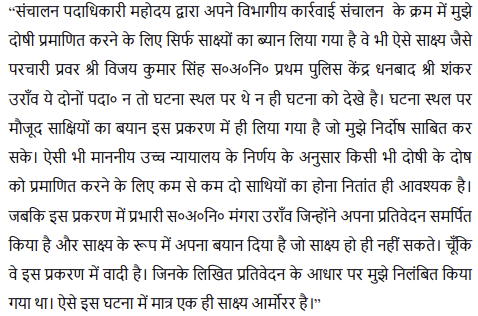
The petitioner, a police constable, was removed from service following a departmental proceeding for firing 11 rounds from his weapon, which he attributed to mental instability due to work-related stress. He challenged the removal, claiming violations of natural justice, particularly the denial of the right to cross-examine witnesses during the inquiry.
Finding of the Court:
The court found that the petitioner had not raised his grievances regarding the denial of cross-examination or the opportunity to present a defense at the appropriate stages of the proceedings. The court determined that the inquiry was conducted in accordance with the principles of natural justice and that the punishment imposed was appropriate given the circumstances.
Issues: Whether the petitioner was denied the principles of natural justice during the departmental proceedings, and whether the punishment of compulsory retirement was disproportionate to the charges.
Ratio Decidendi: The court held that the principles of natural justice were not violated as the petitioner failed to raise his objections during the inquiry and appeal processes. The court emphasized that the scope of judicial review in disciplinary matters is limited, and the appellate authority's decision to impose compulsory retirement was justified based on the petitioner's mental health and the severity of the incident.
Final Decision: The writ petition was dismissed, upholding the order of compulsory retirement passed by the appellate authority.
JUDGMENT :
Anubha Rawat Choudhary, J.
Heard the learned counsels for the parties.
2. This writ petition has been filed for the following reliefs:
“i. Quashing Order dated 5.2.2015 passed by Superintendent of Police, Dhanbad, in DNB 434/15, by which Respondent No.4 has convicted the Petitioner in Departmental Proceeding and has removed the Petitioner from service of Police and for quashing order of punishment as removal of service dated 25.01.2016 passed by Deputy Inspector General of Police, Dhanbad in Departmental Appeal No.13/14; and for
ii. Commanding the Respondents to allow the Petitioner to continue in his service during the pendency of this application; and for
iii. Issuance of a writ in the nature of prohibition for restraining the Respondents from acting in pursuance to order of petitioner’s removal as contained in Annexure – 11; and / or
iv. In the alternative for commanding the Respondents for disposal of the Departmental Appeal of the Petitioner as early as possible; and for any other relief(s) for which the Petitioner is entitled in law.”
3. This writ petition was earlier dismissed vide judgment dated 07.03.2022 against which the petitioner preferred an appeal being L.P.A. No.152 of 2022.
4. Before the Hon’ble Division Bench the petitioner confined his argument to the limited aspect regarding non-compliance of the principles of natural justice and submitted that the writ Court did not consider the question as it was not pleaded in the writ application. Consequently, the amendment was filed at the appellate stage to incorporate the question of non-compliance of principle of natural justice. It was stated that the witnesses were examined in presence of the petitioner but the petitioner was never allowed to cross-examine the witnesses and this being a very important aspect the amendment to the writ petition was allowed at the appellate stage and the order passed by the writ court in W.P.(S) No.4956 of 2015 dated 07.03.2022 was set aside and the matter was remanded back for reconsideration after amendment.
5. The order dated 17.05.2023 passed in L.P.A. No.152 of 2022 is quoted as under:
“1) In this case, the appellant, being the petitioner in W.P. (S) No.4956 of 2015, has assailed the order passed by the learned Single Judge on 07.03.2022, whereby the writ petition was dismissed.
2) Learned Senior Counsel Mr. V.P. Singh would confine his argument to the limited aspect regarding non-compliance of the principles of natural justice.
3) It is borne out from the records that the petitioner-appellant has taken a plea about non-compliance of the principles of natural justice in the sense that he was never granted any opportunity to cross-examine the witnesses before the appellate authority and the appellate authority has not considered this aspect, but, unfortunately, the petitioner has not pleaded in this respect in the writ application. In that view of the matter, the learned Single Judge did not consider the question of non-compliance of the principles of natural justice in the departmental proceeding.
4) After filing this Letters Patent Appeal the petitioner has filed an application for amendment of the writ application to incorporate this question of non-compliance of principles of natural justice which, in our considered opinion, is a very important aspect to be considered as it is stated that the witnesses were examined in his presence but he was never allowed to cross-examine the witnesses. In that view of the matter, we are inclined to allow the application for amendment. Accordingly, I.A. No. 2554 of 2023 is allowed.
5) Since the pleading has to be reconsidered, we consider it appropriate to remand the matter back to the learned Single Judge for reconsideration after amendment, after affording reasonable opportunity of filing additional counter affidavit to the State, if so desired.
6) In the result, this appeal is allowed. The order dated 07.03.2022 passed by the learned Single Judge is hereby set aside and the matter is remanded