Back


2026 Supreme(Mad) 2506
IN THE HIGH COURT OF JUDICATURE AT MADRAS
M. JOTHIRAMAN, J.
Dakshinamoorthi, S/o. Puliyendra Naicker – Appellant
Versus
Narayanasamy Naicker (died), Arjuna Naicker, S/o. Narayanasamy Naicker – Respondent
AS No. 500 of 2016
Decided On : 17-07-2026
For the Appellant : Mr. V. Raghupathi
For the Respondent:Mr. S. Mukunth, Senior Advocate for Mr. V. Nicholas assisted by B. Bharath Kumar.
The burden of proving an oral partition lies heavily on the party asserting it; such a plea requires cogent, contemporaneous public documentation of physical division. Mere separate enjoyment of properties for convenience is insufficient to establish a legal partition.
Headnote:(A) Hindu Succession Act - Section 6(5) - Partition - Suit for partition of joint family properties - Plea of oral partition - Burden of proof lies on the party asserting the partition to establish it through cogent, impeccable, and contemporaneous public documents - Separate enjoyment of property for convenience does not constitute partition in the eyes of law - Such a plea must be supported by evidence indicating severance of joint ownership and actual physical division - (Paras 27, 37)
(B) Evidence - Appellate Court - Findings of trial court regarding the existence of joint family property upheld based on documentary evidence of joint purchases and the testimony of parties - Trial court order confirmed in the absence of evidence proving the alleged earlier partition - (Paras 20, 45, 48)
Facts of the case:
A partition suit was filed by the plaintiffs seeking the division of ancestral and joint family properties among the members. The contesting defendants resisted the suit by claiming the existence of a prior oral partition that had been acted upon for decades. They contended that the properties were in separate management and that they had made significant improvements to their respective portions. The trial court decreed the suit in favour of the plaintiffs, finding that the defendants failed to substantiate the existence of this oral partition.
Findings of Court:
The court observed that the defendants failed to examine independent witnesses or panchayatdars to prove the alleged oral partition. The revenue records and tax receipts submitted did not demonstrate a valid severance of status or physical division. Evidence confirmed that properties were purchased jointly, and parties engaged in joint dealings even after the purported partition date.
Issues: The central issues addressed were whether the suit properties are joint family properties and whether the plea of oral partition is legally sustainable and proven.
Ratio Decidendi: A plea of oral partition is not to be accepted based on mere allegations. It requires high-quality, continuous, and contemporaneous documentary evidence evidencing the conversion of joint ownership into ownership in severalty. In accordance with settled principles, the burden of proving an oral partition is exceptionally heavy, and in the absence of such evidence, the status of joint family property persists.
Result: Appeal dismissed.
JUDGMENT :
M. JOTHIRAMAN, J.
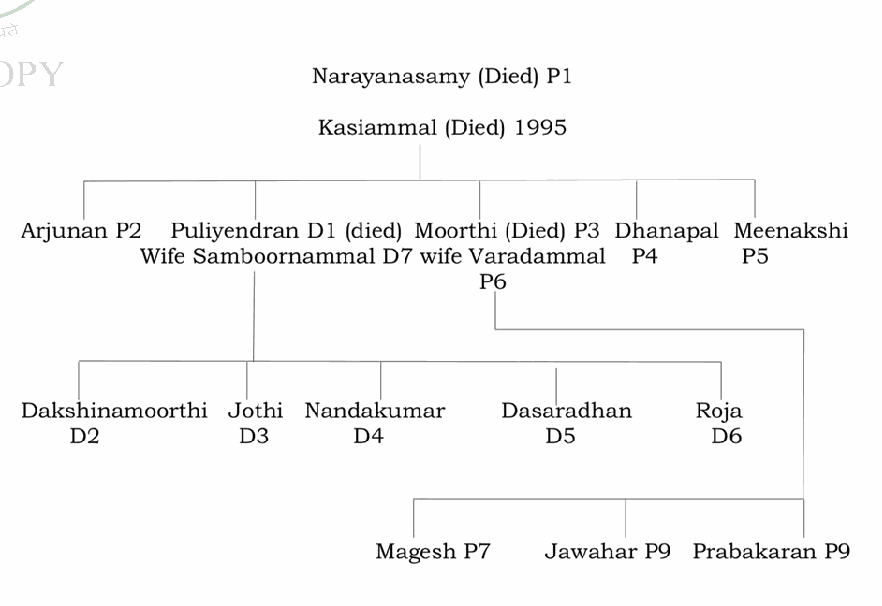
Unsuccessful defendants 2 to 7 have preferred this appeal. The Suit is filed for partition of the Suit schedule properties into 25th equal shares and allotment of 19/25th share to the plaintiffs 2 to 5.
For the sake of convenience, the parties are referred to as per their ranking in the suit.
2. Brief case of the plaintiffs are as follows:
2.1. The plaintiffs and the defendants are members of Joint Hindu family owning suit schedule properties. The family had substantial ancestral properties. The members of the family were cultivating lands of 3rd parties. The family owned sheep, cows and buffaloes. From and out of the income derived from the joint family, substantial properties were purchased in the name of the family members. The 1st defendant has been acting as the Manager of the Joint Family from the year 1980. The 1st defendant has taken an hostile attitude towards the plaintiff. Hence, the plaintiff issued a Legal Notice (Ex.A1) dated 24.09.1996 to the 1st defendant calling for partition. The 1st defendant gave a reply notice (Ex.A2) dated 17.11.1996 with false allegations. The 1st defendant, with an intention to develop their shares, has executed settlement deeds in favour of is sons / defendants 2 to 5 and the 1st defendant also settled properties in favour of his daughter / 6th defendant. Hence the Suit.
3. Brief case of the defendants are as follows:
3.1. The first defendant, in his written statement dated 24.08.2000, resisted the claim of the plaintiffs that the suit properties are ancestral and joint family properties of the plaintiffs and the first defendant and the same have been divided during the Tamil month of Thai in 1981 by way of oral family partition before Panchayatdars. The plaintiffs and the first defendant have already divided, the partition is true, valid and acted upon. Since the partition, the shares are in separate possession and enjoyment of the respective parties. Some shares have been sold and some shares have been mortgaged with the Bank. The sharers have also purchased certain properties after partition and such properties are the self acquired properties of the sharers. Patta and other revenue records have been separately obtained. The plaintiffs, who claim joint status, purposely omitted to include the properties acquired by them after 1981. The properties purchased in the name of the members of the joint family have been allotted to the other members in the partition took in the Tamil month of Thai in 1981.
3.2. With regard to the omission of properties to be included in the plaint, it is specifically pleaded that Item No.15 of the suit properties purchased in the name of the defendant’s mother in the year 1964 fell to the share of the fourth plaintiff, who sold the same, through his power agent. So also, Item No.19 of the suit properties purchased in the name of the first plaintiff was allotted to the fourth plaintiff, who sold the same through his power agent. Certain items, which are subjected to the family partition, omitted to be included in the suit.
3.3. The properties purchased in the name of the second plaintiff including Item No.2 fell to the share of the third defendant, who mortgaged the same in favour of one Vedagiri of Thandalam. Like Item Nos.23, 28 and 30 purchased in the share of the second plaintiff. Item Nos.31, 33, 35, 37, 38, 41 and 42 purchased in the name of the second plaintiff was allotted to the first defendant and he obtained patta transfer in his name and he is in separate enjoyment of the same.
3.4. After partition, the first defendant purchased properties under different sale deeds from various parties from and out of his own income, which includes cultivable lands, house site together with houses. Such properties are always treated as self acquired properties of the first defendant. The plaintiffs purposely included such items and made a false claim. In family partition, the first plaintiff not take claims. In the family partition, the first