
 Back
Back





IN THE HIGH COURT OF ALLAHABAD
RAJIV GUPTA, SHIV SHANKER PRASAD, JJ.
State of U.P – Appellant
Versus
Chandra Pal and Others – Respondents
Government Appeal No. 1809 of 1984
Decided On : 31-05-2024
ACQUITTAL - Murder and Common Intention - Section 302 IPC, Section 34 IPC - The court discussed the provisions of Section 302 IPC concerning murder and Section 34 IPC regarding common intention. It emphasized that for a conviction under Section 34, there must be a prior concert or meeting of minds among the accused. The court found that the prosecution failed to establish a common intention among the accused, leading to the acquittal of the accused-respondent Chandra Pal.
Fact of the Case:
The case arose from a dispute over land between two families, leading to the murder of Raghubir by Yad Ram, who was armed with a knife, while Chandra Pal and Hira Lal allegedly held the victim. The prosecution claimed that the attack was premeditated and involved common intention among the accused.
Finding of the Court:
The court found that the testimonies of the key witnesses were inconsistent and unreliable, particularly regarding the role of Chandra Pal. The court noted that the prosecution did not establish a common intention or prior concert among the accused, which is necessary for a conviction under Section 34 IPC.
Issues: Whether the accused-respondent Chandra Pal can be convicted under Section 302 IPC read with Section 34 IPC based on the evidence presented.
Ratio Decidendi: The court held that mere presence at the scene of a crime or holding the victim does not imply common intention to commit murder. The prosecution's failure to prove a pre-arranged plan or concerted action among the accused led to the conclusion that Chandra Pal was not guilty of the charges against him.
Final Decision: The appeal by the State was dismissed, and the acquittal of the accused-respondent Chandra Pal was upheld as the trial court's findings were not perverse or illegal.
JUDGMENT :
RAJIV GUPTA, J.
1. Heard Shri J.P. Tripathi, learned AGA for the State/ appellant, Shri Ravi Pandey, holding brief of Shri Rahul Kumar Sharma, learned counsel for the accused-respondents and perused the record.
2. The instant government appeal has been filed against the judgment and order dated 20.03.1984 passed by Special Judge/ Additional Sessions Judge, Aligarh in Sessions Trial No. 291 of 1983 (State of Uttar Pradesh Vs. Yad Ram and Others), arising out of Case Crime No. 96 of 1983, under Section 302 IPC, Police Station Sasani, District Aligarh, by which the accused-respondents have been acquitted for the charge under Section 302 read with Section 34 IPC.
3. During the pendency of the said government appeal, accused-respondent no. 2 Hira Lal has already passed away on 06.03.2005 and as such, the instant government appeal qua accused-respondent no. 2 Hira Lal has been abated and now, it survives only for accused-respondent no. 1 Chandra Pal.
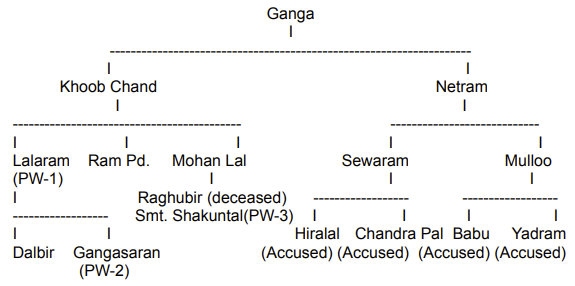
4. The prosecution story as unfurled in the FIR is that a litigation regarding partition of land was pending between the first informant Lala Ram, Raghubir and Ram Prasad, on one hand and Chandra Pal, Hira Lal, Yad Ram and Babu, on the other.
5. It is further alleged that on the joint land, a grove of mango and guava, measuring 16 bigha, was under the control and use of Yad Ram, Babu, Chandra Pal and Hira Lal, whereas on the joint land, measuring 10 bigha, there was another grove, which was in the possession and use of the first informant Lala Ram and his nephew Raghubir (Deceased).
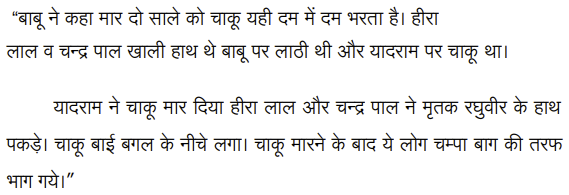
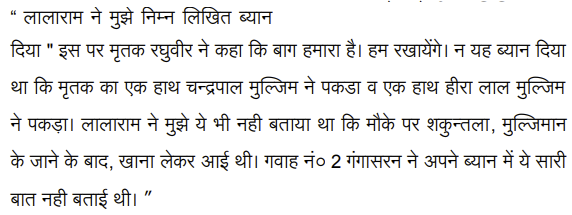
6. It is further alleged that on 14.04.1983 at about 8:00 AM, Lala Ram alongwith his son Ganga Saran and Leela and his nephew Raghubir were present in the grove, where Yad Ram, armed with knife and Babu, armed with lathi, Chandra Pal and Hira Lal, who were unarmed, reached the grove and asked the first informant Lala Ram and his nephew Raghubir as to why they are keeping a watch on the grove and started hurling abuses. In the meantime, Hira Lal and Chandra Pal caught hold of his nephew Raghubir. Babu, who was armed with lathi, exhorted Yad Ram to kill Raghubir, who poses to be very arrogant, consequent thereto, Yad Ram, with an intention to kill Raghubir, assaulted him with a knife blow below his left armpit in the chest. On the alarm being raised, all the four assailants ran away towards Champa Bagh. After some time, his sons Dalbir and Karan Singh also reached the place of incident and took the injured Raghubir on a cot towards Government Hospital, Sasani, where Raghubir succumbed to his injuries.
7. On the basis of the said allegations, a written report, which has been proved and marked as Exhibit Ka-1, was scribed by one Satya Dev, which was taken to the Police Station Sasani and handed over to the Head Moharrir Ram Swaroop Singh, who, on the basis of said written report, lodged a first information report, which has been proved and marked as Exhibit Ka-16, corresponding G.D. entry of which was drawn vide G.D. Report No. 14, which has been proved and marked as Exhibit Ka-17.
8. After registration of the first information report, the investigation of the said case was entrusted to S.I. Ram Murti Yadav, who was present at the Police Station. He reached the spot and prepared the inquest report alongwith other relevant documents, including photo lash, challan lash, chitthi R.I., chitthi C.M.O. and sealed samples, which have been proved and marked as Exhibit Ka-11 to Exhibit Ka-13. The investigating Officer also collected the blood-stained earth and plain earth from the place of incident and kept it in a container and prepared its fard recovery memo, which has been proved and marked as Exhibit Ka-14. Thereafter, the corpse was wrapped in a cloth by preparing sample seal and thereafter, dispatched the dead body for the post-mortem. An autopsy was conducted on the person of the deceased by Dr. G.P. Varshney (PW-4). The Doctor has noted following injuries on the person of the deceased:
(i) Stab wound 1” x 1/2” x

AI

The presumption of innocence remains paramount, and an acquittal can only be overturned if the trial court's findings are perverse or unsupported by evidence.
The prosecution must prove its case beyond reasonable doubt; acquittal upheld due to unreliable eyewitness testimony and lack of corroborative evidence.

In criminal law, the prosecution must prove the accused's guilt beyond reasonable doubt, particularly in murder cases where intent and knowledge are critical elements.

Common intention under Section 34 IPC can be established through evidence of participation in the crime, even without prior planning, as demonstrated by the credible testimony of an eyewitness.
The prosecution must prove the guilt of the accused beyond reasonable doubt, and the High Court's power to convert a finding of acquittal into one of conviction is limited as per Section 401(3) of Cr....

An appellate court must bear in mind that in case of acquittal, there is double presumption in favour of accused. Firstly, presumption of innocence is available to him under fundamental principle of ....

The acquittal of the accused was upheld due to insufficient evidence and contradictions in witness testimonies, reinforcing the presumption of innocence.



An indispensable Tool for Legal Professionals, Endorsed by Various High Court and Judicial Officers
Please visit our Training & Support
Center or Contact Us for assistance

Scan Me!
India’s Legal research and Law Firm App, Download now!


For Daily Legal Updates, Join us on :



 Back to top


