Back





2024 Supreme(All) 792
IN THE HIGH COURT OF ALLAHABAD
MAHESH CHANDRA TRIPATHI, ANISH KUMAR GUPTA, JJ.
The State of UP and 5 others – Appellants
Versus
Geeta Rani W/o Late Man Singh – Respondent
Special Appeal Defective No. 380 of 2024
Decided on : 15-05-2024
Important Points
Compassionate appointments are exceptional and do not confer a right to a second chance in physical efficiency tests; the definition of 'suitable post' must consider the position held by the deceased employee.
Subject
Administrative Law - Compassionate Appointment
Act Referred
CONSTITUTION OF INDIA : Art.141, Art.226, Art.136
UTTAR PRADESH RECRUITMENT OF DEPENDANTS OF GOVERNMENT SERVANTS DYING-IN-HARNESS RULES : R.5
Headnote
DELAY CONDONATION - COMPASSIONATE APPOINTMENT - Chapter VIII Rule 5 of the Allahabad High Court Rules, 1952; Uttar Pradesh Recruitment of Dependents of Government Servants Dying in Harness Rules, 1974 - The court condoned the delay in filing the appeal and discussed the provisions of the Allahabad High Court Rules and the Uttar Pradesh Recruitment Rules. It emphasized that compassionate appointments are exceptional and should not be treated as a right. The court interpreted the rules to mean that a second chance for physical efficiency tests is not typically permitted, especially in disciplined forces, and that the definition of a 'suitable post' must consider the position held by the deceased employee.
Fact of the Case:
The petitioner applied for compassionate appointment after her husband, a Head Constable, died in harness. She was directed to undergo a physical efficiency test for the post of Sub-Inspector but failed to complete it within the required time, exceeding by 3 seconds. She sought the court's intervention to allow her another chance to take the test.
Finding of the Court:
The court found that the petitioner had voluntarily participated in the physical test and failed. It ruled that there is no provision for a second chance under the relevant rules and that the compassionate appointment should not be equated with regular recruitment processes. The court emphasized the need for strict adherence to physical efficiency standards in the police force.
Issues: Whether the petitioner is entitled to a second chance to take the physical efficiency test for compassionate appointment despite failing the first attempt.
Ratio Decidendi: The court held that compassionate appointments are not a right and that the rules do not provide for a second chance in physical efficiency tests. The interpretation of 'suitable post' must align with the position held by the deceased employee, and the court cannot create exceptions outside the established rules.
Final Decision: The court set aside the order of the learned Single Judge that granted the petitioner a second chance for the physical efficiency test, affirming that she could apply for other suitable posts within the department based on her eligibility.
Certainly. Based on the provided legal document, here are the key points:
-
Compassionate appointments are considered exceptional and do not inherently grant the right to a second chance in physical efficiency tests. The rules governing such appointments emphasize strict adherence to prescribed standards (!) (!) .
-
The definition of "suitable post" must be aligned with the position held by the deceased employee. The dependent cannot claim a higher or different post than what was held by the deceased, as this would defeat the purpose of compassionate appointment, which is to provide immediate relief to the family of the deceased (!) (!) .
-
The participation in physical tests is voluntary, and failure in such tests, especially in disciplined forces like the police, generally disqualifies a candidate from immediate appointment, unless rules explicitly permit relaxation or additional chances, which they typically do not (!) (!) .
-
The courts have clarified that orders granting second chances or relaxations in physical efficiency tests are exceptional and are not to be treated as binding precedents. Such decisions are based on the specific facts of each case and do not alter the strict rules governing physically demanding roles (!) (!) .
-
The interpretation of "suitable employment" should consider the post held by the deceased employee and the educational or qualification criteria relevant to that post. Higher qualifications of dependents do not automatically entitle them to higher or different posts on compassionate grounds (!) (!) .
-
Orders or judgments that provide for second chances or relaxations in physical tests, especially in the context of disciplined services, are generally not binding as precedents and are often based on equitable considerations rather than statutory provisions (!) (!) .
-
The primary purpose of compassionate appointments is to offer immediate financial relief to the family of a deceased government employee, not to serve as an alternative or extended recruitment process. Such appointments are not meant to confer status or serve as a substitute for regular recruitment procedures (!) (!) .
-
In cases where a candidate fails to meet the physical standards, the appropriate course is to allow the candidate to apply for other suitable posts within the department, subject to eligibility and departmental discretion. Second chances for physical tests are generally not provided unless explicitly permitted by rules (!) .
-
The courts have consistently emphasized adherence to the rules governing physical efficiency and the limited scope for discretion or relaxation, reaffirming that compassionate appointments do not override these standards (!) (!) .
-
Overall, the legal framework and judicial interpretation underscore that compassionate appointment rules are designed to provide immediate relief, and any relaxation or second chance must be supported by clear statutory provisions or exceptional circumstances, which are rare (!) (!) .
Would you like a summary or assistance with a specific aspect of this case?
Advocate Appeared:
For the Appellant : C.S.C., Kunal Ravi Singh, S.C.
For the Respondent: Atipriya Gautam, Devesh Mishra
JUDGMENT :
(In Re:- Civil Misc. Delay Condonation Application)
1. Heard learned counsel for the parties.
2. Cause shown in the affidavit filed in support of the instant application is to the satisfaction of the Court.
3. Accordingly, the delay in filing the instant appeal stands condoned and delay condonation application is allowed.
(Order on Memo of Appeal)
4. The instant intra-court Special Appeal under Chapter VIII Rule 5 of the Allahabad High Court Rules, 1952 (hereinafter referred to as the "Rules, 1952") is being preferred by the appellant-respondent challenging the legality and validity of the judgment and order dated 21.12.2023 passed by the writ Court in WRIT - A No. -21105 of 2023 (Geeta Rani Vs. The State of Uttar Pradesh and 5 Others), wherein, learned Single Judge while accepting the ratio has essentially premised its judgment on the basis of the mandate given by a Coordinate Bench of this Court vide its judgment and order dated 22.10.2020 passed in SERVICE SINGLE No.-14796 of 2020 (Dharmendra Singh Vs. State of Uttar Pradesh Thru. Prin. Secy. Home, Lko. & Ors.) and accorded a last opportunity to the respondent-petitioner to clear the physical efficiency test within a period of 30 days and even if she fails, suitable appointment on compassionate basis shall be accorded to her.
5. Before hearing the rival submissions of the parties, it would be in the fitness of things to reproduce the order dated 21.12.2023 passed by learned Single Judge:-
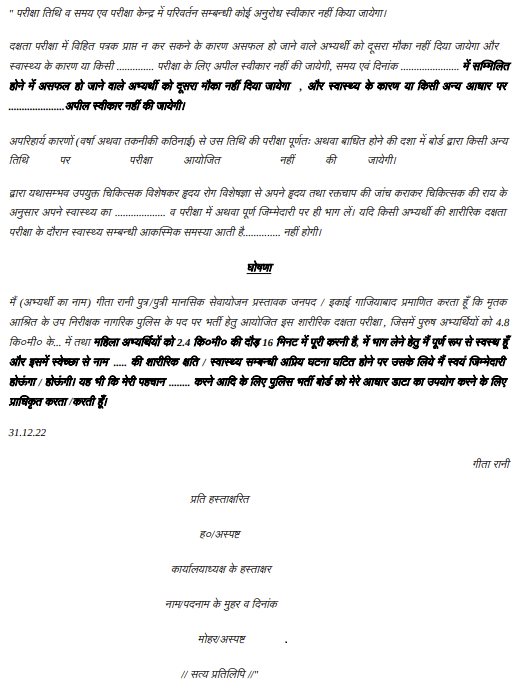
"Petitioner applied for compassionate appointment on account of her husband late Man Singh dying in harness while working as Head Constable with Civil Police on 02.02.2021 however, while his application was entertained for the post of Sub-Inspector and was directed for the physical efficiency test, he could complete running in excess of 3 seconds to the scheduled time which was prescribed as 16 minutes for 2.4 kms.
Learned counsel for the petitioner submits that in respect of 3 seconds of delay there should be taken a sympathetic consideration because in many of service rules that provide for compassionate appointment relaxations are offered. He submits that in matters of compassionate appointment, the authorities ought to have taken pragmatic view as these rules are exception to the general rules of recruitment to show compassion towards the bereaved family as sole earning member has met premature death leaving liability behind. However, he submits that given an opportunity, may be as a last one, she would be again participating in the physical efficiency test and if this time she fails, she will not be setting up any further claim for the post and then can be offered any suitable appointment on compassionate basis.
Learned counsel for the petitioner has also relied upon an order of a coordinate Bench of this Court at Lucknow Bench in Service Single No.- 14796 of 2020 decided on 22nd October, 2020.
Learned Standing Counsel submits that the police force requires certain level of physical efficiency and any compromise to the same would not be in the interest in the police force which is involved in policing like civil administration as and when requires qua security of the people. However, he does not dispute that one direction has been issued in a case but submits, that cannot be taken as a binding precedent. He though submits that second opportunity as such could be offered in the discretion of this Court only as he does not dispute that the rules of compassionate appointment are exceptional to the general rules, however, reiterates the principle that there is no vested right to get a post of choice by way of compassionate appointment.
Having heard learned counsel for the respective parties and their arguments raised across the bar, considering the fact that the petitioner has been seeking a compassionate appointment and for which he was directed for physical efficiency test and has just exceeded three seconds to the scheduled time prescribed for running of a candidate as per the rules, th