Back


2026 Supreme(All) 820
IN THE HIGH COURT OF JUDICATURE AT ALLAHABAD
ACHAL SACHDEV, J.
Mayya @ Prem Kumari and Others – Appellants
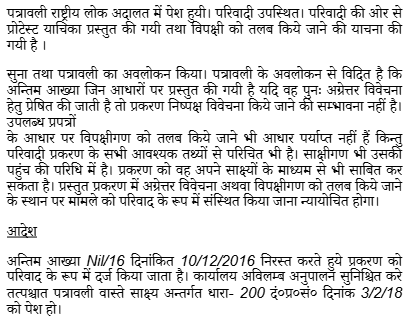
Versus
State of U.P. and Another – Respondents
Application U/s 528 BNSS No. 7481 of 2025
Decided On : 23-04-2026
For the Appellants : Markandey Rai, Pradeep Kumar Rai, Sandeep Kumar Rai
For the Respondents: Anil Kumar Dubey, Ram Milan Dwived
Conciliatory forums lack the jurisdiction to perform judicial functions such as rejecting police reports, taking cognizance of offenses, or registering criminal complaints. Their role is restricted to facilitating settlements; if none is reached, cases must return to the competent court. Orders passed exceeding this mandate are void.
Headnote:(A) Legal Services Authorities Act, 1987 - Sections 20 and 21 - Code of Criminal Procedure, 1973 - Sections 190, 200, 202, 204 and 482 - Jurisdictional scope of conciliation forums - Rejection of final report - The role of such forums is limited to facilitating settlement - They lack authority to perform judicial functions such as rejecting police reports or taking cognizance of offenses when disputes remain unresolved between parties. (Paras 8, 12, 16)
(B) Judicial Process - Summoning of accused - Validity of judicial action - Any order originating from a forum acting beyond its statutory jurisdiction is void - If an order initiating criminal proceedings is foundationally flawed due to lack of competence in the primary forum, all consequential judicial orders, including those for summoning the accused, are legally unsustainable and liable to be quashed. (Paras 14, 16, 21)
Facts of the case:
The grievance arose from a judicial order passed by a conciliatory forum, which had been seized of a protest petition against a final investigation report. Instead of facilitating a compromise between the involved parties, the forum rejected the police report and directed that the matter be registered as a criminal complaint case, which subsequently led to the issuance of a summoning order against the applicants.
Findings of Court:
The court observed that the conciliatory forum exceeded its statutory authority by assuming adjudicatory functions. It held that such forums are non-adjudicatory in nature and are statutorily mandated to return cases to the court of original jurisdiction if no settlement is reached. The act of registering a criminal complaint by the forum was held to be an exercise of power without jurisdiction.
Issues: The primary issue was whether a conciliatory forum possesses the legal mandate to perform judicial functions, including the rejection of police investigation reports and the conversion of a protest petition into a registered criminal complaint.
Ratio Decidendi: Conciliatory forums are strictly limited by statute to resolving disputes through mediation and consensus. Any judicial attempt to adjudicate upon the merits or to formalize criminal proceedings in the absence of a settlement constitutes a jurisdictional nullity, which renders all subsequent judicial steps, including the issuance of summons, fundamentally invalid.
Result: Application allowed; entire proceedings quashed.
| Table of Content |
|---|
| 1. overview of procedural history and factual context of the complaint. (Para 1 , 2 , 4 , 5 , 6 , 19 , 20) |
| 2. parties' contentions regarding jurisdictional error in lok adalat proceedings. (Para 3 , 7) |
| 3. magistrate's functions and complaint case procedures post-final report. (Para 8 , 9 , 10 , 11) |
| 4. lok adalats lack jurisdiction for non-consensual judicial adjudication. (Para 12 , 13 , 14 , 15 , 16 , 17 , 18) |
| 5. quashing of orders due to lack of jurisdictional competence. (Para 21 , 22) |
JUDGMENT :
ACHAL SACHDEV, J.
1. Learned counsel for the applicants, learned A.G.A. for the State and learned counsel for the opposite party no. 2 are present.
2. From perusal of order sheet, it appears that this Court, vide order dated 11.08.2025, had granted three weeks time to the opposite party no. 2 to file counter affidavit but till date, no counter affidavit has been filed.
3. Learned A.G.A. submits that the matter has been decided in Lok Adalat which is not as per law laid down by the Hon'ble Supreme Court.
4. Perused the record.
5. The protest petition had been filed against the final report no. Nil/2016 dated 10.12.2016 submitted in NCR No. 141/2015 against which the complainant/informant had filed his protest petition and the protest petition was treated as complaint by the court of Judicial Magistrate, Banda, in National Lok Adalat vide order dated 09.12.2017.
6. Learned counsel for the applicants, by way of the present application u/s 482 Cr.P.C., has challenged the order dated 09.12.2017 by which final report has been treated as complaint case in National Lok Adalat and also the impugned summoning order dated 28.03.2024 by which applicants have been summoned in Complaint Case No. 725/ukS/2017 (Gulab Singh Vs. Smt. Mayya Alias Prem Kumari and others) u/s 323, 504, 506 I.P.C., Police Station-Atarra, District- Banda.
7. Learned counsel for the applicants has drawn the attention of the Court to the judgement of Supreme Court in the case of State of Punjab and Ors. Vs. Ganpat Raj , (2006) 8 SCC 364.
8. A Magistrate has the legal authority to reject a police Final Report (FR) and instead treat the matter as a complaint case. However, this typically occurs in a regular court setting rather than during Lok Adalat proceedings, as Lok Adalats lack the jurisdiction to adjudicate or decide cases on merit if no settlement is reached.
9. Section 21 of the LSA Act provides that every award of a Lok Adalat shall be deemed to be a decree of a civil court, that it shall be final and binding on the parties to the dispute, and that no appeal shall lie against it. Similarly, section 22E, which deals with awards of a Permanent Lok Adalat, similarly declares that every award shall be final and binding on the parties and persons claiming under them, shall be deemed to be a decree of a civil court and shall not be called in question in any original suit, application or execution proceeding. Both provisions reflect a common legislative intent that such awards are to attain finality, are not appealable in the ordinary sense, and are to operate as decrees only for the limited purpose of execution. But in a case investigated by the police, when the police submit a report stating that no case is made out, the Magistrate has following primary options :
1) Accept the final report and close proceedings.
2) Disagree with the final report and take cognizance under Section 190(1)(b) Cr.P.C. based on the police papers.
3) Treat the protest petition/complaint as a complaint case under Section 190(1)(a) Cr.P.C. and proceed under Chapter XV (Sections 200–203 Cr.P.C.).
4) Direct further investigation.
10. If the Magistrate rejects the final report and registers the matter as a complaint, he must follow the complaint case procedure as laid out in Chapter XV of Cr.P.C. 1973/Chapter XVI BNSS, 2024:
i) Record statements under Section 200 Cr.P.C.
ii) Conduct an inquiry under Section 202 Cr.P.C. if necessary.
iii) Only thereafter, if sufficient grounds exist, issue a process under