Back


2026 Supreme(All) 851
HIGH COURT OF JUDICATURE AT ALLAHABAD, LUCKNOW
RAJNISH KUMAR, ZAFEER AHMAD, JJ.
Chhidu And Others - Appellants
Versus
State of U.P. - Respondent
CRIMINAL APPEAL No. 237 of 1988
Decided On : 20-04-2026
For the Appellant : K.K. Dixit, Kamlesh Kumar Gupta, Sunil Kumar Singh
For the Respondent:Govt. Advocate
In cases of circumstantial evidence, conviction is sustainable if the chain of facts is unbroken and points exclusively to the accused's guilt. Once a prima facie case is established, Section 106 of the Evidence Act shifts the burden onto the accused to explain facts within their exclusive personal knowledge.
Headnote:(A) Code of Criminal Procedure, 1973 - Section 374(2) - Indian Penal Code, 1860 - Sections 302, 201, 364, 147, 148, and 149 - Indian Evidence Act, 1872 - Sections 8, 27, and 106 - Circumstantial evidence - Appreciation of evidence - Chain of circumstances - To establish guilt on circumstantial evidence, the prosecution must present an unbroken chain leading exclusively to the guilt of the accused (Para 37). Motive, while significant, is not the sole determinant of guilt; in the presence of convincing circumstances proving guilt beyond doubt, the absence of proof on motive does not merit acquittal (Para 22). Conduct of the accused, such as absconding or attempts to conceal evidence, is highly relevant under Section 8 of the Evidence Act (Para 39, 41).
(B) Burden of Proof - Section 106 of the Evidence Act - When facts are within the special knowledge of the accused, the burden shifts to them to explain circumstances surrounding the crime, such as the discovery of a deceased person within their private premises (Para 45, 47).
Facts of the case:
An appeal was preferred against a trial court judgment convicting the accused for murder and destruction of evidence. The prosecution's case rested on circumstantial evidence, including an extra-marital relationship as motive, the last seen theory, the discovery of the deceased's body within the residence of the accused, and the recovery of the body based on the disclosure statement of one of the accused persons, followed by the others absconding.
Findings of Court:
The court found the chain of circumstances to be complete and consistent only with the hypothesis of guilt. The court relied on the recovery of the deceased within the accused's property and the subsequent conduct of the accused persons. It was held that the trial court's evaluation of evidence was neither perverse nor illegal.
Issues: The central issues were the legal sufficiency of circumstantial evidence in the absence of eye-witnesses, the significance of the recovered body within the accused's premises, the relevance of post-incident conduct, and the applicability of the burden of proof under Section 106 of the Evidence Act.
Ratio Decidendi: Where the chain of circumstances points conclusively and exclusively to the guilt of the accused, the court is entitled to convict. Furthermore, when a crime occurs within the exclusive domain of an accused’s residence, and the prosecution establishes a prima facie case, the burden under Section 106 of the Evidence Act shifts to the accused to explain the events.
Result: Appeal dismissed; conviction and sentences upheld.
| Table of Content |
|---|
| 1. procedural history, summary of prosecution evidence, and factual background of the criminal case. (Para 1 , 2 , 3 , 4 , 5 , 6 , 7 , 8 , 9 , 10 , 11 , 12 , 13 , 14 , 15) |
| 2. contentions regarding the validity of circumstantial evidence and explanation for fir delay. (Para 16 , 17) |
| 3. assessment of evidence, credibility of witnesses, and evaluation of motive in cases involving circumstantial evidence. (Para 18 , 19 , 20 , 21 , 22 , 23 , 24 , 25 , 26 , 27 , 28 , 29 , 30 , 31 , 32 , 33 , 34 , 35 , 36) |
| 4. application of the panchsheel principles, subsequent conduct under section 8 of the indian evidence act, and burden of proof under section 106 of the indian evidence act. (Para 37 , 38 , 39 , 41 , 42 , 43 , 44 , 45 , 46 , 47) |
| 5. final analysis, confirmation of conviction, and imposition of sentencing orders. (Para 48 , 49 , 50 , 51 , 52 , 53) |
JUDGMENT :
Rajnish Kumar, J.
(1) The instant criminal appeal under Section 374(2) of the Code of Criminal Procedure, 1973 (here-in-after referred to as “Cr.P.C.”) has been filed by the accused/convicts/appellants, Chhidu, Rohan, Smt. Sukhdevi, Dayaram, Kallu alias Ram Kishore and Raghubar, assailing the judgment and order dated 13.04.1988 passed by VIth Additional District and Sessions Judge, Sitapur, in Sessions Trial No. 66 of 1985 ; State Versus Chhidu and others, emanating from Case Crime No. 200 of 1984, under Section 364 of the Indian Penal Code, 1860 (here-in-after referred to as “I.P.C.”), Police Station Sandana, district Sitapur, whereby the appellants have been convicted and sentenced under Section 302 I.P.C. for life imprisonment and under Section 201 I.P.C. for seven years rigorous imprisonment, whereas appellant No.4, Daya Ram was acquitted under Section 148 and 364 read with Section 149 I.P.C. and rest of the appellants have been acquitted under Sections 147 and 364 read with Section 149 I.P.C.
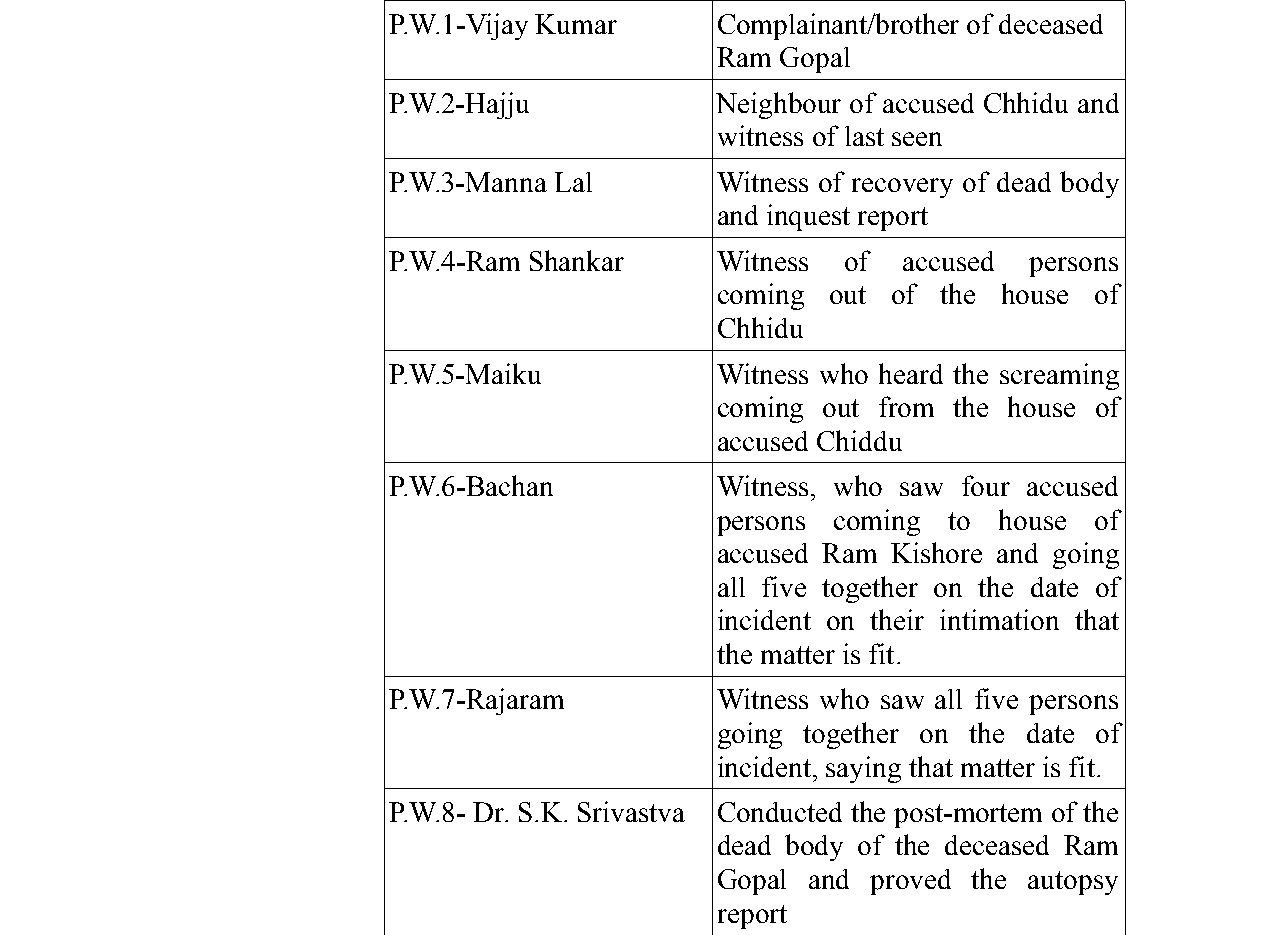
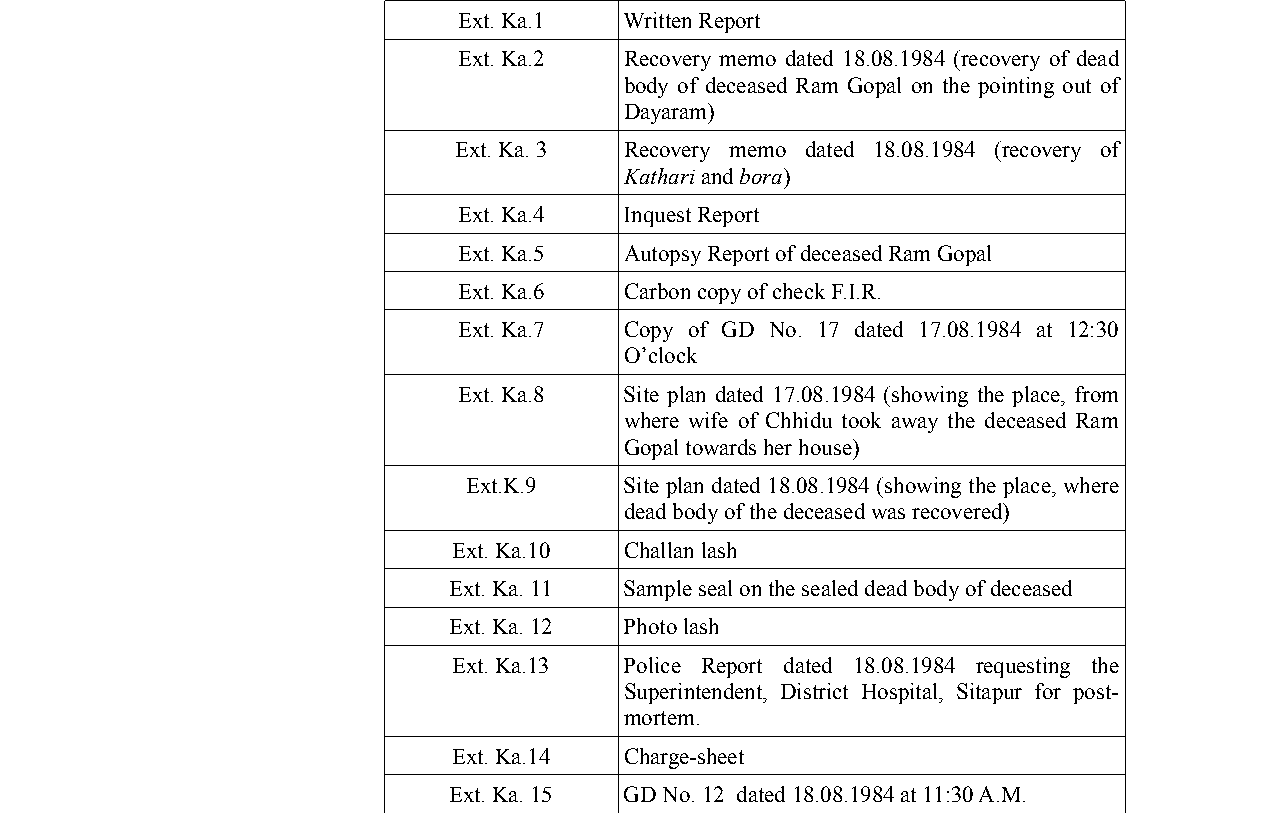
(2) The prosecution case, in short, is that complainant Vijay Kumar, had submitted a written complaint (Ext. Ka.1) at police station Sandana, district Sitapur on 17.08.1984 alleging therein that his brother Ram Gopal seemed to having a secret illicit relationship with the wife of Chhidu Chamar of his village, because of which, Chhidu Chamar had beaten his wife. On 14.08.1984, at about 06:00 in the evening, wife of Chhidu took away his brother Ram Gopal to her house and Hajju son of Madhaee, Rambilash son of Badri and Ramkumar son of Amrit Lal etc. of his village saw them going towards the house of Chhidu. Since then, his brother has been missing and was not found anywhere among his relatives etc. In such circumstances, it appears that Chhidu Chamar and Rohan son of Deo and wife of Chhidu have made his brother disappear with the intention of killing him. It is possible that they have killed. Report may be written and necessary action may be taken.
(3) On the basis of the aforesaid written report, F.I.R., bearing Case Crime No. 200 of 1984, under Section 364 I.P.C. was registered at police station Sandana, district Sitapur on 17.08.1984 at12:30 p.m.
(4) The investigation was entrusted to S.I. Radhey Shyam. He along with the police personnel reached to the place of incident and recorded the statements of uncle of complainant Ram Prasad, mother of complainant Kaushaliya, witness of F.I.R. Hajju, and witnesses Ram Khelawan and Ram Kumar. He, thereafter, prepared the site plan on the pointing out of complainant. On 18.08.1984, at 12:30 in the night, he apprehended accused Dayaram from his house and on his pointing out, police party along with witnesses proceeded further with accused Dayaram leading from the front. Upon reaching the house of Chhidu, accused Dayaram knocked at his door and called out Chhidu. However, on seeing the police, accused Chhidu fled by jumping over the back wall. Thereafter, Dayaram himself opened the door with his own hand and took the police party to eastern room where the dead body of Ram Gopal had been concealed. He recovered the dead body of Ram Gopal in the