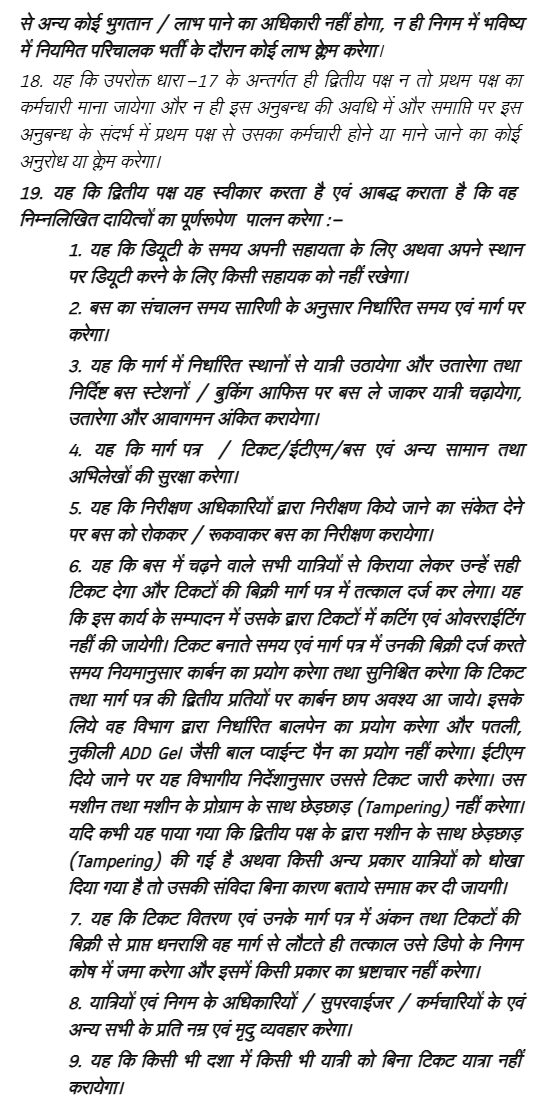
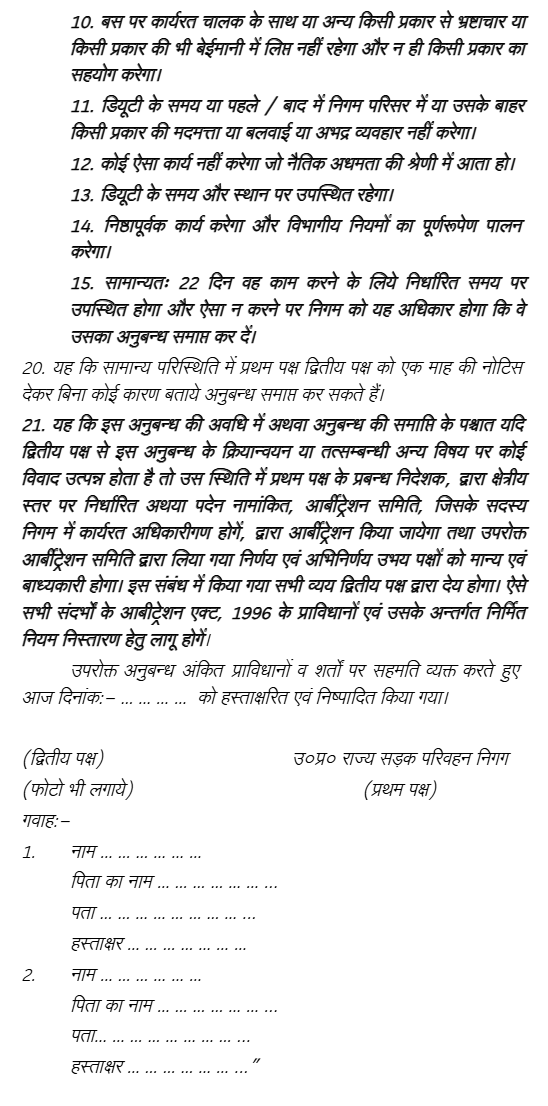
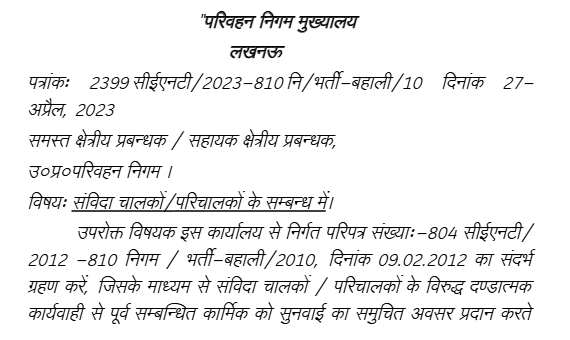
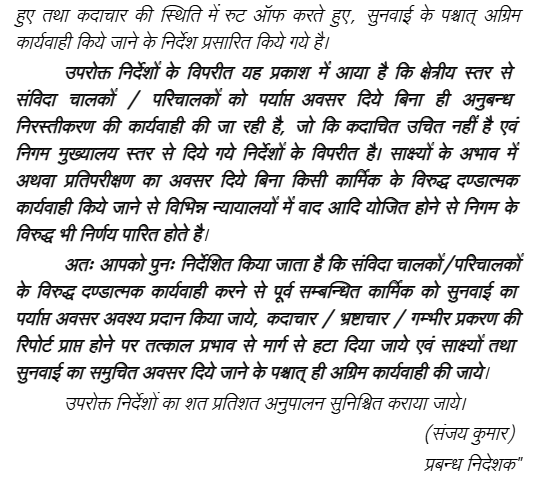
1. Challenge to termination of contractual conductors based on complaints of carrying passengers without tickets. (Para 1 , 8 )
 Back
Next 





2025 Supreme(All) 3834
HIGH COURT OF JUDICATURE AT ALLAHABAD
Saurabh Shyam Shamshery, J.
Arvind Singh - Petitioner
Versus
U.P. State Road Transport Corporation and others - Respondent
Writ –A No. - 14886 of 2022, Writ-A Nos. 20976 of 2023; 10044 of 2023; 10404 of 2023; 10869 of 2023; 11049 of 2023; 13182 of 2023; 1044 of 2020; 13516 of 2023; 1229 of 2023; 2823 of 2023; 4191 of 2023; 8586 of 2023; 7691 of 2023; 10405 of 2023; 7602 of 2023; 9625 of 2023; 10014 of 2023; 7242 of 2023; 7237 of 2023; and, 5718 of 2023
Decided On : 09-09-2025
Important Points
Contractual employees must be granted an opportunity of hearing before termination based on misconduct. Furthermore, an arbitration clause in a service contract does not absolutely bar the invocation of writ jurisdiction under Article 226 of the Constitution of India if the contract is unfair or unreasonable.
Subject
Service Law - Contractual Employment
Act Referred
Headnote
(A) Constitution of India - Article 226 - Writ jurisdiction in contractual matters - A contract of service between the State and an individual can be challenged on grounds of being unconscionable, unfair, unreasonable, or against public policy, irrespective of whether it was questioned at the time of entry into the contract - An agreement for arbitration is not an absolute bar to invoking writ jurisdiction, although the exercise of such power remains subject to judicial discretion (Paras 3, 4).
(B) Service Jurisprudence - Contractual Employment - Principles of Natural Justice - Even in the case of contractual appointees, if termination is based on grounds of misconduct, a regular inquiry or an opportunity of hearing must be provided - Termination through stigmatic orders without adhering to the principles of natural justice or relevant administrative circulars is liable to be set aside (Paras 10, 12, 14).
Facts of the case:
Contractual employees engaged as conductors were terminated from service, primarily on allegations of carrying passengers without tickets. In a significant number of cases, these terminations were executed via stigmatic orders without granting the employees an opportunity to reply. In other cases, an opportunity was provided, but employees either failed to appear or the inquiry was subsequently challenged. Administrative circulars existed which reiterated that proper opportunities of hearing must be granted to contractual appointees before any order of termination is passed.
Findings of Court:
The court found that the termination orders passed without any opportunity for a hearing were in direct violation of the principles of natural justice and the governing administrative circulars. The court observed that while contractual employees are generally bound by the terms of their agreements, the state's failure to follow its own guidelines regarding fair hearings rendered the termination orders invalid.
Issues: Whether a writ petition is maintainable despite the existence of an arbitration clause in a service contract, and whether the principles of natural justice require a hearing for contractual employees terminated on grounds of misconduct.
Ratio Decidendi: Termination of contractual employment on grounds of misconduct without a regular inquiry or an opportunity of hearing is contrary to the principles of natural justice and specific administrative directives. Such stigmatic orders must be set aside, leaving the employer the option to either conduct a fresh inquiry following due process or permit the execution of a fresh contract.
Result: Impugned orders set aside.
Legal Category Hierarchy
- administrative law
- contract law
- practice and procedure
Advocates Appeared:
For the Petitioner: Bhawesh Pratap Singh
For the Respondent: Awadhesh Kumar Saxena
Table of Contents
2. Petitioners argued termination without notice; respondents relied on contractual terms including an arbitration clause. (Para 8 , 10 , 11 , 12 , 14 )
3. State service contracts can be challenged if unconscionable; arbitration clause not an absolute bar to writ jurisdiction. (Para 2 , 3 , 4 , 5 , 6 , 7 , 11 , 12 , 13 , 14 )
4. Termination of a contractual employee on stigmatic grounds without an opportunity of hearing is liable to be set aside. (Para 12 , 14 , 15 )
5. Impugned termination orders set aside; respondents given option to conduct fresh inquiry or permit execution of fresh contract. (Para 15 , 19 )
6. Can a service contract between the State and an individual be challenged even if it was willingly accepted?
Yes, if any term is unconscionable, unfair, unreasonable, or against public policy, the contract can be challenged. (Para 3 )
7. Does an arbitration clause in a state service contract bar the invocation of writ jurisdiction?
No, an arbitration clause is not an absolute bar to invoking Article 226, though it is a matter of judicial discretion. (Para 4 , 14 )
8. Is an opportunity of hearing required before terminating a contractual employee on stigmatic grounds?
Yes, even for contractual appointees, termination on misconduct grounds requires adherence to principles of natural justice. (Para 8 , 10 , 12 , 14 )
JUDGMENT :
SAURABH SHYAM SHAMSHERY, J.
1. All petitioners before this Court were engaged on contractual basis on the post of Conductor on different dates and their respective yearly contracts were extended and as such they have worked for a substantial period, in some cases for more than 10 years.
2. Initially when Writ-A No. 14886 of 2022 was filed, a Coordinate Bench of this Court vide order dated 20.09.2022 has referred following two questions to a Full Bench:
"(i) Whether a contract of service purely governed by its terms and conditions, can be subjected to examination, even when it is not challenged and willingly accepted by the contractual employee at the time of entry into the service, and writ jurisdiction be invoked when remedy under the contract is by a specific clause for invoking arbitration?
(ii) Whether the judgment rendered by the Division Bench of this Court in Rajesh Bhardwaj and others Vs. Union of India and others reported in (2019 2 ADJ 830) lays down the law correctly or the judgment of the Division Bench of this Court in Prem Chandra Gupta Vs. State of U.P. and 4 others (Special Appeal No.104 of 2021, rendered on 14.06.2021) should be followed?”
3. Thereafter a Full Bench was constituted and referred questions were answered vide judgment dated 20.12.2024 in following manner:
“36. As a result of above discussions, the reference is answered as follows: -
Question No. 1 : The first part of the question is answered by holding that a contract of service between the State and an individual can be challenged on the ground that the contract or any term of contract is unconscionable, unfair, unreasonable or against public policy and the mere fact that it was not questioned at the time of entry into contract, would not be a bar to challenge the same.
The second part of Question No. 1 is answered by holding that notwithstanding an agreement for referring the dispute to arbitration, the writ jurisdiction can be invoked by an aggrieved party. Whether the writ should be entertained or not, would be a matter of judicial discretion to be exercised within the framework of self-imposed restrictions governing the exercise of such power by the writ court.
Question No. 2 : It is answered by holding that the judgment of this court in Rajesh Bhardwaj on the aspect of maintainability of writ petition should be read as confined to the facts of that case. The subsequent Division Bench in Prem Chand Gupta is in line with the recent developments in law relating to judicial review of administrative actions in service contract between State and its servants but its application would depend on fact of each case.”
4. Few more paragraphs of aforesaid judgment dated 20.12.2024 passed by the Full Bench, being relevant, are reproduced hereinafter:
“27. Even the Constitution Bench in Sirsi Municipality vs. Cecelia Kom Francis Tellis (1973)1 SCC 409 did not held that there is any absolute bar in entertaining writ petition in service matters arising out of non statutory contracts between the State and a private person, rather recognised that in cases of master and servant in employment of State or other public authority or body created under statute, "court have declared in appropriate cases the dismissal to be invalid if the dismissal is contrary to rules of natural justice or if the dismissal is in violation of the provisions of the statute".
28. The first principles of service jurisprudence in the sphere of contractual matters between State and individuals has succinctly been summarized in the aforesaid judgments. There is no absolute bar in entertaining the writ petition even in the matters arising out of contractual employment between State and private person but each case has to be examined on its own facts. As noted above, the dividing line between the public and private law is getting obliterated day by day and the trend is towards subjecting more and more actions of the State to the scrutiny of Article 14 unless there is absolutely no insignia