
 Back





2025 Supreme(All) 3840
HIGH COURT OF JUDICATURE AT ALLAHABAD, LUCKNOW BENCH
Saurabh Lavania, J.
X / Complainant Of Complaint Case No. 07/2024 – Revisionist
Versus
State Of U.P. Thru. Prin. Secy. Deptt. Of Home Lko. And Others – Opposite Parties
Criminal Revision No. - 808 of 2025
Decided On : 22-08-2025
Important Points
Subject
Criminal Law - Procedural Criminal Law
Act Referred
Headnote
(B) Criminal Procedure - Magistrate's Power - Discretion to treat application as complaint - Magistrate is empowered to verify the veracity of allegations before directing a police probe - Where the court is of the opinion that the allegations seem non-genuine or intended for secondary motives, it may choose not to exercise its power to order an investigation under Section 156(3) and instead initiate a prompt inquiry under Chapter XV. (Paras 16, 17)
Facts of the case:
An application under Section 156(3) of the Code of Criminal Procedure was filed by a complainant requesting an order for the registration of a first information report. The Magistrate, after perusal of the record, rejected the application for a police-led investigation and instead directed the matter to be registered as a formal complaint case. The petitioner filed a revision against this order, contending that the failure to order an investigation as sought was an error of law.
Findings of Court:
The Court held that the order passed by the Magistrate was within the scope of judicial discretion. The Court observed that the application was filed with considerable delay and lacked sufficient credibility to mandate police intervention. The Magistrate acted appropriately in choosing to pursue a complaint-based inquiry rather than ordering a police investigation.
Issues: Whether the Magistrate is mandatorily required to order registration of a first information report upon filing an application under Section 156(3) of the Code of Criminal Procedure and whether it is illegal for a Magistrate to treat such an application as a complaint case.
Ratio Decidendi: The Magistrate is not duty-bound to order an investigation in every instance under Section 156(3). The provision entails judicial discretion. When evidence is in the complainant's possession or the petition appears intended to harass or lacks prima facie substance, the Magistrate has the authority to treat the application as a complaint or reject it, ensuring that abuse of the legal process is curtailed and fair judicial discretion is exercised.
Result: Revision dismissed.
For the Revisionist : Firoz Ahmad Khan,Mohd.Anas Siddiqui
For the Opposite Party : G.A.
| Table of Content |
|---|
| 1. procedural history and factual context of the revision petition. (Para 1 , 2 , 3 , 4 , 5 , 6) |
| 2. judicial precedents defining the scope and discretionary powers of a magistrate under section 156(3) cr.p.c. (Para 7 , 8 , 9 , 10 , 11 , 12 , 13 , 14 , 15) |
| 3. magistrate's judicial authority to reject or treat an application under section 156(3) as a complaint. (Para 16 , 17) |
| 4. application of legal principles to the specific facts, noting judicial discretion and case merits. (Para 18 , 19) |
JUDGMENT :
Saurabh Lavania, J.
1. Supplementary affidavit filed today is taken on record.
2. Heard.
3. This criminal revision under Section 397/401 Cr.P.C. has been filed against the judgment and order dated 09.05.2025, passed by the Special Judge (POCSO) Act Ist, Ayodhya in Complaint Case No.07/2024 (Smt. Anjali @ Anjana Vs. Alok Gupta & Another), PS.- Kotwali Ayodhya, District- Ayodhya.
4. Vide order dated 09.05.2025, the Special Judge/POCSO Act-Ist, Ayodhya rejected the application preferred by the applicant under Section 156(3) Cr.P.C.
5. Operative portion of order dated 09.05.2025 reads as under:-
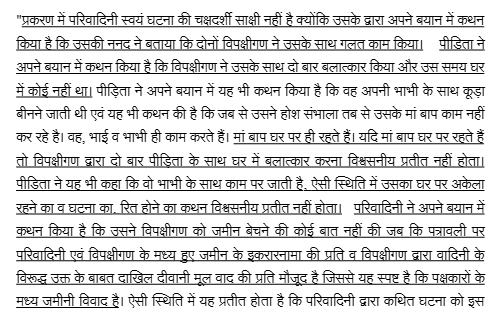
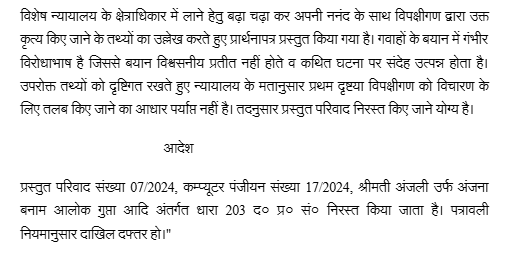
6. Considered the submissions advanced by the learned counsel for the parties and perused the record.
7. Law dealing with an application under Section 156(3) Cr.P.C. has already been settled in various pronouncements including the following judgments:-
8. Relevant paras of the judgment passed in the case of Sukhwasi vs. State of U.P. , reported in 2007 SCC OnLine All 1088; wherein this Court answered the question referred on account of difference of opinion on the issue of exercise of power under Section 156(3) Cr.P.C., are as under:-
"“Whether the Magistrate is bound to pass an order on each and every application under Section 156(3) Cr.P.C. containing allegations of commission of a cognizable offence for registration of the F.I.R. and its investigation by the police even if those allegations, prima-facie, do not appear to be genuine and do not appeal to reason, or he can exercise judicial discretion in the matter and can pass order for treating it as ‘complaint’ or to reject it in suitable cases”?
XXXXXXXXXXXXXXXXXXXXXXXXXXXXXXXXXXXXXXXXXXXX
18. It is hardly possible to infer from the aforesaid observations that the Magistrate cannot treat an application under Section 156(3) Cr.P.C. as a ‘complaint’. Even a nebulous of far fetched interpretation will not lead to that inference. The inference drawn by Hon'ble Vinod Prasad, J. is not logical.
19. The Hon'ble Judge has also referred to the case of State of Haryana v. Bhajan Lal: JT 1990 (4) SC 650 : (1992 Supp (1) SCC 335 : AIR 1992 SC 604) and has extracted the following observations:— (Paras30, 32)
“At the stage of registration of a crime or a case on the basis of the information disclosing a cognizable offence in compliance with the mandate of Section 154(1) of the Code, the concerned police officer cannot embark upon any enquiry as to whether the information, laid by the informant is reliable and genuine or otherwise and refuse to register a case on the ground that the information is not reliable or credible. On the other hand, the officer-in-charge of a police station is statutorily obliged to register a case and then to proceed with the investigation if he has reason to suspect the commission of an offence which he is empowered under Section 157 of the Code to investigate, subject to the proviso to Section 157 (as we have proposed to make a detailed discussion about the power of a police officer to the field of investigation of a cognizable offence within the ambit of Sections 156 and 157 of the Code in the issuing part of this judgment, we do not propose to deal with those sections in extenso in the present context).
In case an offence incharge of a police station refuses to exercise the jurisdiction in him and to register a case on the information of a cognizable offence reported and thereby violates the statutory duty cast upon him, the person aggrieved by such refusal can send the substan









