Back





2025 Supreme(All) 3977
IN THE HIGH COURT OF JUDICATURE AT ALLAHABAD
PRAKASH PADIA, J.
Hemant Kumar Gupta - Petitioner
Versus
State Consumer Disputes Redressal Commission - Respondent
WRIT - C No. - 27326 of 2025
Decided On : 13-08-2025
Important Points
Subject
Judicial Administration - Expunction of Adverse Remarks
Act Referred
Headnote
Facts of the case:
The petitioner, a presiding officer of a district-level forum, challenged adverse and stigmatic remarks passed against him in two separate appellate orders by the respondent commission. The petitioner contended that these remarks were made without any notice or opportunity of being heard, thereby causing irreparable damage to his professional reputation and career, as he had not previously faced such observations during his tenure.
Findings of Court:
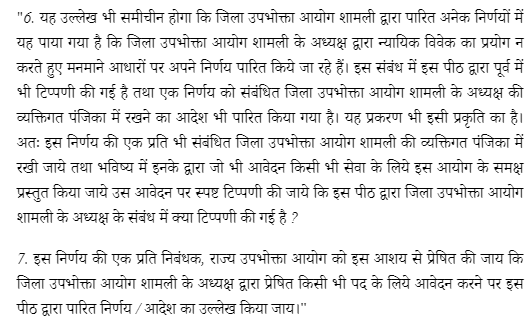
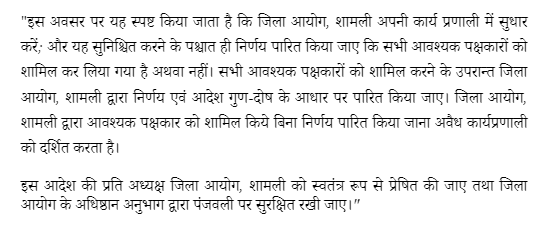
The court held that the remarks were made without adherence to the principles of natural justice. It observed that the superior forum should have, if necessary, initiated proceedings on the administrative side rather than casting public aspersions in judicial orders. The court found that the impugned remarks were not essential for the final adjudication of the appeals.
Issues: The main issues were whether a superior judicial or quasi-judicial body can pass adverse personal remarks against a lower judicial officer without affording them an opportunity to be heard, and whether such remarks, if unwarranted, should be expunged by the High Court.
Ratio Decidendi: Governed by the principle that judicial officers must be protected from unmerited and disparaging remarks to ensure the independence of the judiciary, the court ruled that if a judicial officer's conduct is questioned, it should be addressed on the administrative side, providing an opportunity for the officer to clarify their position. Remarks that are irrelevant to the specific adjudication and likely to cause harm to personal reputation must be expunged to prevent abuse of the judicial process.
Result: Writ petition allowed; remarks expunged.
Advocate Appeared:
For the Petitioner: Aishwarya Pratap Shahi, Nipun Singh.
| Table of Content |
|---|
| 1. judicial restraint and composure are essential for maintaining the independence and dignity of the judiciary. (Para 1 , 2 , 3 , 4 , 5) |
| 2. petitioner seeks expunction of disparaging remarks passed by the appellate commission without prior notice. (Para 6 , 7 , 8 , 9 , 10 , 11 , 12 , 13) |
| 3. superior courts must not pass disparaging remarks against subordinate judicial officers without providing a fair opportunity to be heard. (Para 14 , 15 , 16 , 17 , 18 , 19 , 20 , 21 , 22 , 23 , 24 , 25 , 26 , 27 , 28 , 29 , 30) |
| 4. unjustified adverse remarks against judicial officers are expunged in the interest of justice and fairness. (Para 31 , 32 , 33) |
JUDGMENT :
1. Justice Cardozo of course said: [ The Nature of the Judicial Process, Benjamin N. Cardozo pp. 168-69]
The great tides and currents which engulf the rest of men, do not turn aside in their course, and pass judges by. We like to figure to ourselves the processes of justice as coldly objective and impersonal. The law, conceived of as a real existence, dwelling apart and alone, speaks, through the voices of priests and ministers, the words which they have no choice except to utter. That is an ideal of objective truth toward which every system of jurisprudence tends.... It has a lofty sound; it is well and finely said; but it can never be more than partly true.
2. It is true that the judges are flesh and blood mortals with individual personalities and with normal human traits. Still what remains essential in judging, Justice Felix Frankfurter said: [ The Judiciary and Constitutional Politics — Views from the Bench, Mark W. Cannon and David M.O.'s Brien p. 27]
First and foremost, humility and an understanding of the range of the problems and (one's) own inadequacy in dealing with them, disinterestedness ... and allegiance to nothing except the effort to find (that) pass through precedent, through policy, through history, through (one's) own gifts of insights to the best judgment that a poor fallible creature can arrive at in that most difficult of all tasks, the adjudication between man and man, between man and state, through reason called law.
3. Judicial restraint and discipline are as necessary to the orderly administration of justice as they are to the effectiveness of the army. The duty of restraint, this humility of function should be constant theme of our judges. This quality in decision making is as much necessary for judges to command respect as to protect the independence of the judiciary. Judicial restraint in this regard might better be called judicial respect, that is, respect by the judiciary. Respect to those who come before the court as well to other co-ordinate branches of the State, the executive and the legislature. There must be mutual respect. When these qualities fail or when litigants and public believe that the judge has failed in these qualities, it will be neither good for the judge nor for the judicial process.
4. The Judge's Bench is a seat of power. Not only do judges have power to make binding decision, their decisions legitimate the use of power by other officials. The judges have the absolute and unchallengeable control of the court domain. But they cannot misuse their authority by intemperate comments, undignified banter or scathing criticism of counsel, parties or witnesses. We concede that the court has the inherent power to act freely upon its own conviction on any matter coming before it for adjudication, but it is a general principle of the highest importance to the proper administration of justice that derogatory remarks ought not to be made against persons or authorities whose conduct comes into consideration unless it is absolutely necessary for the decision of the case to animadvert on their conduct.
5. The aforesaid observations (Paragraph-3 & 4) of this judgment are made by the Hon'ble Apex Court in the case of A.M. Mathur vs. Pramod Kumar Gupta reported in (1990) 2 SCC 533.
6. Heard Shri Nipun Singh along-with Shri Aishwarya Prat