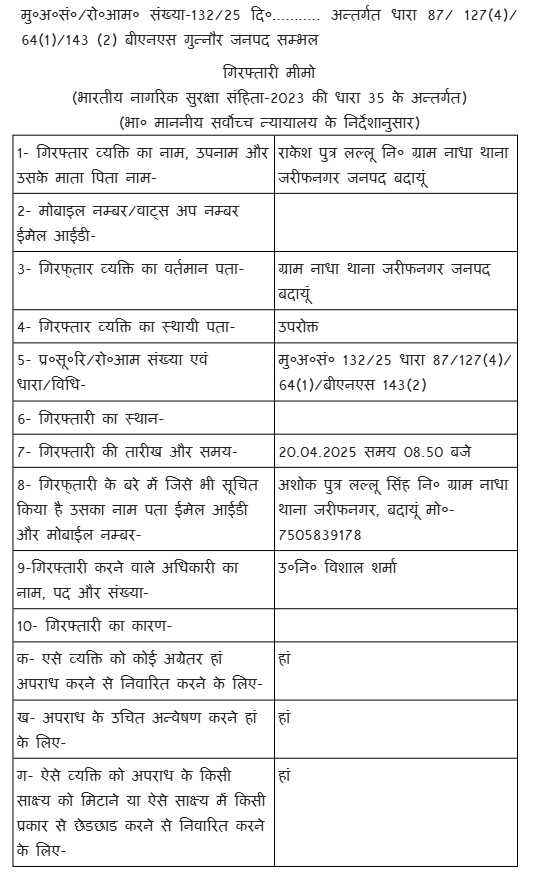
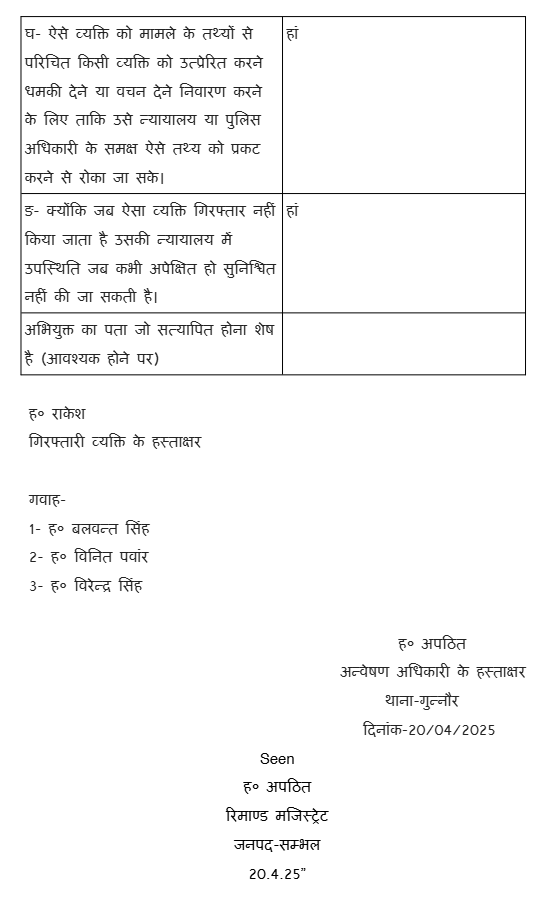
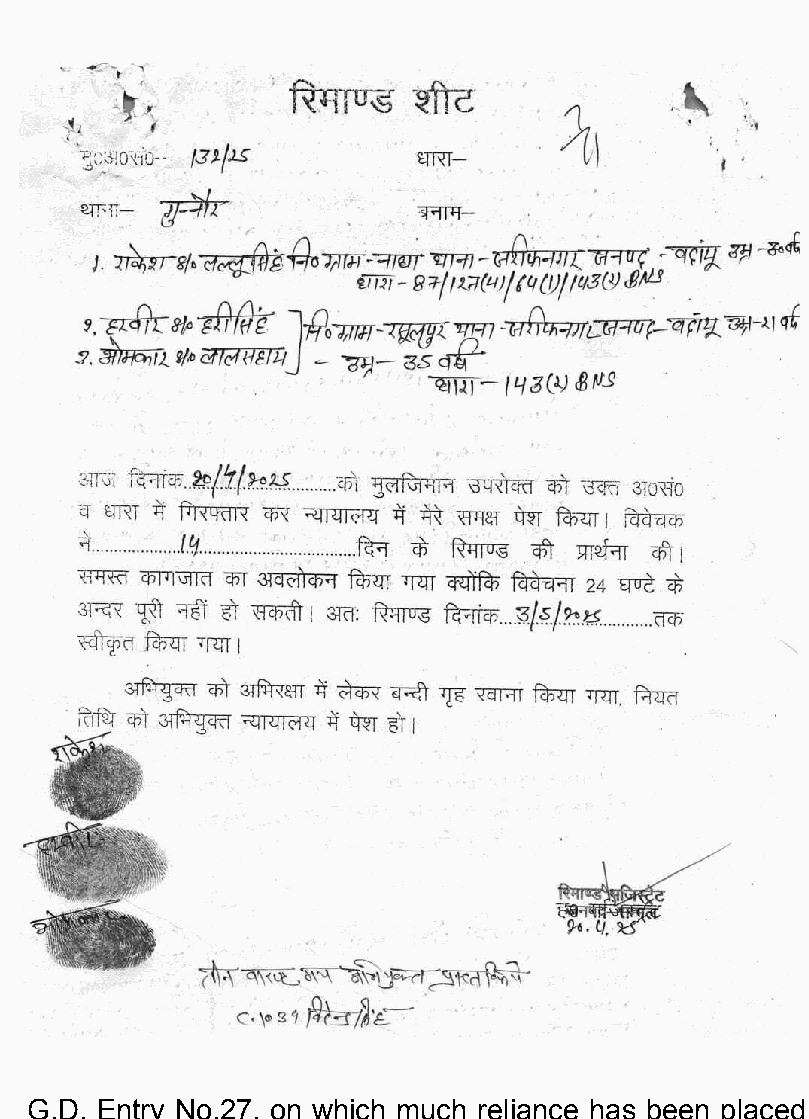
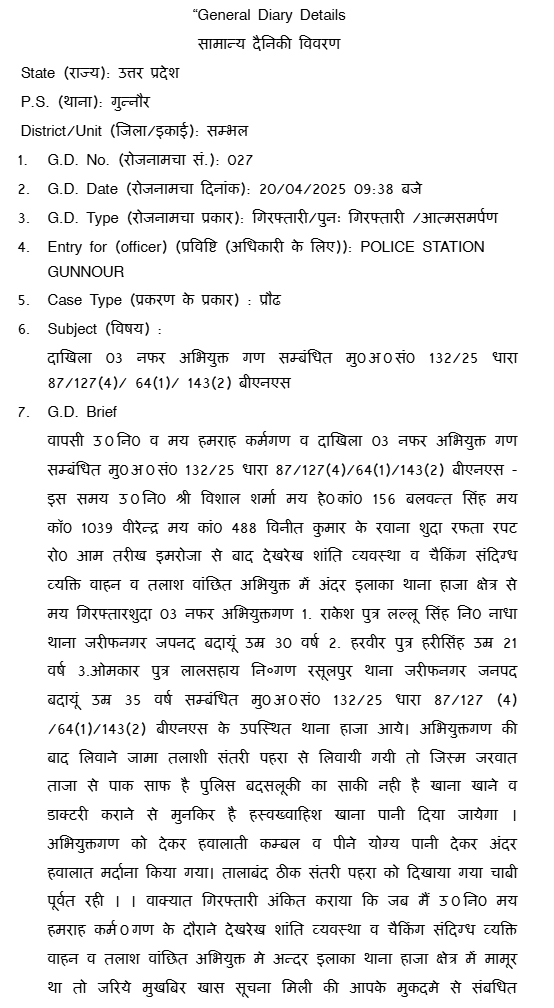
1. Petition challenging remand order in a crime involving sections of BNS, 2023, on ground of illegal arrest. (Para 1 , 2 , 5 )
 Back
Next 


2026 Supreme(All) 1205
HIGH COURT OF JUDICATURE AT ALLAHABAD
J.J. Munir, Tarun Saxena, JJ.
Rakesh - Petitioner
Versus
State of U.P. and others - Respondents
Criminal Misc. Writ petition No. - 25626 of 2025
Decided On : 27-07-2026
Advocates Appeared:
For the Petitioner: Dileep Kumar Shukla, Shikhar Neelkanth
For the Respondent: G.A.
For the Petitioner: Dileep Kumar Shukla, Shikhar Neelkanth
For the Respondent: G.A.
Non-communication of specific grounds of arrest in writing, as mandated by Article 22(1) of the Constitution, vitiates the arrest and subsequent remand orders, regardless of the gravity of the offense or filing of a charge-sheet, rendering the detention illegal.
Headnote:(A) Constitution of India - Articles 21 and 22(1); Bharatiya Nagarik Suraksha Sanhita, 2023 (BNSS) - Section 47 - Communication of grounds of arrest - Requirement to inform an arrested person of the grounds for arrest "as soon as may be" is a mandatory constitutional safeguard and a fundamental right, not a mere procedural formality (Paras 18, 19, 21) - The purpose is to enable the arrestee to effectively defend themselves, consult legal counsel, and oppose custodial remand - Grounds of arrest must be communicated in writing and in a language the arrestee understands to be meaningful (Paras 19, 21) - Significant distinction exists between "reasons for arrest" (general formal parameters such as preventing further offences or tampering with evidence) and "grounds of arrest" (specific, personal facts necessitating the arrest of that particular individual) - Non-compliance with Article 22(1) vitiates the arrest, rendering subsequent remand orders illegal and the detention void, regardless of the gravity of allegations or the subsequent filing of a charge-sheet (Paras 19, 21).
(B) Duties of Remand Magistrate - It is the duty of the Magistrate, upon the production of an arrested person, to ascertain whether the mandatory requirements of Article 22(1) and other statutory safeguards have been complied with - A remand order passed mechanically on a printed proforma without such verification is unconstitutional and illegal (Paras 21, 35).
Facts of the case:
A petitioner was arrested in connection with offences under the Bharatiya Nyaya Sanhita. He challenged the remand order on the basis that he was not informed of the specific grounds of his arrest. The arrest memo contained only generic check-boxes for "reasons for arrest," and the case diary entry was vague. The Remand Magistrate passed the order of judicial custody on a printed proforma without recording satisfaction regarding the communication of the grounds of arrest.
Findings of Court:
The court found that the arrest memo did not specify the "grounds of arrest" but only provided generic "reasons." The case diary failed to show a contemporaneous record of the grounds being communicated. The Remand Magistrate acted in a routine and mechanical manner by using a printed proforma without verifying compliance with Article 22(1) of the Constitution.
Issues: Whether the failure to communicate the specific grounds of arrest in writing renders the arrest and the subsequent remand order illegal under Article 22(1) of the Constitution.
Ratio Decidendi: The court ruled that the right to be informed of the grounds of arrest is indispensable for the protection of personal liberty. Since "reasons for arrest" (general) cannot be equated with "grounds of arrest" (specific), and because the written communication was absent, the fundamental right under Article 22(1) was violated. This violation vitiates the arrest itself, and consequently, any remand order based on an illegal arrest is void.
Result: Writ petition allowed; impugned order of remand quashed; petitioner to be released from custody upon furnishing a bond.
Legal Category Hierarchy
- constitutional law
- practice and procedure
- crime and sentencing
Table of Contents
2. Petitioner: arrest illegal as grounds not communicated. State: arrest valid, serious allegations, oral communication through GD entry sufficed. (Para 6 , 7 , 9 , 10 , 11 )
3. Arrest memo and GD entry did not contain grounds of arrest as distinguished from reasons, violating Article 22(1). Remand order was mechanical. (Para 14 , 15 , 16 , 32 , 33 , 34 , 35 )
4. Non-compliance with Article 22(1) of the Constitution vitiates arrest and subsequent remand; filing of charge-sheet does not validate the illegality. (Para 21 , 23 , 25 , 26 )
5. Writ petition allowed. Remand order quashed. Petitioner to be released on furnishing a bond under Section 91 BNSS. (Para 36 )
6. What is the constitutional mandate under Article 22(1) regarding grounds of arrest?
Every arrested person must be informed of the grounds of arrest as soon as may be. This is a fundamental right, and non-compliance renders the arrest illegal. (Para 18 , 19 , 20 , 21 )
7. What is the distinction between 'reasons for arrest' and 'grounds of arrest'?
Reasons for arrest are general formal parameters applicable to any arrest. Grounds of arrest are personal to the accused, containing specific basic facts necessitating the arrest. (Para 37 )
8. What is the duty of a magistrate when an arrested person is produced for remand?
It is the magistrate's duty to ascertain whether compliance with Article 22(1) has been made. Failure to do so renders the remand order illegal. (Para 25 )
9. Does filing of a charge-sheet validate an arrest that was illegal due to violation of Article 22(1)?
No. Filing a charge-sheet does not validate an arrest that is unconstitutional and violative of Articles 21 and 22(1) of the Constitution. (Para 21 )
10. What is the mode of communicating grounds of arrest to satisfy Article 22(1)?
The grounds must be communicated in writing in a language the arrested person understands to effectively enable him to defend himself and seek bail. (Para 19 )
JUDGMENT :
J.J. Munir, J.
1. This writ petition has been instituted by Rakesh with a prayer that the order of remand dated 20.04.2025 passed by the Remand Magistrate in Case Crime No. 0132 of 2025, under Sections 87 , 127(4), 64(1) and 143(2) of the Bharatiya Nyaya Sanhita, 2023 (for short, ‘BNS’), Police Station Gunnour, District Sambhal, be quashed. He seeks a direction in the nature of mandamus ordering the respondents to release the petitioner from custody, after quashing of the remand order authorizing his detention pending investigation and/ or trial in the said crime.
2. A First Information Report (‘FIR’ for short) was lodged by one Umar Ahmad son of Sharafat Khan on 18.04.2025 at Police Station Gunnour, District Sambhal with a case that the informant/ respondent no.4 was a resident of Village Patti Kurki, P.S. Anwala, District Bareilly. On 03.04.2025, his wife ‘X’, aged about 36 years, was taken away by blandishment by the petitioner Rakesh. The petitioner later kept the victim in confinement. On 14.04.2025, the fourth respondent’s wife was found in a disoriented condition in Village Bairpur, P.S. Junavai. The fourth respondent requested necessary legal action in the matter.
3. We must remark at the outset before proceeding further with the petitioner’s case that this petition has nothing to do with the exercise of the right of bail by the petitioner and, a fortiori, if the allegations of the prosecution carried in the FIR, or those that have surfaced during investigation, are true or unreliable and false. The office of this petition is limited to the question, if the petitioner has been validly arrested in accordance with the mandate of Article 22(1) of the Constitution read with the statutory safeguards engrafted in the Bharatiya Nagarik Suraksha Sanhita, 2023 (for short, ‘BNSS’).
4. The point which the petitioner moots here is, if the petitioner’s arrest is illegal at the inception in the sense that it has been effected in violation of his fundamental right guaranteed under Article 22(1) of the Constitution, no matter what the charge is or the gravity thereof, he is entitled to regain his liberty by an order quashing his remand in connection with the crime and his arrest as well. It hardly need be said that in the event, the petitioner’s stand is vindicated and his arrest and remand declared illegal, he would be entitled to the restoration of his liberty. This is the essence of this petition and the scope of the challenge that the petitioner mounts in this case to his detention in the crime under reference.
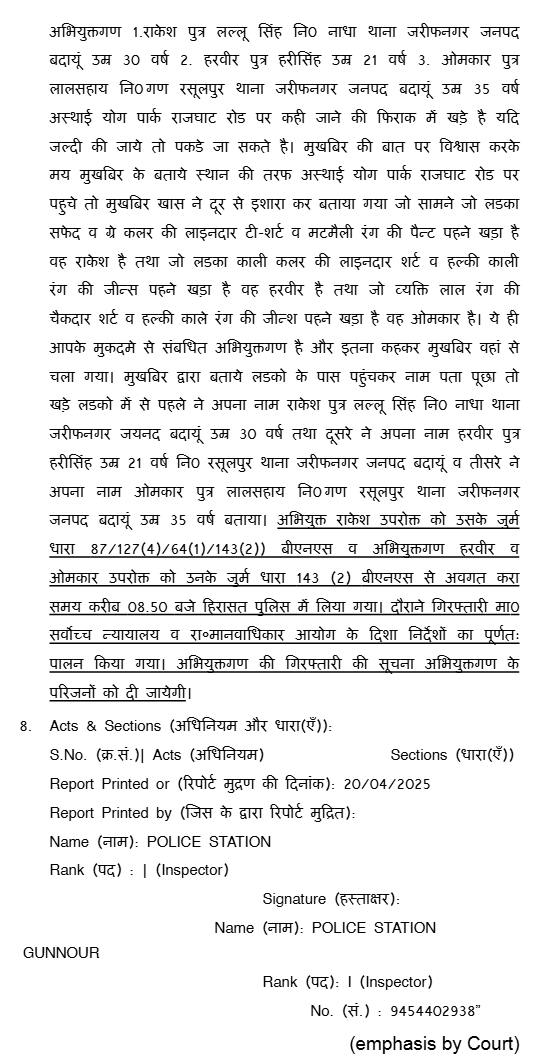
5. The case of the petitioner is that the incident is said to have taken place on 03.04.2025, regarding which the FIR was lodged on 18.04.2025 with Police Station Gunnour, District Sambhal. After registration of the crime, the petitioner was shown to have been arrested on 20.04.2025 at 08.50 hours. The attention of this Court has been drawn to the arrest memo, that is on record and to which we would allude later in this judgment. The petitioner was taken into custody by the Police and produced before the Remand Magistrate on 20.04.2025. The Remand Magistrate, in a routine and mechanical manner, passed a remand order on a printed proforma carrying blanks that were filled up without application of mind and remanded him to judicial custody in the crime. This order too is on record and is one made on 20.04.2025. Our attention again has been drawn to this order and we would allude to this too later in this judgment.
6. It is the petitioner’s case that while remanding the petitioner to judicial custody, the learned Remand Magistrate failed to record any satisfaction regarding due compliance of the Police’s obligation of communicating the petitioner with the grounds of his arrest, a fundamental right that flows from Article 22(1) of the Constitution. It is specifically averred by the petitioner in paragraph no. 17 of the writ petition that he was not informed of the grounds of arrest, either orally or in writing, a fact appar