1. Murder trial — conviction under Section 302 IPC — appeal against conviction — circumstantial evidence case — triple murder of wife and children. (Para 1 , 2 , 3 , 7 , 8 , 9 , 14 )
 Back
Next 





2026 Supreme(All) 1285
HIGH COURT OF JUDICATURE AT ALLAHABAD
J.J. MUNIR, SANJIV KUMAR, JJ.
Babu - Appellant
Versus
State of U.P. – Respondent
Criminal Appeal No. 1952 of 2022
Decided On : 13-07-2026
Important Points
Conviction based on circumstantial evidence requires a complete chain of evidence. Recovery under Section 27 of the Evidence Act must strictly follow procedural requirements for admissibility, and the burden under Section 106 of the Evidence Act cannot replace the prosecution's primary burden of proof under Section 101.
Subject
Criminal Law - Murder
Act Referred
Headnote
(A) Indian Penal Code, 1860 - Section 302 - Indian Evidence Act, 1872 - Sections 27, 101, and 106 - Circumstantial evidence - Recovery of weapon and blood-stained clothes - Burden of proof - Requirement of a complete chain of evidence for conviction.
(B) Burden of proof - Section 106 Evidence Act - The mere fact that a member of a joint family is absent while others are found murdered does not automatically shift the burden of proof to the surviving member - The prosecution must first establish incriminating circumstances before invoking the special knowledge of the accused to bridge gaps in the evidence. (Paras 30-31)
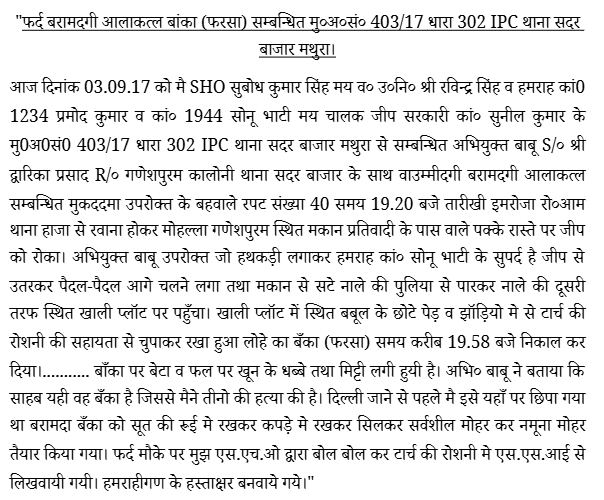
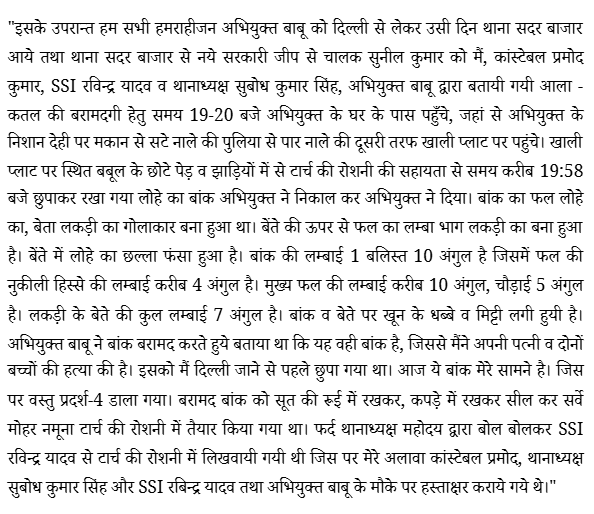
(C) Admissibility of recovery under Section 27 Evidence Act - Evidence of recovery of a weapon is inadmissible if the disclosure statement was not recorded in the presence of independent witnesses and the procedural requirement of drawing a two-part panchnama (disclosure at the station, followed by recovery at the site) was not followed. (Paras 35-39)
(D) Motive in circumstantial evidence - While the absence of motive is not always fatal to the prosecution, it becomes a significant factor weighing in favor of the accused when the chain of circumstantial evidence is incomplete and does not exclude other hypotheses of innocence. (Paras 41-42)
Facts of the case:
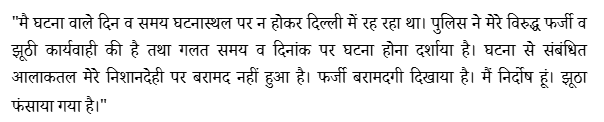
The appellant was convicted for the murder of his wife and two children. The prosecution's case rested entirely on circumstantial evidence, specifically the appellant's absence from the home during the crime, the alleged recovery of blood-stained clothes from his person upon arrest in another city, and the recovery of the murder weapon at his instance. The appellant pleaded alibi, testifying that he had been working in another city and had not visited his home for several days prior to the incident.
Findings of Court:
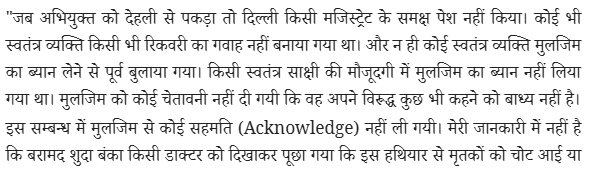
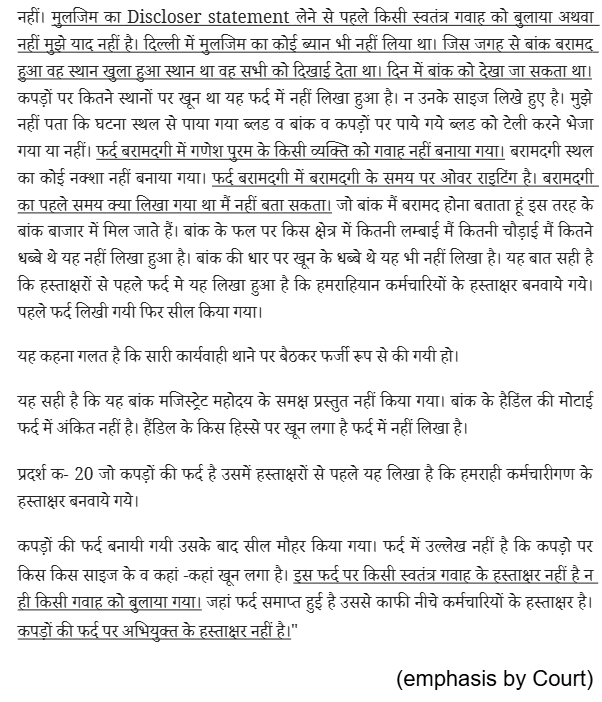
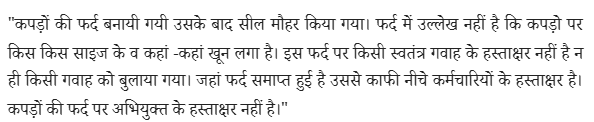
The recovery of blood-stained clothes was deemed unreliable as the recovery memo was unsigned by the accused and lacked independent witnesses. The recovery of the weapon failed to meet statutory requirements under Section 27 of the Evidence Act due to a lack of prior recorded disclosure and the fact that the weapon was recovered from a public open space. Additionally, the testimony of a neighbor supported the appellant's claim of absence from the home, and the total absence of motive further weakened the prosecution's case.
Issues: Whether the circumstantial evidence, including the contested recoveries and the application of Section 106 of the Evidence Act, formed a complete and unbroken chain sufficient to prove the guilt of the accused beyond reasonable doubt.
Ratio Decidendi: To convict on circumstantial evidence, the prosecution must establish a chain of events so complete as to leave no reasonable ground for a conclusion consistent with the innocence of the accused. Failure to adhere to the procedural mandates of Section 27 of the Evidence Act for recoveries, combined with the lack of established motive and supporting evidence for an alibi, renders the prosecution's case insufficient for conviction.
Result: Appeal allowed, set aside the impugned judgment and order, and acquitted the appellant.
Legal Category Hierarchy
- crime and sentencing
- practice and procedure
Advocates:
Petitioner: Abhishek Mayank , Apsara , Arbaz Danish , Kartikey Singh , Shashikala Mani Tripathi and Upendra Kumar Pushkar
Respondent: G.A.
Table of Contents
2. Prosecution: circumstantial evidence, recovery of weapon and blood-stained clothes, absence of explanation. Defence: alibi, unreliable recoveries, no motive. (Para 30 , 31 , 32 , 34 , 43 )
3. Recovery of weapon and clothes unreliable; no proper Section 27 compliance; absence of motive; alibi supported; chain of circumstances incomplete. (Para 17 , 30 , 32 , 33 , 38 , 39 , 40 , 41 , 43 , 44 )
4. In circumstantial evidence cases, prosecution must prove complete chain consistent only with guilt; recovery under Section 27 requires proper panchnama; absence of motive weighs in accused's favour. (Para 17 , 37 , 38 , 39 , 41 )
5. Appeal allowed; conviction set aside; appellant acquitted and ordered to be released forthwith; personal bond required under BNSS. (Para 45 , 46 , 47 )
6. What are the requirements for admissibility of recovery evidence under Section 27 of the Evidence Act?
The recovery must be preceded by a disclosure statement recorded in the presence of independent witnesses at the police station, followed by recovery in their presence. Failure to comply renders the evidence inadmissible. (Para 37 , 38 )
7. In a case based on circumstantial evidence, does absence of motive weigh in favour of the accused?
Yes, absence of motive is a factor that weighs in favour of the accused when the chain of circumstances is not complete. It cannot be the sole ground for acquittal but weakens the prosecution case. (Para 41 )
8. What is the standard of proof in a case based entirely on circumstantial evidence?
The prosecution must establish all circumstances beyond reasonable doubt, which must form a complete chain consistent only with the guilt of the accused, excluding every other hypothesis. (Para 17 )
9. Is the mere absence of the accused from the house where murder occurred an incriminating circumstance?
No, mere absence is not itself an incriminating circumstance unless coupled with other evidence showing complicity. The prosecution must prove other conduct indicating guilt. (Para 31 )
JUDGMENT :
J.J. Munir, J.
1. This is an appeal by the convict Babu, who has been tried and convicted by Mr. Anil Kumar Pandey, the then Additional Sessions Judge, Court No.01, Mathura vide judgment and order dated 25.01.2022 passed in Sessions Trial No. 817 of 2017 on a charge of murder punishable under Section 302 of the Indian Penal Code, 1860 (for short, 'IPC') and sentenced vide order dated 27.01.2022 to imprisonment for life together with a fine in the sum of Rs.30,000/-. In default, the convict has been ordered to suffer six months of additional imprisonment.
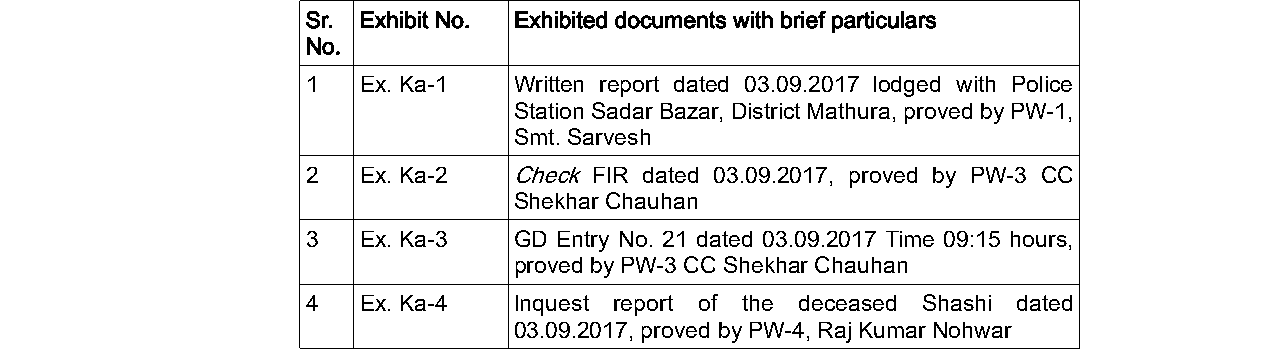
2. Proceedings leading to the appellant’s arraignment and trial commenced on the basis of a written report dated 03.09.2017 lodged with Police Station Sadar Bazar, District Mathura at 9.15 a.m. by Smt. Sarvesh wife of Radhey Shyam, an aunt of the appellant, saying that she was a resident of the place near Radha Kishan Dham, Mathura and that her nephew, Babu son of Dwarka Prasad was a resident of Ganeshpuram Colony, P.S. Sadar Bazar (the appellant). She had gone over to the appellant’s house on 03.09.2017 in the morning hours in connection with some personal work, when she saw that the appellant Babu’s wife Shashi and both his sons were lying dead in their house. The appellant was not there. It was also reported that all three had been done to death with some sharp edged weapon. The informant requested investigation and necessary action in the matter. A copy of the written report is on record and marked as Ex. Ka-1.
3. On the basis of the aforesaid written report, a check First Information Report (for short, 'FIR') was registered on 03.09.2017 at 9.15 a.m. vide G.D. Entry No. 21, giving rise to Crime No.403 of 2017, under Section 302 IPC, P.S. Sadar Bazar, District Mathura. The check FIR is on record and marked as Ex. Ka-2. A copy of the relevant G.D. Entry No.21 is also on record and marked as Ex. Ka-3.
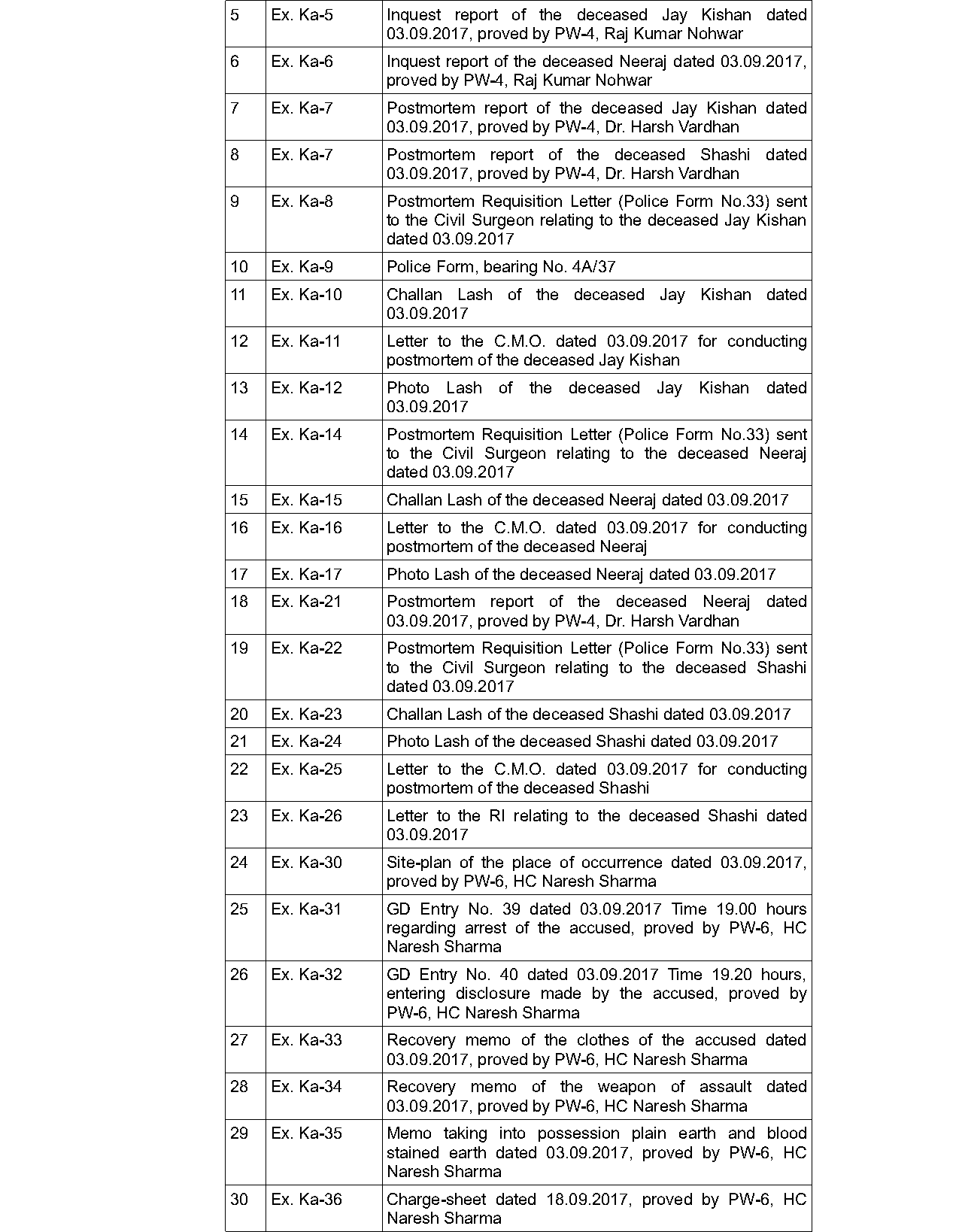
4. Here, it must be noted that during trial, apart from the original written report, marked as Ex. Ka-1, two photostat copies of the written information dated 03.09.2017 were also placed on record and mistakenly marked as Exhibits Ka-19 and Ka-28. Likewise, two photostat copies of the check FIR, in addition to the one already marked as Ex. Ka-2, were also placed on record and marked as Ex. Ka-18 and Ka-27. In addition to the extract of the G.D. Entry, that was proved and marked as Ex. Ka-3, three photostat copies of the same were placed on record and marked as Ex. Ka-13, Ka-20 and Ka-29. These Exhibits Ka-19, Ka-28, Ka-18, Ka-27, Ka-13, Ka-20 and Ka-29 are duplication of documents, which the learned Sessions Judge too has noticed to be superfluous documents, that were mistakenly marked as Exhibits. These were, therefore, ignored by the learned Trial Judge. We have also looked into the record and find that indeed these documents, which are duplicates and superfluous, were marked as exhibits by mistake. We also, therefore, ignore them.
5. Consequent upon registration of the crime, the Police proceeded with the investigation and inquest for the deceased Smt. Shashi commenced on 03.07.2017 at 10 a.m. ending at 12.15 p.m. Likewise, inquest for the deceased Jay Kishan also commenced on the same day at 10 a.m. ending at 12.15 p.m. Inquest for the deceased Neeraj commenced on 03.09.2017 at 10 a.m. ending at 1.00 p.m. The inquest report relating to Smt. Shashi is on record as Ex. Ka-4, that relating to Jay Kishan as Ex. Ka-5 and the one relating to the deceased Neeraj as Ex. Ka-6.
6. Autopsy on the cadavers of the three deceaseds was held on 03.09.2017 at 6 p.m. Smt. Shashi sustained six incised wounds and an abrasion. The cause of death opined was shock and haemorrhage as a result of ante-mortem injuries. The autopsy report is on record as Ex. Ka-7. The autopsy report relating to the deceased Jay Kishan shows that the deceased sustained as many as fourteen incised wounds and the cause of death indicated is shock and haemorrhage as a result of ante- mortem injuries. This autopsy rep