1. Appeal against conviction under Sections 302, 201 IPC — Wife's murder and concealment of body — Evidence circumstantial — Decomposed skeleton recovered. (Para 1 , 2 , 3 , 4 , 5 , 6 , 7 , 8 , 9 , 10 , 11 , 12 , 13 )
 Back
Next 


2026 Supreme(All) 1309
HIGH COURT OF JUDICATURE AT ALLAHABAD, LUCKNOW
Rajnish Kumar, Babita Rani, JJ.
Pawan Kumar - Appellant
Versus
State of U.P. - Respondent
Jail Appeal No. - 774 of 2016
Decided On : 08-07-2026
Advocates Appeared:
For the Appellant : Pawan Kumar Pandey, Purnima Singh, Shailendra Singh Rajawat, Smriti
For the Respondent: G.A.
For the Appellant : Pawan Kumar Pandey, Purnima Singh, Shailendra Singh Rajawat, Smriti
For the Respondent: G.A.
In cases of circumstantial evidence, conviction is sustainable if the prosecution establishes a complete chain of events consistent only with the accused's guilt, corroborated by relevant subsequent conduct under Section 8 and discoveries made under Section 27 of the Indian Evidence Act.
Headnote:(A) Indian Penal Code, 1860 - Sections 302 and 201 / Indian Evidence Act, 1872 - Sections 8 and 27 / Code of Criminal Procedure, 1973 - Section 374(2) - Conviction for murder and causing disappearance of evidence - Case based on circumstantial evidence - Prosecution must prove the chain of circumstances such that it leads to the irresistible conclusion of the guilt of the accused - "Five golden principles" of proof in circumstantial cases require that: (1) circumstances from which conclusion of guilt is drawn should be fully established; (2) established facts should be consistent only with the hypothesis of guilt; (3) circumstances should be of a conclusive nature; (4) they should exclude every possible hypothesis except the one to be proved; and (5) there must be a chain of evidence so complete as not to leave any reasonable ground for the conclusion consistent with the innocence of the accused (Paras 22-25).
(B) Indian Evidence Act, 1872 - Section 8 - Relevance of conduct - Conduct of a party, either previous or subsequent to the commission of a crime, is relevant if such conduct influences or is influenced by a fact in issue - Absconding after the occurrence and filing a false report to mislead the investigation constitutes relevant subsequent conduct providing a close nexus to the fact in issue (Paras 49-53).
(C) Indian Evidence Act, 1872 - Section 27 - Discovery of fact - Information received from an accused in police custody that leads to the discovery of a material object (e.g., a spade used for burial) is admissible as a relevant fact, provided the discovery is deposed to in court (Paras 56-58).
(D) Evidence - Reliability of witnesses - Conviction can be based on the testimony of a single reliable witness, even if that witness is a related party, provided the testimony is trustworthy - Extra-judicial confessions, when corroborated by the recovery of material objects and consistent conduct, lend weight to the prosecution's case (Paras 55, 61-63).
Facts of the case:
The deceased went missing from her home. The husband initially informed the father-in-law of her disappearance and later lodged a non-cognizable report alleging she had eloped with another person due to illicit relations. Subsequently, a decomposed skeleton was recovered from a ditch near a pond close to the husband's house. Medical evidence indicated that death occurred approximately three weeks prior to the post-mortem, aligning with the date the deceased went missing. Following his arrest, the husband disclosed the location of the spade used to dig the ditch for concealing the body, which was subsequently recovered.
Findings of Court:
The court found that the husband's suspicion of illicit relations provided a motive for the murder. The internal contradictions in the husband's reports, his act of absconding after the body's recovery was pointed out, the recovery of the body from a location near his house, and the subsequent recovery of the burial tool based on his disclosure statement formed a complete and unbroken chain of circumstances proving his guilt.
Issues: Whether the circumstantial evidence presented by the prosecution was sufficient to establish a complete chain of events that excluded any hypothesis of innocence and proved the accused's guilt beyond a reasonable doubt.
Ratio Decidendi: Where the motive is established, the conduct of the accused is incriminating (absconding and making false reports), and the recovery of the body and the weapon of concealment is linked to the accused through disclosure and physical evidence, the chain of circumstances is complete. Such evidence, meeting the "five golden principles" of circumstantial proof, justifies a conviction.
Result: Appeal dismissed.
Legal Category Hierarchy
Table of Contents
2. Appellant challenges conviction on circumstantial evidence — Prosecution asserts complete chain, motive, extra-judicial confession, and recovery — Both sides dispute sufficiency and reliability of evidence. (Para 15 , 16 , 17 , 18 , 19 )
3. Court analyzed chain of circumstances: motive, disappearance, NCR, concealment, recovery, and conduct — Found prosecution case complete, corroborating medical and inquest evidence, and affirmed conviction. (Para 38 , 39 , 40 , 41 , 42 , 43 , 44 , 45 , 46 , 48 , 49 , 50 , 51 , 52 , 53 , 54 , 55 , 56 , 57 , 58 , 59 , 60 , 61 , 62 , 63 , 64 )
4. In circumstantial evidence cases, prosecution must prove complete chain of circumstances excluding every hypothesis except guilt; conduct of accused is relevant under Section 8 Evidence Act. (Para 22 , 23 , 24 , 25 , 49 , 50 , 51 , 52 , 53 )
5. Appeal dismissed; conviction and sentence under Sections 302 and 201 IPC upheld; trial court record transmitted. (Para 65 , 66 , 67 )
6. What are the five golden principles for proving a case based on circumstantial evidence?
The prosecution must establish all circumstances fully, consistent only with guilt, conclusive in nature, excluding every hypothesis but guilt, and forming a complete chain leaving no reasonable ground for innocence. (Para 22 )
7. Is the conduct of an accused after the incident relevant evidence in a criminal trial?
Yes, under Section 8 of the Evidence Act, previous or subsequent conduct, including absconding and concealment of evidence, is relevant if it has a close nexus with a fact in issue. (Para 49 , 50 , 51 , 52 , 53 )
8. Can a conviction be based solely on the testimony of a related witness?
Yes, if the witness is wholly reliable, conviction may rest on their sole testimony; there is no absolute rule requiring corroboration by independent witnesses. (Para 60 , 61 , 62 , 63 )
9. What is the evidentiary value of an extra-judicial confession and recovery under Section 27 Evidence Act?
Extra-judicial confession is admissible; recovery of an object pursuant to a disclosure statement is a relevant fact, even if the confession itself to police is barred under Section 26. (Para 54 , 55 , 56 , 57 , 58 )
10. When should the benefit of doubt be given to an accused in a criminal appeal?
If two reasonable views are possible on evidence, one favoring guilt and the other innocence, the view favoring the accused must be adopted; but evidence that is ex facie trustworthy should not be rejected on fanciful grounds. (Para 59 )
JUDGMENT :
Rajnish Kumar, J.
(1) This jail appeal under Section 374 (2) of the Code of Criminal Procedure, 1973 (here-in-after referred to as “Cr.P.C.”) has been filed by convict/appellant, Pawan Kumar, assailing the judgment and order dated 27.05.2016 passed by Additional Sessions Judge, Court No.9, Hardoi, in Sessions Trial No. 344 of 2014; State Versus Pawan Kumar, emanating from Case Crime No. 572 of 2014, under Sections 302, 201 of the Indian Penal Code, 1860 (here-in-after referred to as “I.P.C.”), Police Station Pihani, District Hardoi, whereby the appellant has been convicted and sentenced as under :-
I. Under Section 302 I.P.C.; to undergo life imprisonment and fine of Rs.50,000/-. In default of payment of fine, to undergo additional one year’s simple imprisonment.
II. Under Section 201 I.P.C.; to undergo three years’ R.I. and fine of Rs.5,000/-. In default of payment of fine, to undergo additional three months’ simple imprisonment.
All the sentences have been directed to run concurrently and half of the fine on deposit, would be paid to the complainant as compensation.
FACTS
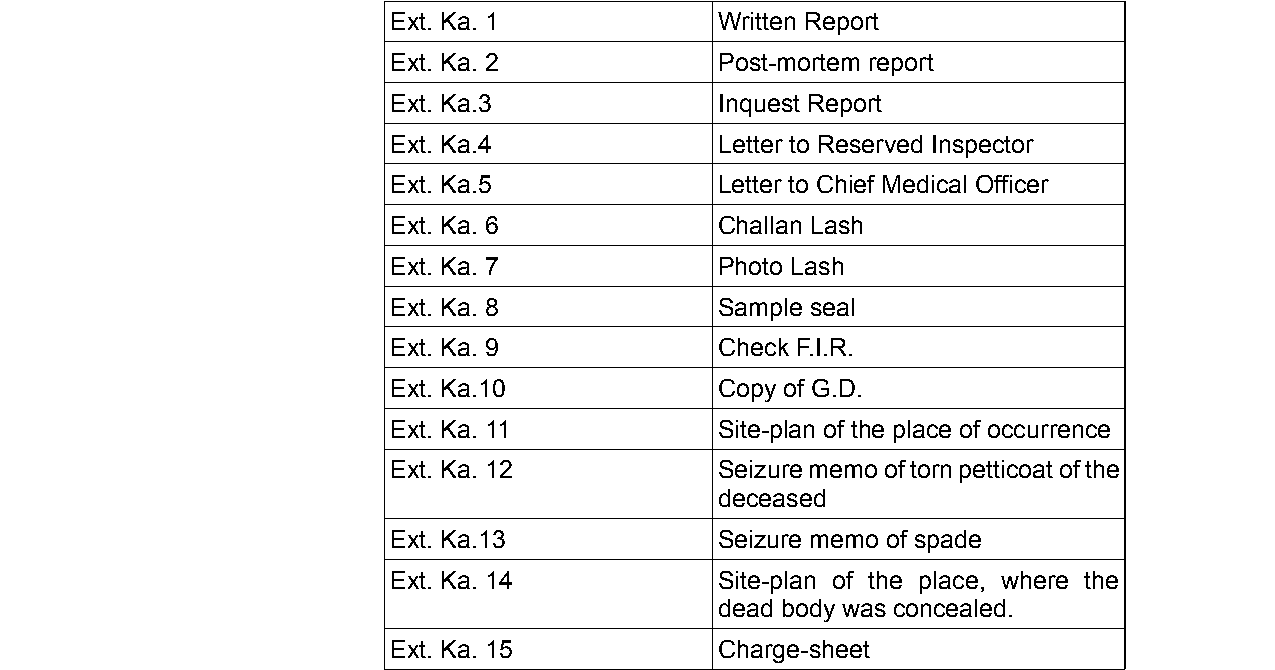
(2) The complainant, Rajendra son of late Lochan, resident of village Shivari, police station Hariyanwan, district Hardoi, submitted a written complaint (Ext. Ka.1) on 22.05.2014 to Station House Officer, police station Pihani, district Hardoi, alleging therein that the marriage of his daughter, Kusuma aged 21 years, was done about three years ago with Pawan son of Ramdas Raidas, resident of village Itara, police station Pihani, district Hardoi. His son-in-law Pawan had given information of absconding of his daughter Kusuma that she had gone somewhere in the night of 04.05.2014 at about 09:00. When he came to village Itara, his daughter was not at home. They kept searching for her. On account of illicit relations of Kusuma with Rajeev son of Ram Ratan Raidas, resident of village Itara and on account of complete suspicion, his son-in-law Pawan lodged a case, N.C.R. No. 159/2014 under Section 498 I.P.C. on 17.05.2014, at police station Pihani against Rajeev son of Ram Ratan. On 22.05.2014, he came to know that his daughter Kusuma had been murdered by his son-in-law Pawan and her body has been buried in a pond situated between village Itara and Mathhia. He strongly believes that on account of suspicion of her having illicit relationship with Rajeev, his son-in-law, murdering his daughter, concealed her dead body. The body buried in the pond is of his daughter Kusuma. The body may be exhumed and necessary action may be taken.
(3) On the basis of the aforesaid written report (Ext. Ka.1) , check F.I.R., bearing Case Crime No. 572 of 2014, under Sections 302 and 201 I.P.C. was registered at police station Pihani, district Hardoi on 22.05.2014 at 18:20 hours against accused Pawan.
(4) The investigation of the case was conducted by Sub-Inspector Nagendra Kumar Mishra (P.W.6). He, on getting copy of check F.I.R. and copy of G.D. report, recorded statement of scriber of check F.I.R., Head Moharrir Mohd. Farid Khan, and the complainant Rajendra in the case diary. Thereafter, he proceeded from the police station to the place of occurrence village Itara. He informed the Sub-Divisional Magistrate, Shahabad for conducting the proceedings of panchayatnama (inquest) and secured the place of occurrence. The proceedings of panchayatnama could not be conducted on 22.05.2014 on account of night. On 23.05.2014, on the direction of Sub- Divisional Magistrate, Shahabad, Judicial Magistrate, Tehsildar Ramavtar Verma, came at the place of occurrence and after completion of inquest proceedings, the dead body was sent for post-mortem. Thereafter, he, on the pointing out of the complainant, inspected the place from where the dead body of the deceased was recovered and prepared the site-plan. He also prepared the seizure memo (fard) of the clothes and other articles of the deceased recovered from the place of occurrence. On 26.05.2014, he arrested the accused Pawan and recorded his dis