Back
Back





2026 Supreme(All) 1401
2026 AHC 128836
HIGH COURT OF JUDICATURE AT ALLAHABAD
J.J. Munir, Arun Kumar, JJ.
Sharif Ahmad and others - Petitioners
Versus
State of U.P. and others - Respondents
Public Interest Litigation No. - 1495 of 2026
Decided On : 24-06-2026
Advocates Appeared :
For the Petitioner : Mr. Azad Khan, Advocate holding brief of Mr. Saiyad Iqbal Ahmed, Advocate
For the Respondent : Mr. Girijesh Kumar Tripathi, Additional Chief Standing Counsel
For the Appellants/Petitioners: Azad Khan, Saiyad Iqbal Ahmed
For the Respondents: Girijesh Kumar Tripathi
The right to practice religion under Article 25 of the Constitution does not include an absolute fundamental right to carry out religious processions along a specific route; such matters are subject to administrative regulation in the interest of public order and law enforcement.
Headnote:(A) Constitution of India - Article 25 - Right to practice religion - Extent and scope - Right to practice religion does not include an absolute right to use a specific route for religious processions - Public order and law and order considerations take precedence over individual preferences for specific routes during religious processions.
(B) Administrative Law - Exercise of discretion - Administration's reliance on existing inter-community agreements and festival registers to regulate procession routes - Court will not interfere with administrative decisions regarding procession routes based on law and order assessments unless clearly illegal or perverse.
Facts of the case:
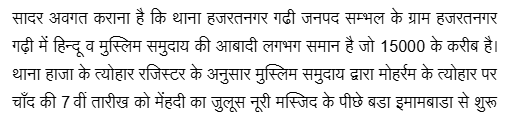
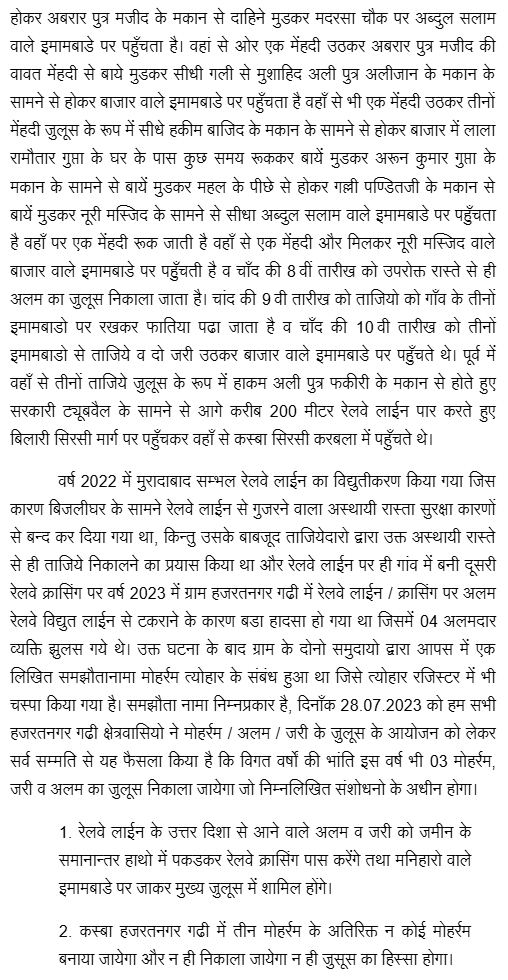
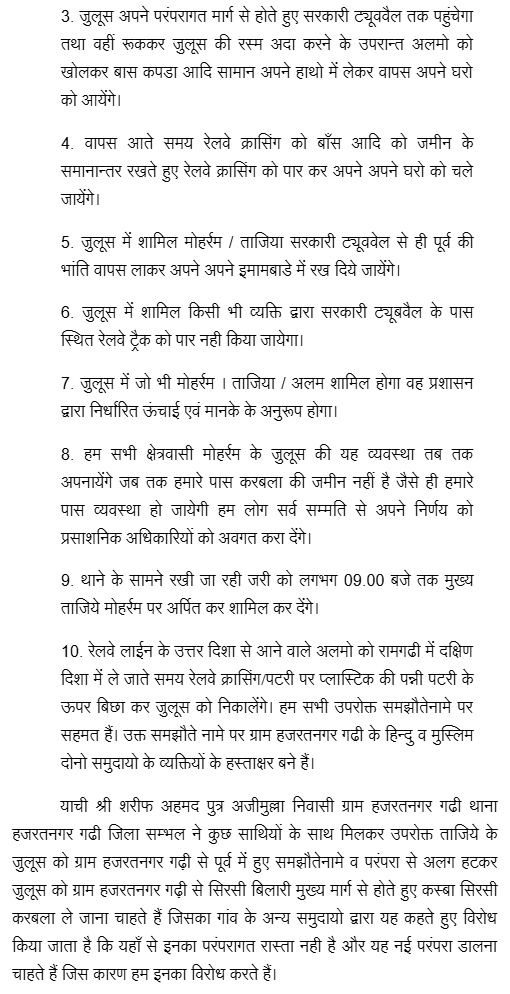
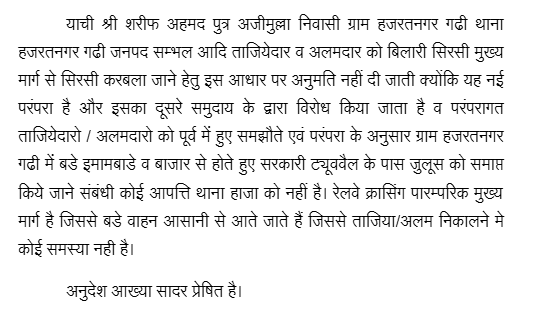
The petitioners sought a direction to permit a new route for the Muharram Alam/Tazia procession following the closure of the traditional route due to railway electrification and a previous fatal accident involving electrocution. The administration opposed the new request, citing an existing bilateral agreement between community representatives and potential law and order issues arising from opposition by other religious groups.
Findings of Court:
The court determined that the petitioners failed to establish any fundamental right to dictate a specific route for their religious procession. The court held that the authorities acted within their discretion in balancing the religious practices against the maintenance of public order and the terms of an existing settlement agreement.
Issues: Whether the petitioners have a fundamental right under Article 25 of the Constitution to force the authorities to approve a specific, non-customary route for a religious procession when the traditional route is closed due to safety concerns.
Ratio Decidendi: While Article 25 guarantees the right to practice religion, it does not confer a right to perform religious rites along a specific path or public thoroughfare, especially where doing so poses risks to public peace, law and order, or conflicts with prior documented community agreements.
Result: Petition dismissed.
| Table of Content |
|---|
| 1. background facts regarding the tazia procession dispute and the existing community agreement. (Para 1 , 2 , 3 , 4 , 5 , 6 , 7) |
| 2. analysis of the changed route circumstances and the legality of the standing inter-community agreement. (Para 8 , 9 , 10) |
| 3. scope of article 25 regarding routes for religious processions vs public order. (Para 11 , 12 , 13) |
JUDGMENT :
J.J. MUNIR, J.
This writ petition has been filed, seeking a direction to the respondents to ensure that the customary right of the petitioners, including other members of the community, to take out the Alam/Tazia procession on the occasion of Muharram falling on 26/27.06.2026, is done without hindrance and the authorities may grant provisional permission for the aforesaid purpose.
2. The petitioners say that they are social workers, espousing a public cause. It is said that since the year 1952-2022, the route for Alam/Tazia procession, and for its burial on the tenth day of Muharram, has been one from Hazrat Nagar Garhi to the Railway Crossing LC/8C and LC/9C. An accident occurred in the year 2022 and the route has now been closed by the Railways on the crossing by construction of a permanent wall on both sides. A letter in this regard is said to have been issued by an Engineer of the Railways to the District Magistrate, Sambhal. It is pointed out that according to the khasra and khatauni, the Karbala, or the place where the Tazia is buried, is situate in Village Sirsi in Gata No. 1650/1.
3. After the old route was closed by the Railways, the villagers made an application to the Authorities to permit the procession on the said route, inasmuch as the new route from Sirsi-Bilari Road, passing through a village, involves a travel time of 3-4 hours on the tenth day of Muharram. A sketch map of the old route and the tentative new route have been annexed to the writ petition.
4. From the year 2023, right up to the year 2025, the petitioners, including all the villagers, have made applications each year, by registered post, seeking grant of permission to move away from Sisri-Bilari Road, while taking out the Alam/Tazia to the Karbala, apparently seeking restoration of the old route. Information regarding the matter of the route for the procession sought by the villagers was asked about under the Right to Information Act, 2005. The Tahsil Authorities have given information on applications dated 23.04.2025 and 06.06.2025, signed by the Lekhpal, Sirsi, which shows some different route, that is not clear.
5. The petitioners moved an application to the respondents on 17.05.2026, and again on 25.05.2026, both through registered post, seeking permission for the procession route, which does not create any dispute in future. It is emphasised that Muharram has commenced this year on 18.06.2026 and the tenth day would fall on 26/27.06.2026, when the procession is required to take out the Alam and Tazia to the Karbala. It is emphasised that permission is required on the proposed route because of the changed circumstances that the Railways have blocked the traditionally used route and the new route via the Sirsi-Bilari Road to Sharkari Karbala takes an inconveniently long time for the procession to traverse. The petitioners say that the rites and rituals, along with customs followed for taking out the Tazia procession, are performed every year on the tenth day of Muharram under the supervision of Alamdar/Taziadar by the villagers and members of the Muslim community at large. They have a right according to the customs to undertake this religious practice. The State authorities are bound to grant permission on the new route sought by the petitioners, according to the sketch plan. Once the Railways have blocked the traditional route due to an accident, a new route has to be sanctioned by the Authorities for the taking out of the procession on the tenth day of Muharram. The Authorities are bound to pass appropriate orders on the petitioners’ applications, already pending before the