1. Petitioner challenged eviction order under Section 67, U.P. Revenue Code, 2006 for alleged encroachment on public land. (Para 1 , 10 , 11 , 12 , 13 )
 Back
Next 


2026 Supreme(All) 1520
HIGH COURT OF JUDICATURE AT ALLAHABAD LUCKNOW
KARUNESH SINGH PAWAR, J.
Gorakhnath Dubey - Petitioner
Versus
State Of U.P. Thru. Prin. Secy. Revenue, Lko. And Others - Respondents
WRIT - C No. - 9093 of 2026
Decided On : 18-09-2026
Important Points
Proceedings under Section 67 of the U.P. Revenue Code, 2006, follow statutory procedures; court-laid guidelines are not mandatory unless adopted by the State. Concurrent findings of encroachment on public land are not interfered with unless perverse, especially when the party fails to produce evidence despite sufficient opportunity.
Subject
Land Law - Revenue Law
Act Referred
Headnote
(A) U.P. Revenue Code, 2006 - Section 67; U.P. Revenue Code Rules, 2016 - Rule 67(2) - Encroachment on public land - Procedure for enquiry - Whether guidelines laid down by a court in a previous judgment are mandatory unless adopted by the State through amendment of statutory Rules - Proceedings under Section 67 are summary in nature; guidelines that convert such summary procedure into a regular procedure are not mandatory unless adopted by the State. (Paras 20, 21)
(B) Opportunity of Hearing - Failure to produce evidence - Petitioner filed objections and sought time to produce evidence in 2018 but failed to do so until the conclusion of proceedings in 2023 - A plea of chronic ailment cannot be accepted when medical documents are subsequent to the passing of the impugned order and do not establish incapacitation during the period for producing evidence. (Paras 23, 24)
(C) Writ Jurisdiction - Scope of interference with concurrent findings of fact - High Court under Article 226 of the Constitution of India does not ordinarily interfere with concurrent findings unless they are shown to be perverse, based on no evidence, or suffer from an error of law - Strict approach to be adopted in cases of unauthorized construction on public land; judicial discretion cannot be used to regularize such illegality. (Paras 18, 25, 28)
Facts of the case:
A petition was filed seeking to quash orders passed under Section 67 of the U.P. Revenue Code, 2006, alleging unauthorized encroachment upon public land. The petitioner contended that no encroachment was made, that the area in the revenue map was inconsistent with records, and that the mandatory enquiry procedure was not followed. Additionally, it was argued that due to chronic illness, an effective opportunity of hearing was not afforded. The authorities had based their orders on a report by a revenue official, noting that the petitioner had failed to produce evidence in support of his objections since 2018.
Findings of Court:
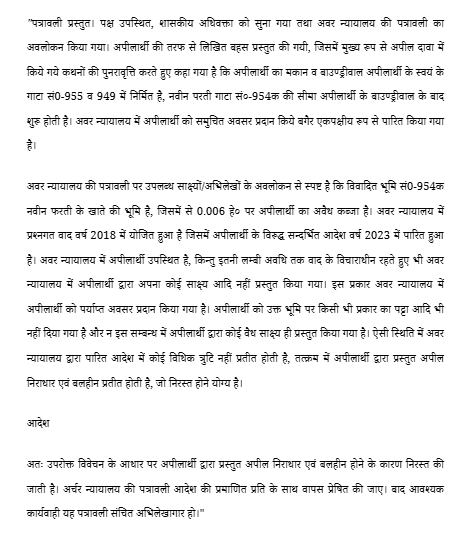
The court found that the petitioner had ample opportunity over five years to produce evidence but failed to do so. The medical documents provided were dated after the primary order was passed, meaning the petitioner was not incapacitated during the proceedings. The court held that the procedure followed complied with the statutory framework and that the guidelines from previous judgments were not binding as they were not adopted by the state. The findings of encroachment were concurrent across the trial and appellate stages.
Issues: Whether the procedure indicated in previous judicial guidelines was mandatory for proceedings under Section 67 of the U.P. Revenue Code; whether the petitioner was denied a reasonable opportunity of hearing; and whether concurrent findings of fact regarding encroachment on public land warranted interference under Article 226.
Ratio Decidendi: Guidelines issued by the court are not mandatory unless adopted by the State via amendment of the U.P. Revenue Code Rules, as following them would convert a summary procedure into a regular one. Where a party fails to produce evidence despite prolonged opportunity, and fails to provide contemporaneous medical evidence for illness, a plea of denial of hearing is unsustainable. Concurrent findings of fact are not disturbed unless perverse, particularly in cases of public land encroachment.
Result: The writ petition is, accordingly, devoid of merit and is dismissed.
Legal Category Hierarchy
-
administrative law
-
judicial review
- concurrent findings of fact (Para 25)
-
judicial review
- property law
- practice and procedure
Advocates Appeared:
For the Petitioner: Anand Dubey, Prashant Dubey
For the Respondent: C.S.C.
For the Petitioner: Anand Dubey, Prashant Dubey
For the Respondent: C.S.C.
Table of Contents
2. Petitioner claimed no encroachment and denial of hearing; State alleged illegal construction on public land supported by revenue map. (Para 2 , 3 , 4 , 5 , 6 , 7 )
3. Petitioner had ample opportunity over five years to produce evidence but failed; concurrent findings of encroachment were not perverse. (Para 11 , 12 , 13 , 23 , 24 , 25 , 26 )
4. Guidelines in Rishi Pal Singh are not mandatory unless adopted by state; Section 67 proceedings follow summary procedure under the Code. (Para 20 , 21 , 22 )
5. Writ petition dismissed; no interference warranted with concurrent findings of fact under Article 226. (Para 30 )
6. Are the guidelines in Rishi Pal Singh mandatory for proceedings under Section 67, U.P. Revenue Code, 2006?
No. The guidelines converting summary procedure into regular procedure are not mandatory unless adopted by the State by amending the Rules. (Para 20 , 21 , 22 )
7. What is the scope of judicial review of concurrent findings of fact under Article 226?
The High Court will not interfere unless the findings are perverse, based on no evidence, or suffer from an error of law. (Para 25 )
8. Can a claim of denial of hearing succeed when the party was given ample opportunity but failed to produce evidence?
No. The petitioner had sufficient opportunity over several years but did not produce evidence; the plea of illness was not supported. (Para 23 , 24 , 26 )
9. What approach should courts adopt in cases of illegal construction or encroachment on public land?
Courts must adopt a strict approach and should not readily engage in judicial regularisation of unauthorized constructions. (Para 18 , 28 )
JUDGMENT :
KARUNESH SINGH PAWAR, J.
1. Heard Shri Anand Dubey, learned counsel for the petitioner and learned Standing counsel for the respondents. By means of the present writ petition, the petitioner has prayed for the following reliefs:
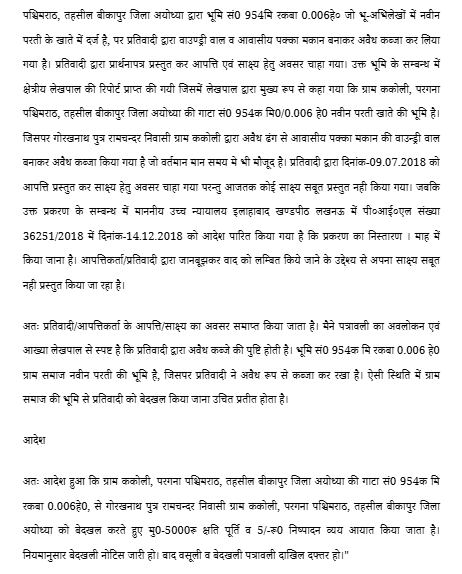
"(i) Issue a writ, order or direction in the nature of certiorari quashing the orders dated 13.03.2023 passed by opposite party No. 3 in Case No. 02123 of 2018 (Computerized Case No. T201804230302123) and 05.08.2026 passed by opposite party No. 2 in Case No. 1346 of 2026 (Computerized Case No. D202604230001346), as contained in Annexure Nos. 1 and 2 to the present writ petition.
(ii) Issue a writ, order or direction in the nature of mandamus commanding the opposite parties to drop the proceedings initiated against the petitioner under Section 67 of the U.P. Revenue Code, 2006."
2. Learned counsel for the petitioner submits that the petitioner has constructed his residential house over Gata Nos. 949, 953 and 955 and has not made any encroachment over Gata No. 954-Ka. It is contended that the area of the petitioner's land shown in the revenue map is less than the area actually recorded in the Khatauni and, therefore, the allegation of encroachment over the adjoining public land is wholly misconceived.
3. It is further submitted that no effective opportunity of hearing was afforded to the petitioner before passing the impugned order contained in Annexure No. 1. Learned counsel submits that the petitioner could not appear before opposite party No. 3 on account of his chronic ailment, but this aspect was neither considered nor dealt with by opposite party Nos. 2 and 3 while passing the impugned orders. It is also contended that the impugned orders are non-speaking orders and have been passed without proper consideration of the material available on record or the actual position at the spot. According to learned counsel, the petitioner has merely raised a boundary wall over his own land and has not encroached upon any public land.
4. Learned counsel for the petitioner has placed reliance upon the judgment of this Court in Rishi Pal Singh v. State of U.P. , 2022 SCC OnLine All 829, as also the guidelines laid down therein. It is submitted that, in terms of the procedure prescribed therein, the enquiry contemplated under sub-rule (2) of Rule 67 of the U.P. Revenue Code Rules, 2016, is a condition precedent to the issuance of notice under the said provision. According to learned counsel, the said mandatory procedure was not followed in the present case.
5. It is, therefore, submitted that the notice itself was issued without following the procedure prescribed under Rule 67(2), as elucidated in Rishi Pal Singh (supra), and that both the authorities below failed to consider this material aspect while passing the impugned orders.
6. Per contra, learned Standing Counsel submits that the petitioner's house and boundary wall are situated over land recorded as Naveen Parti, which is public land, and that the petitioner has illegally raised construction thereon. It is further submitted that the encroachment is also apparent from the revenue map.
7. It is contended that the petitioner had filed his objection in the year 2018 and had sought time to produce evidence in support of his claim. Despite having been afforded an opportunity, however, he failed to produce any evidence. The impugned order was thereafter passed on the basis of the report submitted by the Revenue Inspector/Lekhpal, which records that the petitioner had encroached upon the public land.
8. In support of his submissions, learned Standing Counsel has placed reliance upon the judgment of the Hon'ble Supreme Court in Kaniz Ahmed v. Sabuddin , 2025 SCC OnLine SC 995, and the judgment of the Coordinate Bench of this Court in Shahban v. State of U.P. , 2026 SCC OnLine All 1246.
9. Perused the record.
10. A perusal of the record indicates that the proceedings under Section 67 of the U.P. Revenue Code, 2006 were initiated on the basis of the report submitted by