Back





2022 Supreme(UK) 499
IN THE HIGH COURT OF UTTARAKHAND AT NAINITAL
SHARAD KUMAR SHARMA, RAMESH CHANDRA KHULBE, JJ.
Ravi Shankar Joshi - Petitioner
Versus
Union of India and others - Respondents
Writ Petition (PIL) No. 30 of 2022 Along with Intervention Application No. 3, 5, 6, 7, 8, 9, 10, 11, 13, 15 of 2022
Decided On : 20-12-2022
Important Points
Subject
Land & Property - Encroachment and Eviction
Act Referred
PUBLIC PREMISES ACT: S.2
TRANSFER OF PROPERTY ACT: S.105
DISPLACED PERSONS COMPENSATION AND REHABILITATION ACT: S.20
SOCIETIES REGISTRATION ACT: S.6
RAILWAYS ACT: S.147
Headnote
(B) Nazul Rules/Manual - Rule 1, 59, and 61 - Nature and management of nazul land - Land in certain specified estate regions is expressly excluded from the definition of nazul land (Para 30). For any nazul land adjoining a railway station, prior consultation, sanction, and permission from the railway administration are mandatory before any sale, lease, or construction can be executed; absence of such sanction renders the lease or construction illegal (Paras 125, 127).
(C) Transfer of Property Act, 1882 - Section 105 - Nature of lease - A lease is a transfer of a right to enjoy property for a specified time and does not grant title or ownership. Where the lease deed stipulates registration as a condition precedent, failure to register the document means no legally sustainable right was created. Furthermore, once the fixed term of a lease expires, the right of enjoyment is extinguished unless validly renewed (Paras 105-114).
(D) Revenue Law - Mutation entries - It is settled law that mutation entries in revenue records are intended only to enable the state to collect revenue and do not create, extinguish, or confer title or interest in the property (Paras 144-146).
Facts of the case:
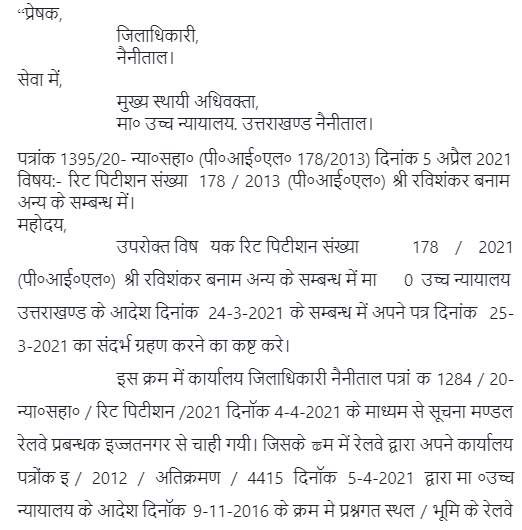
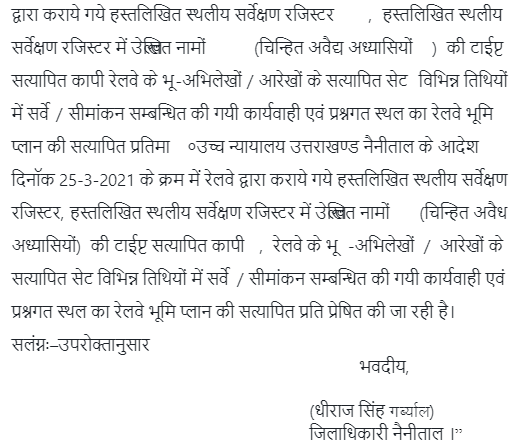
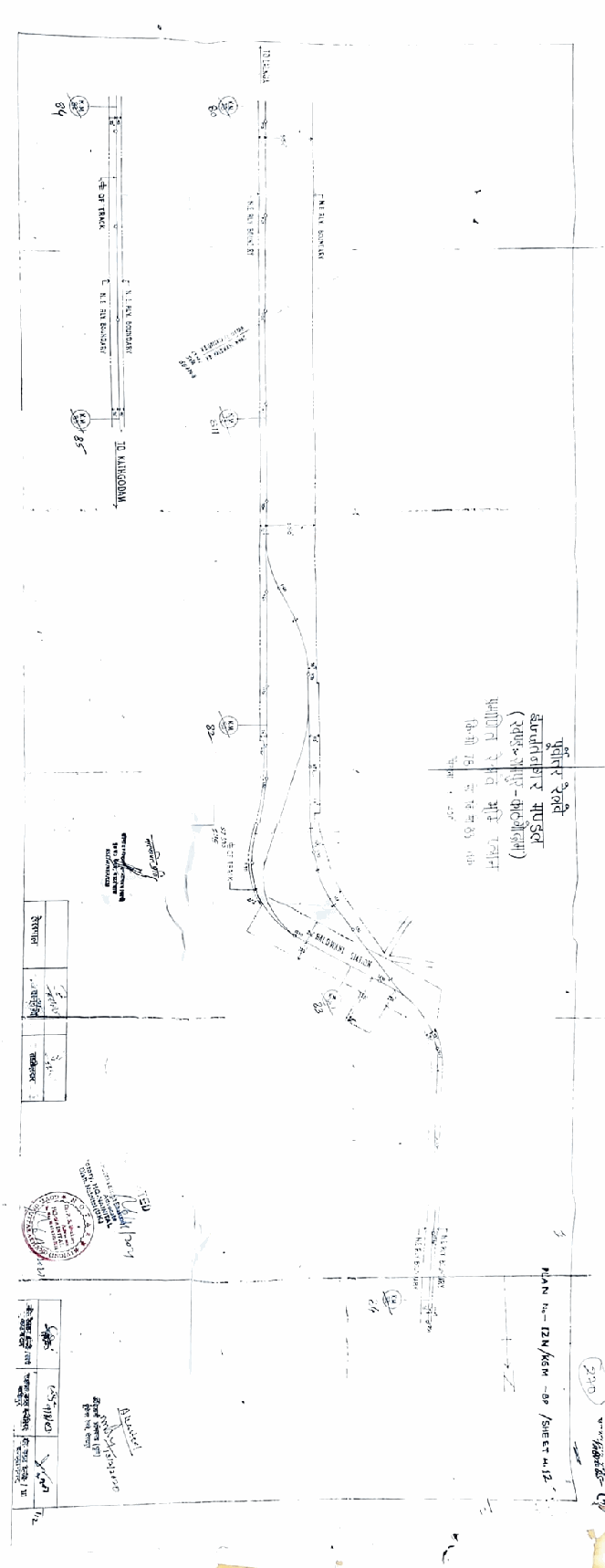
This Public Interest Litigation seeks a writ of mandamus for the removal of unauthorized occupants from land adjoining a railway station. The occupants claimed rights based on alleged nazul land leases, long-term possession exceeding 50 years, and sale certificates issued under the Displaced Persons (Compensation and Rehabilitation) Act, 1954. A joint survey and demarcation report by revenue and railway authorities confirmed that the land is vested with the railways. The occupants challenged the demarcation and relied on municipal tax records to assert ownership.
Findings of Court:
The court found that the land in question does not qualify as nazul land under the applicable rules. The lease deeds produced by the interveners were unregistered, had already expired, and were executed in violation of the mandatory requirement for railway consultation. Possession for a long period or payment of municipal taxes does not mature into a legal title. As the land is vested with the railways, the occupants are unauthorized trespassers.
Issues: The primary issues were whether the land was nazul land, whether unregistered and expired leases confer title, and whether the Public Premises Act or the Railways Act is the appropriate legal mechanism for eviction.
Ratio Decidendi: Special statutes override general laws; therefore, the Railways Act governs eviction from railway land. Public interest in the expansion of railway infrastructure outweighs private possessory claims lacking legal title. Summary eviction of unauthorized occupants is permissible when the property is established as government land and a fair procedure for notice has been followed (Paras 227-239).
Result: Writ of mandamus issued directing the railway and district authorities to evict unauthorized occupants within one week, authorizing the use of force and demolition of unauthorized structures if necessary.
How to determine whether the land in Haldwani Khas is Nazul land under Nazul Rules?
What is the status and enforceability of long-standing leases claimed over Nazul land near a railway station?
What are the powers and procedures for eviction of unauthorized occupants from railway land under the Public Premises Act and the Railways Act?
For the Petitioner:Mr. Rajeev Singh Bisht, Advocate
For the Interverners :Mr. Ahrar Baig, Mr. Gopal K. Verma, Mr. Sanpreet Singh Ajmani, Mr. Rahul Bhatt, Mr. Piyush Garg, Mr. Sandeep Tiwari, Mr. Kurban Ali, Mr. Vinay Bhatt, Mr. M.K. Ray, Advocates
State of Uttarakhand :Mr. S.N. Babulkar, Advocate General, assisted by Mr. C.S. Rawat, Chief Standing Counsel, Mr. Ajay Singh Bisht, Addl. C.S.C. and Mr. Gajendra Tripathi, Brief Holder
For the Union of India : Mr. V.K. Kaparuwan, Mr. Rajesh Sharma, and Mr. Lalit Sharma, Standing Counsel
JUDGEMENT :
Per Hon’ble Sharad Kumar Sharma, J.
The instant Writ Petition (PIL) deals with a very intrinsic and a sensitive issue, whereby, relief has been modulated in the PIL, for seeking writ of mandamus for removing the unauthorised occupants from the railway land, adjoining Haldwani Railway Station, commonly called as Gaffur Basti. Despite of best of our efforts to be precise in adjudication, but owing to the intricate legal and factual issues involved from the following perspectives:-
i. The historical background,
ii. The individual actual rights and,
iii. The legal issues,
We are bound to have a detailed deliberation.
All would require a detailed scrutiny, before arriving at any plausible conclusion for adjudicating the various contentions, which had been agitated by the learned counsel for the parties to the PIL, as well as the various resident interveners, whose respective applications for intervention has to be dealt with individually.
2. The first aspect of historical background, its hereby summarized as under :-
3. The township of Haldwani was initially, as back as in early 1800, was geographically a non existing township. It emerged, as to be a gradually a developing township with the following historical backdrops.
i. In 1815, the then East India Company, had waged a war with the Bhotias of Nepal, which continued unabated for quite a sufficient long period.
ii. In 1816, as a consequence of settlement by way of a treaty, which was arrived at between the Nepalies and the East India Company, called as Sagauli Treaty. It was executed between the King of Nepal and that with the East India Company, resulting into annexing of the territories of Garhwal and Kumaon Region, as it exists today, with the East India Company.
iii. As a consequence of the Sagauli Treaty of 1816, the East India Company, for the purposes of annexing the aforesaid territory from the Kingdom of Nepal, as it then was, had paid a sum of Rs.2 lacs for annexation of the Garhwal and Kumaon Regions, as it now stands bifurcated, in these two wider topographical divisions.
iv. The historical backdrop reveals, that the territory of Haldwani Khas, for the first time, had acquired its territorial existence, when it was brought into existence by its founder, Mr. Trail in the year 1834.
v. The basic objective of giving this territory as a nomenclature of Haldwani Khas, was then that it had a basic political intention of the East India Company, to utilize the said territory, as to be an area, which was intended to be utilized for the purposes of settling the residents of the interior hills, in the Bhawar Region of Haldwani, intending to give them propriety rights over the land, which included to assign a right of tilling of the soil.
vi. The aforesaid reference of the chronological historical backdrop ever since 1815 till 1882, finds its reference from the conditions, as it has been contained in the Himalayan Gazetteer, as compiled by the then E.T. Atkinson in the years 1882.
vii. With the creation of township of Haldwani in the year 1834, the history, which could be retrieved by us, it shows, that ultimately the rights over the property, lying in Haldwani Khas initially completely stood vested with its then politically reckoned owner, Mr. Thomas Gown.
viii. In 1896, the Himalayan Gazetteer refers to, that the predecessor / owner, Mr. Thomas Gown, had conveyed the property by virtue of a deed of conveyance in favour of Mr. Dan Singh, one of the most reckoned business person, hailing from District Pithoragarh.
ix. Its after the creation of rights, by the deed of conveyance in favour of Mr. Dan Singh, which is yet to be seen in the light of day, its thereafter that he started executing different sale deeds of different parts of the land in favour of different persons ever since 1896 onwards. Out of which, its admitted case that the interveners or their predecessors are not the purchasers by registered or unregistered deed of conveyance.
4. In the PIL, the question, which would be pr