Back


2025 Supreme(MP) 1051
IN THE HIGH COURT OF MADHYA PRADESH AT INDORE
Prem Narayan Singh, J.
Gopal Krishna – Petitioner
Versus
Anandpalsingh S/O Gyanpalsingh Deceased Through Lrs Deepak Singh And Others – Respondents
Second Appeal No. 79 of 2011
Decided On : 26-03-2025
For the Petitioner: Shri Ajay Mishra
For the Respondent:Shri Sunil Kumar Jain, learned Senior advocate with Ms.Nandini Sharma, learned counsel [LR/S].
A document providing for property reconveyance upon repayment creates a mortgage by conditional sale, granting the right of redemption within 30 years. This right is fundamental and protected by the principle 'once a mortgage, always a mortgage,' overriding any conflicting contractual provisions aiming to restrict it.
Headnote:(A) Transfer of Property Act, 1882 - Section 58(c) - Mortgage by conditional sale - Determination of character of instrument - Intention of parties gathered from document as a whole and surrounding circumstances - Distinction from absolute sale - Principle of ''once a mortgage, always a mortgage'' - Doctrine of equity of redemption - Security is redeemable notwithstanding contrary provisions. (Paras 19, 23, 36)
(B) Limitation Act, 1963 - Section 61(a) - Suit for redemption or recovery of possession - Limitation period of 30 years - Calculation of limitation period from the date the right to redeem or recover possession accrues. (Paras 29, 32)
(C) Civil Procedure Code, 1908 - Suit for redemption - Locus standi - Competency of a co-heir acting as head of the family to institute suit for redemption - Suit maintainable without formal joinder of all legal heirs absent specific prejudice. (Para 34)
Facts of the case:
The appellant sought redemption of agricultural land, asserting that the transaction was a mortgage by conditional sale executed years prior. The trial and first appellate courts dismissed the suit, characterizing the transaction as an absolute sale, ruling the suit time-barred and defective due to non-joinder of necessary parties.
Findings of Court:
The court found that based on the document's terms, which included conditions for reconveyance, the transaction was a mortgage by conditional sale. Applying the principle that the right of redemption cannot be clogged, the court held that the 30-year limitation period applied. The court further established that the appellant possessed the authority to initiate the suit as the representative of the family interest.
Issues: Whether the disputed document constituted a mortgage by conditional sale or an absolute sale; whether the suit was barred by limitation; and whether the suit was maintainable without the participation of all other legal heirs.
Ratio Decidendi: Courts must ascertain the true character of a transaction by reading the document in its entirety and considering surrounding circumstances. A conveyance coupled with a condition for reconveyance upon repayment creates a mortgage relationship, and the right to redeem is a fundamental protection that persists notwithstanding label variations, ensuring that any clause attempting to extinguish this right is void.
Result: Appeal allowed. The judgments and decrees of the courts below were set aside and the suit for redemption of mortgage was decreed.
| Table of Content |
|---|
| 1. procedural history and factual background of the redemption suit (Para 1 , 2 , 3 , 5 , 7 , 8 , 9) |
| 2. formulation of substantial questions of law and parties' respective contentions (Para 6 , 10 , 11 , 12 , 13 , 14) |
| 3. characterization of shartiya farokhtnama as a mortgage by conditional sale (Para 15 , 16 , 17 , 18 , 36 , 38 , 39) |
| 4. doctrine of 'once a mortgage always a mortgage' and equity of redemption (Para 19 , 21 , 22 , 23 , 26 , 37) |
| 5. applicability of 30-year limitation period for redemption of mortgage (Para 20 , 24 , 25 , 29 , 30 , 31 , 32 , 33) |
| 6. competency of karta to maintain suit without other legal heirs (Para 34) |
| 7. inapplicability of estoppel when mortgage rights subsist (Para 35) |
| 8. final order granting redemption and directions for property reconveyance (Para 40 , 41) |
JUDGMENT :
Prem Narayan Singh, J.
The appellant has preferred the present appeal under Section 100 of the Code of Civil Procedure, 1908 (for short "CPC") challenging the judgment dated 22.12.2009 passed by the learned Additional District Judge, Sendhwa, District Barwani in Civil Regular Appeal No.19-A/2008 whereby the learned first Appellate Court has dismissed the appeal and affirmed the judgment and decree dated 26.09.2008 passed in Civil Suit No.5-A/2002 by the learned Civil Judge, Class-II, Khetiya, District Barwani wherein the learned Civil Judge has dismissed the suit filed by the appellant for redemption of Mortgage (girvi mukti) and for possession of the land in question.
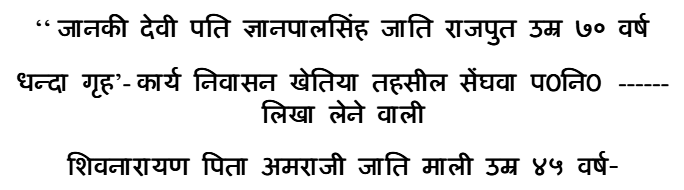
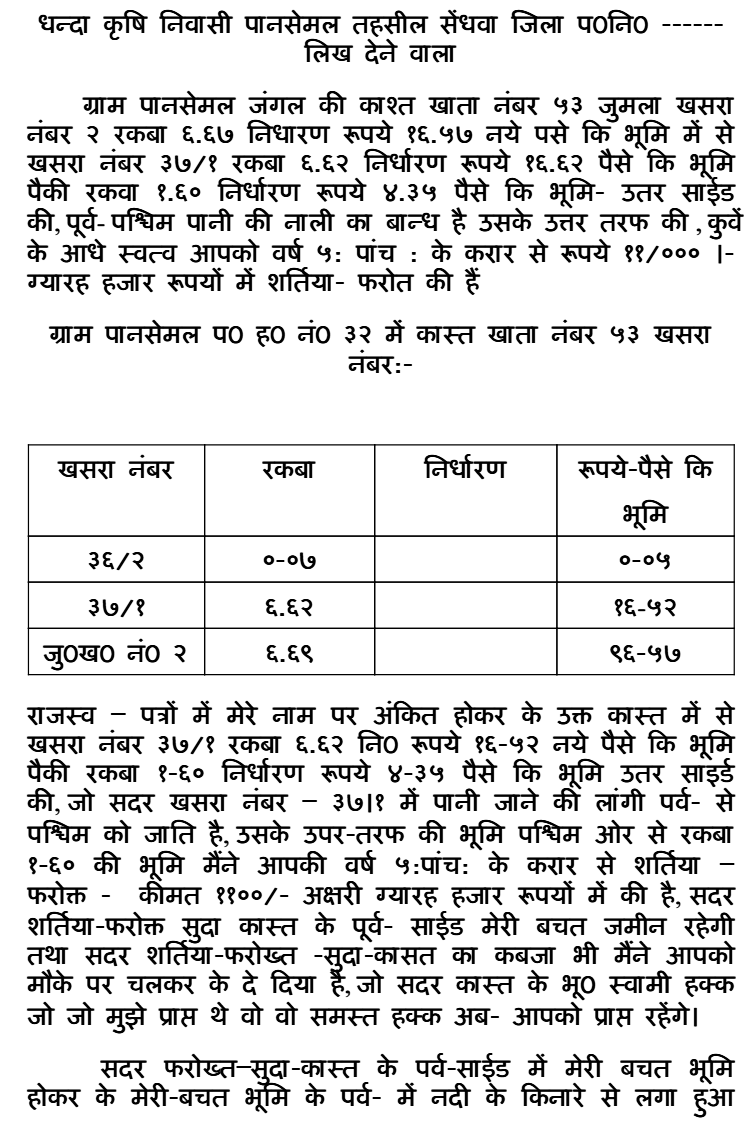
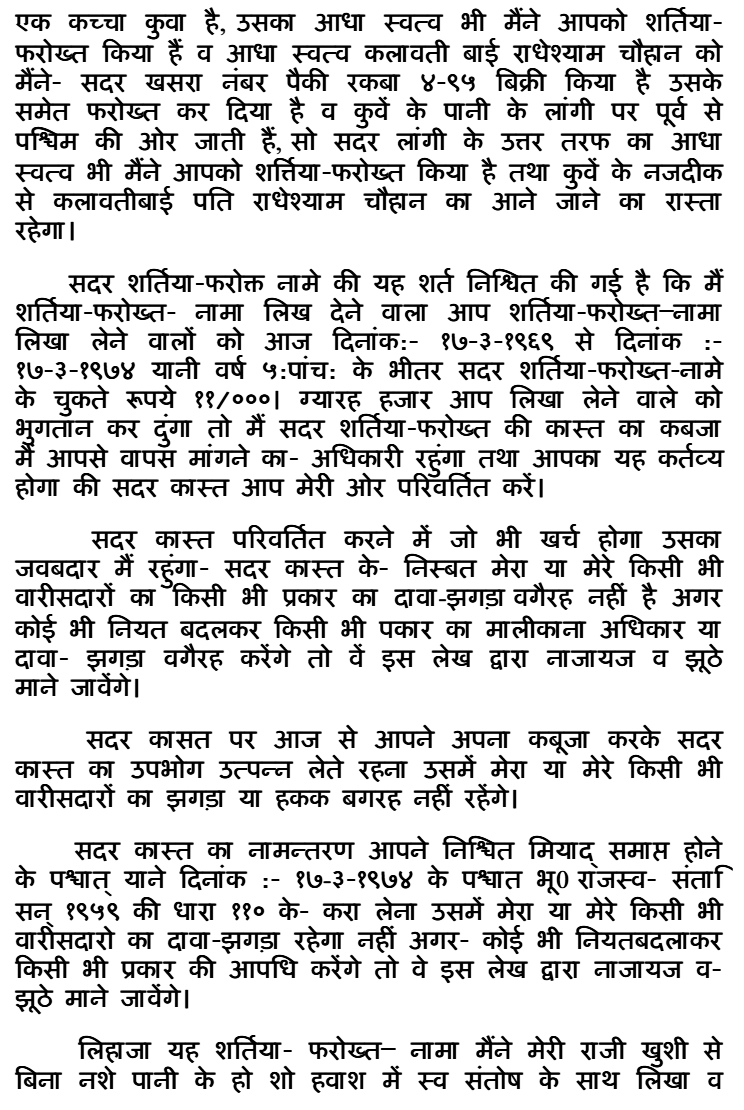
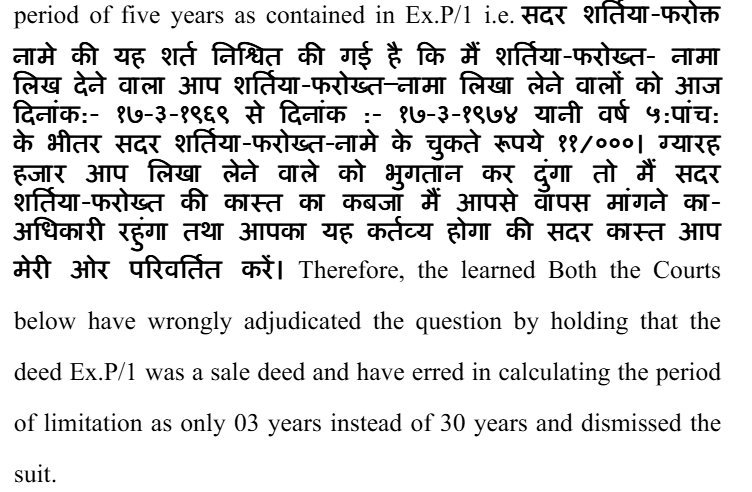
2. Succinctly, the facts of the case are that the appellant filed a suit for redemption of mortgage and for possession of the land bearing Survey No.37/1 ad-measuring 1.60 acres, situated at village Pansemal, District-Khargone. As per pleadings, the aforesaid land in question was mortgaged by late one Shivnarayan, the father of the appellant on 17.03.1969 vide a deed named as "Shartiya Frokhtnama" with consideration of Rs.11000/- in favour of one Janki Devi, the mother of the respondents for a period of five years i.e. up to 17.03.1974. After the lapse of the said period the appellant tried to redeem the mortgage, but the respondent did not give any response, hence, the appellant, on 11.03.2022 served a notice on respondent to accept the sum of Rs.11000/- and give the possession of the land in question to the appellant. In reply to the said notice issued by the appellant, the respondent, denying the execution of such document, remonstrated that the suit land had never been mortgaged to his mother Janki Devi and it was sold to her. As such, the respondent, being son of late Jankidevi, was the sole owner of the suit property.
3. Then, the appellant/plaintiff had filed a Civil Suit bearing Suit No.5-A/2002 for redemption of mortgage and possession of the suit land. the suit was contested on various grounds. In written statements, the respondents have denied all the averments of the appellant and it is contended that no deed of mortgage was executed by Late Shivnarayan, but rather it is a document of sale. Since, appellant is not the sole heir of Late Shivnarayan, he has no locus standi to file the aforesaid civil suit without impleading the other legal heirs of Late Shivnarayan as they are also the necessary parties.The suit is also hopelessly time barred, hence, not maintainable. 4. On the abovementioned pleadings, the learned trial Court has framed the issues and directed both the parties to lead their evidence. After recording and appreciating the evidence of both the parties, the learned trial Court, Civil Judge has dismissed the suit of the appellant vide judgment and decree dated 26.09.2008.
5. Aggrieved by the judgment and decree dated 26.09.2008 passed by learned Civil Judge Class-II, Khetiya, the appellant preferred an appeal bearing Regular Civil Appeal No.19-A/2009 and the learned First appellate Court also dismissed the appeal of the appellant as stated in para no.1 and affirmed the judgment and decree passed by learned trial Court. Hence, the present a