1. Suit for specific performance – Dismissed for want of notice under Section 80 CPC – Appeal on necessity of notice and readiness and willingness. (Para 1 , 2 , 3 , 4 , 5 )
 Back
Next 





2026 Supreme(MP) 198
IN THE HIGH COURT OF MADHYA PRADESH AT GWALIOR
ASHISH SHROTI, J.
Mahila Ravindra Kaur – Petitioner
Versus
Smt. Gurmeet Kaur & Anr. – Respondents
Second Appeal No.372 of 1996
Decided On : 25-08-2026
Important Points
Notice under Section 80 CPC is not required for the State acting as a proforma party under Order 1 Rule 3-B. However, a plaintiff must mandatorily plead and prove continuous readiness and willingness to perform the contract to obtain the equitable relief of specific performance.
Subject
Civil Law - Specific Performance
Act Referred
Headnote
(A) Code of Civil Procedure, 1908 - Section 80 and Order 1 Rule 3-B - Notice to State - Where the State is joined as a defendant or non-applicant under Order 1 Rule 3-B and no relief is claimed against it, the service of notice under Section 80(1) is not required, particularly in light of state amendments providing that such suits shall not be dismissed for omission of the notice. (Para 18)
(B) Specific Relief Act, 1963 - Sections 16(c) and 20 - Specific performance of contract - Equitable relief - The relief of specific performance is discretionary and not granted merely because a valid agreement exists - It is mandatorily required for the plaintiff to aver and prove continuous readiness and willingness to perform the essential terms of the contract from the date of execution until the passing of the decree. (Paras 25, 26, 27, 31)
(C) Specific Relief Act, 1963 - Interpretation of 'Readiness' and 'Willingness' - 'Readiness' refers to the capacity of the plaintiff to perform the contract, including financial position, while 'willingness' relates to the conduct of the plaintiff. (Para 30)
Facts of the case:
A suit for specific performance of an agreement was filed by a joint owner of land against another joint owner who had borrowed money and agreed to execute a sale deed if the borrowed amount was not repaid within three years. The trial court and the first appellate court dismissed the suit on the ground of non-compliance with the notice requirements under Section 80 of the Code of Civil Procedure regarding the State, which was joined as a proforma party. The High Court initially decreed the suit but later recalled the judgment to decide on other substantial questions of law.
Findings of Court:
The court found that the dismissal of the suit based on the absence of notice under Section 80 of the Code of Civil Procedure was illegal and unsustainable as the State was a proforma party. However, upon examining the merits, the court observed a lack of proof regarding the service of summons on the defendant. More critically, the court found that the plaintiff failed to plead and prove readiness and willingness. The fact that the plaintiff requested the return of the borrowed money with interest after the period for executing the sale deed had expired demonstrated an unwillingness to proceed with the specific performance of the contract.
Issues: Whether notice under Section 80 of the Code of Civil Procedure was necessary to the State as a proforma party in a suit for specific performance, and whether the plaintiff was entitled to a decree of specific performance based on the available record.
Ratio Decidendi: While notice to the State is not required when it is a proforma party under Order 1 Rule 3-B and no relief is sought against it, a decree for specific performance cannot be granted if the plaintiff fails to satisfy the mandatory requirement of proving continuous readiness and willingness under Section 16(c) of the Specific Relief Act, as the remedy is equitable and dependent on the conduct of the party.
Result: Judgment and decree passed by the trial Court and the First Appellate Court are upheld; suit filed by the plaintiff stand dismissed.
Legal Category Hierarchy
Advocates Appeared:
For the Petitioner: Shri Gaurav Samadhiya, learned counsel
For the Respondents:Shri Sameer Kumar Shrivastava, learned counsel alongwith Shri Rohit Bansal, learned counsel, Shri Rajendra Jain, learned Government Advocate
Table of Contents
2. Plaintiff argued Section 80 notice unnecessary; defendant argued plaintiff failed to plead and prove readiness and willingness. (Para 11 , 12 , 13 , 14 , 15 , 16 )
3. Appeal dismissed – Suit for specific performance fails as plaintiff lacked pleading and proof of readiness and willingness. (Para 37 , 38 , 39 , 40 )
4. Is notice under Section 80 CPC required when the State is joined as a proforma defendant and no relief is claimed against it?
No, notice is not required under the State amendment to Section 80(4) of CPC where the State is joined under Order 1 Rule 3-B and no relief is claimed against it. (Para 18 )
5. What must a plaintiff plead and prove to obtain a decree for specific performance of contract?
The plaintiff must aver and prove continuous readiness and willingness to perform his part of the contract from the date of agreement till decree, as required under Section 16(c) of the Specific Relief Act. (Para 25 , 26 , 27 , 28 , 29 , 30 , 31 , 33 , 34 , 35 , 36 )
ORDER :
ASHISH SHROTI, J.
1. The appellant/plaintiff has filed this appeal challenging judgment and decree dated 18/07/1996 passed by the Third Additional Judge to the court of District Judge, Gwalior in Civil Appeal No.38-A/1995, whereby the judgment and decree dated 14/09/1995 passed by the fourth Civil Judge, Class-I, Gwalior in Civil Suit No.145-A/1994 has been affirmed and the suit for specific performance of agreement filed by the appellant has been dismissed.
2. The suit was initially filed by Smt. Ravindra Kaur Bharti against Smt. Gurmeet Kaur. They both have expired during the pendency of the appeal and have been substituted by their respective legal heirs. Therefore, for purposes of convenience, in this order, the plaintiff would mean initial plaintiff- Smt. Ravindra Kaur and the defendant would mean initial defendant- Smt. Gurmeet Kaur.
3. The plaintiff filed the present suit inter-alia on the ground that she alongwith the defendant purchased the land bearing Survey No.451 min. area 1.296 hectares situated at Tekanpur, Gwalior vide registered sale-deed dated 04/10/1989. Further, they jointly purchased land bearing Survey No.452 ad-measuring 0.282 hectares situated at Tekanpur, Gwalior vide sale-deed dated 17/05/1990. They, thus, have half and half share in the aforesaid lands. The plaintiff averred that the defendant borrowed Rs.30,000/- from her and promised to re-pay the same within a period of three years alongwith interest at the rate of Rs.1.50 per month and if she could not re-pay the amount within three years, the plaintiff would be entitled to get the sale-deed of the aforesaid lands executed. It is averred that the agreement in this regard was executed by the defendant on 19/12/1990 and the full amount of Rs.30,000/- was received by her. The plaintiff also averred that thepossession of the suit land was also given to her.
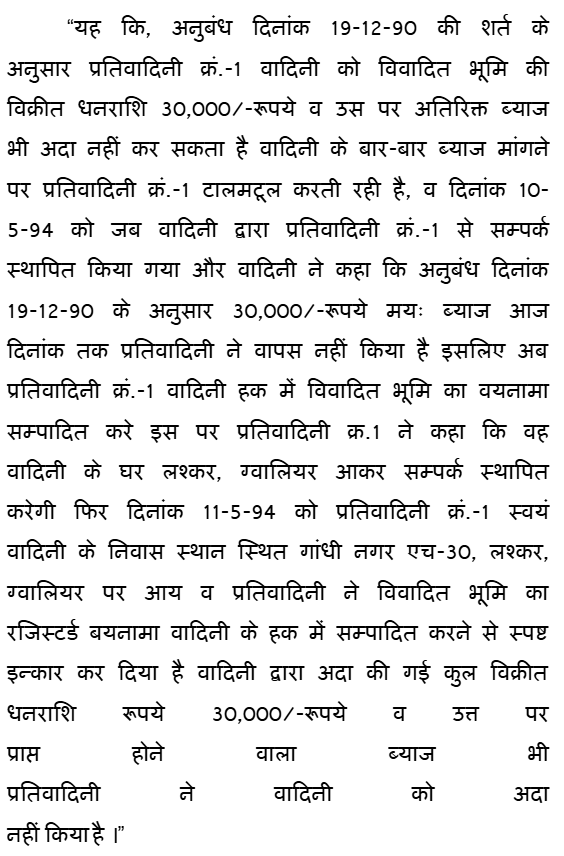
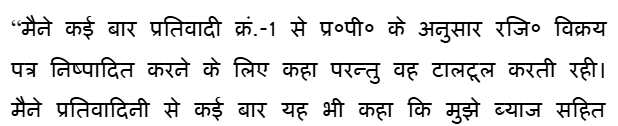
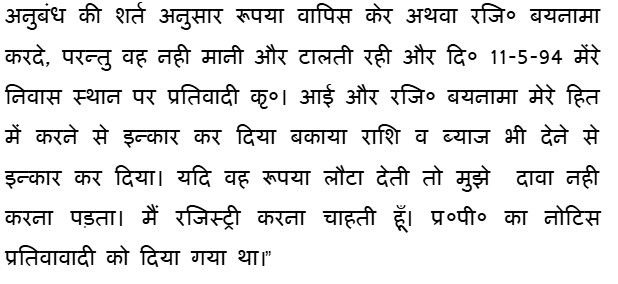
4. It is further pleaded in the plaint that the defendant no.1 could not re-pay the borrowed amount with interest as agreed in the agreement within a period of three years. Despite repeated remarks, defendant avoided repayment of the amount. It is further averred that on 10/05/1994, the plaintiff contacted the defendant and asked her to execute the sale deed as she has failed to repay the amount. Defendant no.1, in turn, told her that she would come to the plaintiff's house andtalk. On the next day i.e. on 11/05/1994, the defendant came to the plaintiff's house and refused to execute the sale deed. She also did not repay the amount with interest. In paragraph 10 of the plaint, the plaintiff has averred that the cause of action for filing the suit arose on 11/05/1994 when the defendant refused to execute the sale-deed and also to repay the amount. The suit was, thus, filed on 24/05/1994seeking specific performance of agreement dated 19/12/1990.
5. The defendant was proceeded ex-parte by the trial Court and her written statement was also not filed.
6. Learned trial Court vide judgment and decree dated 14/09/1995 dismissed the suit. While answering the issue no.3, the trial Court held that the State of Madhya Pradesh is the necessary party. Further, while answering the issue no.2, the trial Court held that the plaintiff served notice under Section 80 of CPC to the State of Madhya Pradesh on 19/05/1994 and immediately thereafter, the suit was filed on 24/05/1994. The trial Court was of the opinion that since the suit was filed before expiry of two months as contemplated under Section 80 of CPC and further that even though the application under Section 80(2) of CPC was filed, no permission in this regard was granted by the trial Court, the suit was held to be not maintainable. In paragraph 11 & 12, the learned trial Court recorded a finding that the defendant executed the agreement dated 19/12/1990 in favour of the plaintiff. However, in para 13, it opined that since the suit has been held to be not maintainable for want of compliance of Section 80 of CPC, no reliefcan be granted to the plaintiff. Thu