Back


2026 Supreme(MP) 206
IN THE HIGH COURT OF MADHYA PRADESH AT JABALPUR
VIVEK JAIN, J.
Brijbhan Prasad - Appellant
Versus
Smt. Mangi & Others – Respondents
Second Appeal No.453 of 1995
Decided On : 18-08-2026
For the Appellant :Shri Abhishek Gulatee, Advocate
For the Respondents:Shri Ravish Chandra Agrawal, Senior Advocate with Shri Jaspreet Gulati, Advocate
Oral gift of immovable property in a princely state required registration under its own Registration Act; prior admission of sub-tenancy bars claim of adverse possession; suit based on title not subject to six-month limitation.
Headnote:(A) Code of Civil Procedure, 1908 - Section 100 - Transfer of Property Act, 1882 - Section 123 - Registration Act, 1908 - Section 17 - Part-C States (Laws) Act, 1950 - Rewa State Registration Act, 1917 - Sections 1 and 21 - Limitation Act, 1963 - Article 65 - Specific Relief Act, 1963 - Section 6 - Suit for recovery of possession based on title - Oral gift of immovable property made in 1948 in erstwhile princely State of Rewa - Requirement of registration - Adverse possession - Limitation period. (Paras 1, 3, 11-15, 20-22)
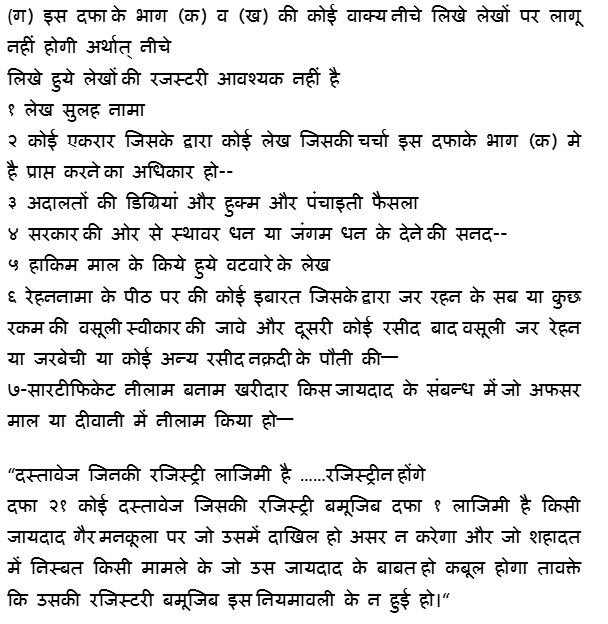
(B) Gift of immovable property made in 1948 in Rewa State was governed by Rewa State Registration Act, 1917, which required compulsory registration of instruments relating to immovable property with annual profit exceeding Rs.25 - Part-C States (Laws) Act, 1950 did not apply retroactively to transactions before 16.04.1950 - Failure to register such gift renders the transaction void under Section 21 of the Rewa State Registration Act. (Paras 11-15)
(C) A plaintiff who had previously claimed before revenue authorities to be a sub-tenant cannot simultaneously set up a plea of adverse possession - The two positions are inconsistent; admission of sub-tenancy negates the element of hostility required for adverse possession. (Paras 16-20)
(D) Where the plaintiff’s case is based on a gift from the defendant’s predecessor, the plaintiff admits the defendant’s better title - If the gift fails, the plaintiff cannot claim better title than the defendant. (Para 21) (E) Suit for possession based on title is governed by Article 65 of the Limitation Act (12 years) and not by Section 6 of the Specific Relief Act (6 months) - Even if such suit is within limitation, failure to prove the underlying title results in dismissal. (Paras 22-23)
Facts of the case:
The plaintiff filed a suit in 1968 for recovery of possession of agricultural land, claiming an oral gift in 1948 from the defendants’ ancestors. The trial court decreed the suit; the appellate court reversed and dismissed it. The plaintiff appealed under Section 100 CPC. The case had been pending for 58 years. The plaintiff had earlier represented to revenue authorities that he was a sub-tenant on the suit land. (Paras 1, 2, 16-20)
Findings of Court:
The appeal was dismissed. The court held that the oral gift was not proved and was not valid due to non-registration under the Rewa State Registration Act, 1917. The plea of adverse possession was not available as the plaintiff had admitted sub-tenancy. The suit was within limitation but the plaintiff failed to establish title. (Paras 23, 24)
Issues: (1) Whether the gift made before Part-C States Laws Act, 1950 required registration under Section 123 of Transfer of Property Act? (2) Whether the plaintiff’s possession founded on the gift could be adverse? (3) Whether the appellate court erred in applying six-month limitation under Section 6, Specific Relief Act? (4) Whether the plaintiff proved better title? (Paras 3, 5)
Ratio Decidendi: (1) The Rewa State Registration Act, 1917, not the Transfer of Property Act or Registration Act of 1908, governed transactions before 1950; oral gift of property with annual profit exceeding Rs.25 required registration. (2) Alternative plea of adverse possession is inconsistent with the plaintiff’s own admission before revenue authorities of being a sub-tenant. (3) Suit based on title is not barred by six-month limitation but plaintiff still failed to prove title. (Paras 15, 20, 22, 23)
Result: Appeal dismissed. Suit of the plaintiff stands dismissed. Appellant shall bear costs of the respondents. (Para 25)
JUDGMENT :
VIVEK JAIN, J.
The present appeal under Section 100 of the Code of Civil Procedure has been filed by the plaintiff being aggrieved by the judgment of reversal passed by the Appellate Court, whereby in appeal the Appellate Court has dismissed the suit of the plaintiff though it was allowed by the trial Court. The judgment of the trial Court in Civil Suit No.70-A of 1987 dated 24.12.1987 has been set aside by the Appellate Court in Civil Appeal No.4-A of 1990 decided on 06.03.1995, against which the plaintiff is before this Court.
2. The litigation in question is pending for the last 58 years, as the original suit was filed in the year 1968 and this Second Appeal is being decided after 31 years of its pendency.
3. The appeal was admitted vide order dated 13.07.1995 on the following two substantial questions of law, which are as under:-
(1). “Whether the gift made anterior to the Part C States (Laws) Act, 1950 required registration as per requirement u/s 123 of the Transfer of Property Act?” and
(2). “Whether, in the alternative, the possession of the plaintiff founded on the gift could be adverse to the defendant?”
4. This case was heard by a coordinate Bench of this Court at length on 11.05.2017 and the matter was released on 16.05.2017 expressing opinion that the appeal has been allowed on two more grounds i.e. the claim of the plaintiff being barred by limitation in view of Section 6 of the Specific Relief Act and secondly that the plaintiff was required to prove his right regarding better title and, therefore, the matter was released granting liberty to the plaintiff to file appropriate application.
5. In terms of the aforesaid order, plaintiff has filed IA No.8693/2017 proposing three more substantial questions of law. This Court is of the opinion that looking to the order dated 16.05.2017, two more substantial questions of law need to be framed, which are as under:-
“(3) Whether, the First Appellate Court erred in law in holding that the suit ought to have been filed within a period of 6 months overlooking the fact that the plaintiff’s suit was based on title and not on prior possession, and thus the suit is not time barred?
(4) Whether, the First Appellate Court failed to appreciate that the plaintiff had proved his right regarding better title?
Counsel for the rival parties are heard on all four substantial questions of law, including two questions that have been newly framed.
6. The counsel for the appellant has argued that a suit had been filed by him seeking recovery of possession founded on title and the suit was not based on Section 6 of the Specific Relief Act, but the suit had been founded on title and, therefore, the question of limitation would not be dealt with as per Section 6 of the Specific Relief Act, but as per Article- 65 of the Limitation Act, the limitation would be 12 years. The plaintiff had been dispossessed in the year 1964, therefore, the suit filed in 1968 was within limitation.
7. It is further argued that the plaintiff had founded his case on the basis of oral gift in the year 1948 and at that time, the provisions of the Transfer of Property Act as well as the Registration Act had not been extended to the Part-C States. Rewa was part of Vindhya Pradesh and it was a Part-C State. The Government of India had enacted the Part-C States (Laws) Act, 1950, as per which the Acts contained in Schedule to the Merged States (Laws) Act, 1949 were extended to Part-C States. The Transfer of Property Act and the Registration Act are contained in the Schedule to the Act of 1949 and, therefore, the extension of the aforesaid two Acts to Part-C States took place only on 16.04.1950, whereas the case was founded on oral sale of the year 1948 which did not require any registration and, therefore, the Appellate Court having held that oral sale is not proved, is perverse in law. It is further argued that alternative plea of adverse possession was taken but the Appellate Court has erroneously held that the case of the ap