1. Employees challenged charge-sheets issued by officers holding current charge of higher posts under Delegation of Powers. (Para 2 , 3 )
 Back
Next 





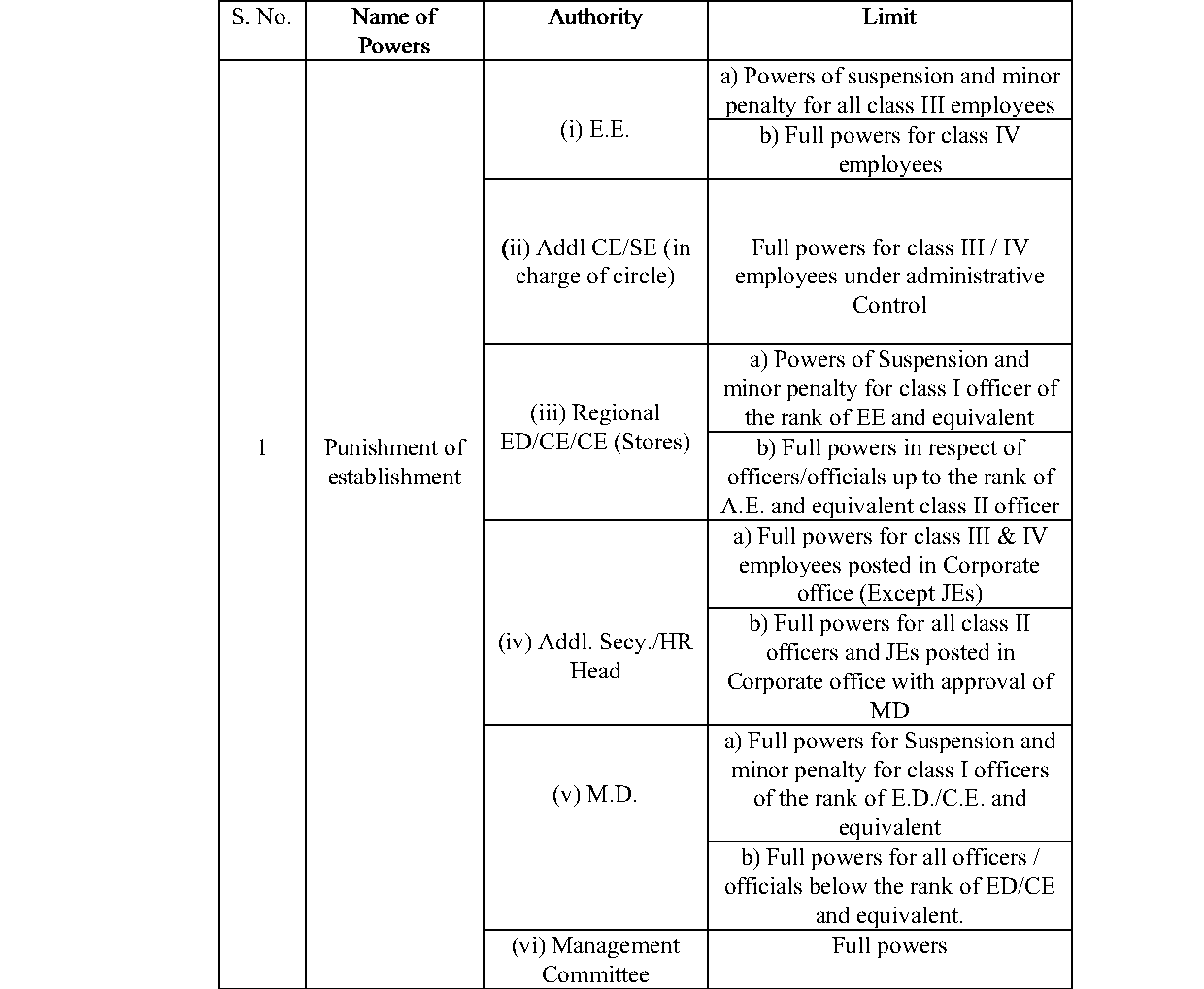
2026 Supreme(MP) 301
IN THE HIGH COURT OF MADHYA PRADESH AT JABALPUR
Anand Pathak, B. P. Sharma, JJ.
Madhya Pradesh Poorv Kshetra Vidyut Vitran Company Ltd. (Mppkvvcl) And Others – Appellant
Versus
Arunendra Prasad Maurya – Respondent
Writ Appeal No. 616 of 2024, Writ Appeal No. 1317 of 2024, Writ Appeal No. 1449 of 2024, Writ Appeal No. 1724 of 2024
Decided On : 10-07-2026
Important Points
Officers holding current charge of a higher post under an authorized Delegation of Powers are competent to exercise statutory disciplinary functions, including issuing charge-sheets, to ensure administrative continuity, provided the governing statutes do not expressly prohibit such exercise.
Subject
Service Law - Disciplinary Proceedings
Act Referred
Headnote
(A) Service Law - Disciplinary Proceedings - Competence of Officer holding current charge - Delegation of Powers - Whether an officer entrusted with current charge of a higher post under a comprehensive Delegation of Powers is competent to initiate disciplinary proceedings and issue charge-sheets (Paras 10, 12).
(B) Administrative Law - Continuity of Administration - Purpose of assigning current charge is to ensure uninterrupted functioning of public institutions, particularly those providing essential public services - Administrative machinery cannot be paralyzed due to vacancies in higher posts (Paras 14, 15).
(C) Jurisdiction - Exercise of statutory functions by in-charge officers - Unless the governing statute expressly prohibits the exercise of a particular function by an officer holding current charge, such officer is competent to discharge the duties and statutory functions attached to that office if authorized by the administrative framework (Paras 13, 18, 22).
Facts of the case:
Employees challenged the validity of charge-sheets issued by officers who were holding current charge of higher posts, contending that only substantive appointees could exercise statutory disciplinary powers. The Single Judge quashed the charge-sheets on the grounds that officers holding current charge lacked jurisdiction to initiate disciplinary proceedings.
Findings of Court:
The court held that the issuance of charge-sheets was valid as the officers were acting under a comprehensive Delegation of Powers that authorized them to exercise the functions of the higher office. The court emphasized that for public utility undertakings, administrative continuity is essential.
Issues: Whether an officer entrusted with the current charge of a higher post under the Delegation of Powers framed by a company is competent to initiate disciplinary proceedings and issue charge-sheets, or whether such statutory powers are confined only to the substantive holder of the office.
Ratio Decidendi: An officer entrusted with the current charge of a higher office is vested with the executive powers, duties, and functions attached to that office during the period of entrustment, provided there is no statutory prohibition. The competence of such an officer is determined by the governing statutory provisions, service rules, and the Delegation of Powers. Mere issuance of a charge-sheet is the initiation of proceedings and does not determine guilt, warranting judicial restraint in intervening on technical grounds of competence (Paras 17, 18, 22, 23).
Result: Writ appeals preferred by Electricity Distribution Companies allowed; Writ appeal preferred by employees dismissed.
Legal Category Hierarchy
- administrative law
- practice and procedure
Advocates Appeared:
For the Appellant :Shri Aditya Khandekar, Advocate
For the Respondent:Shri Vijay Raghav Singh, Advocate
Table of Contents
2. Appellants argued current charge confers full powers; respondents argued statutory powers require substantive appointment. (Para 4 , 5 , 6 , 7 , 8 )
3. Writ appeals allowed, Single Judge orders set aside; employees' appeal dismissed. (Para 24 )
4. Is an officer holding current charge of a higher post under a Delegation of Powers competent to initiate disciplinary proceedings?
Yes, if the Delegation of Powers expressly authorizes the officer to exercise the powers of the higher office, the officer is competent. (Para 10 , 11 , 12 , 13 , 14 , 15 , 16 , 17 , 18 , 19 , 22 )
5. Does the Full Bench decision in Girija Shankar Shukla apply to cases with a comprehensive Delegation of Powers?
No, that decision applied only where there was no statutory or executive authorization; here delegation existed. (Para 10 , 20 )
6. Should courts interfere at the stage of issuance of a charge-sheet on a technical objection regarding competence of the authority?
Courts should exercise restraint as charge-sheet merely initiates proceedings and does not impose any penalty. (Para 23 )
7. What is the legal position regarding the competence of an officer holding current charge to exercise statutory functions?
The competence depends on the governing statutory provisions, service rules, and Delegation of Powers; if authorized, the officer can discharge all functions. (Para 14 , 15 , 16 , 17 , 18 , 19 , 22 )
ORDER :
B. P. Sharma, J.
Since common questions of fact and law arise in this batch of writ appeals, they were heard analogously and are being decided by this common judgment. This order shall govern the disposal of all these appeals. For the sake of convenience, facts stated in Writ Appeal No.616/2024 are taken into consideration.
2. The appeals under Section 2(1) of Madhya Pradesh Uchcha Nyayalaya (Khand Nyaypeeth Ko Appeal) Adhiniyam, 2005 arise out of orders passed by learned Single Judge whereby the writ petitions preferred by the respondents-employees were allowed and the charge-sheets issued against them were quashed on the ground that the officers issuing the charge-sheets were merely holding current charge of the higher posts and were, therefore, not competent to exercise disciplinary powers. Aggrieved by the said orders, the Electricity Distribution Companies have preferred the present appeals.
3. The respondents are employees of the appellant - Electricity Distribution Companies. Allegations of misconduct having been levelled against them, charge-sheets were issued proposing departmental enquiries under the applicable service regulations. The charge-sheets were issued by officers who, at the relevant time, were holding current charge of the posts of Chief Engineer, Additional Chief Engineer or other higher disciplinary authorities pursuant to orders issued under the Delegation of Powers of the Company. Instead of participating in the disciplinary proceedings, the respondents challenged the charge-sheets before learned Single Judge contending that the officers issuing the same were not substantively appointed to the higher posts and consequently lacked jurisdiction to initiate disciplinary proceedings. The Companies (appellant herein) opposed the writ petitions by asserting that the officers concerned had been entrusted with the current charge along with full powers of the higher offices under the Delegation of Powers and were therefore competent to discharge all functions attached to those posts, including disciplinary functions. Learned Single Judge, relying principally upon Full Bench decision of this Court in Girija Shankar Shukla vs. SDO, Harda , AIR 1973 MP 104, accepted the contention of writ petitioners, held that officers merely holding current charge could not exercise statutory disciplinary powers and consequently quashed the charge-sheets. Hence, the present appeals.
4. Learned counsel appearing for the appellants submitted that learned Single Judge failed to appreciate the true scope of Delegation of Powers and the settled legal position governing officers entrusted with current charge. It is argued that appellant - Companies are public utility undertakings where higher posts frequently remain vacant owing to transfers, promotions and retirements and in order to ensure continuity of administration, current charge of such offices is entrusted to senior officers with full powers. Once such officers are authorized to discharge the functions of the higher office, no distinction can be drawn between administrative and disciplinary powers unless the governing rules expressly provide otherwise. It is further contended that issuance of a charge-sheet is merely the initiation of disciplinary proceedings and does not determine the rights of the employee. Consequently, interference at the stage of issuance of charge-sheet on a technical objection relating to competence was wholly unwarranted.
5. In support of the aforesaid submissions, learned counsel appearing for the Companies relied upon Gopalji Khanna vs. Allahabad Bank and others , (1996) 3 SCC 538, wherein the Hon'ble Supreme Court recognized the competence of an officer placed in charge of office to discharge the functions attached thereto. Reliance is also placed upon the Full Bench judgment of the Madras High Court in A. Savariar vs. The Secretary, Tamil Nadu Public Service Commission & Another, 2008 (4) CTC 753, holding that an officer holding current charge i