Back


2026 Supreme(MP) 360
IN THE HIGH COURT OF MADHYA PRADESH AT GWALIOR
ANAND PATHAK, PUSHPENDRA YADAV, JJ.
In Reference Of : State Of Madhya Pradesh - Appellant
Vs.
Kalyan Raikwar - Respondent
Criminal Reference No. 01 of 2024
Decided On : 29-06-2026
Advocate Appeared:
For the Appellant :Shri Deependra Singh Kushwaha – Additional Advocate General
For the Respondent:Shri R.K. Sharma – Senior Advocate and Shri V.D. Sharma – Advocate along with Ms. Bhavya Sharma – Advocate as amici curiae
IMPORTANT POINT
A trial court must exhaust all means, including visual or written communication, to comply with the mandatory requirement of examining an accused under Section 313 of the Cr.P.C. Reference to the High Court under Section 318 is an exceptional remedy, not a substitute for procedural due diligence.
Headnote:
Criminal P. C., 1973 -- Ss. 318 and 313 -- Protection of Children from Sexual Offences Act, 2012 -- Ss. 5(m) and 6 -- Penal Code, 1860 -- Ss. 449, 376(AB) and 506 -- without examining accused u/s. 313 of CrPC and entering into defence evidence stage, trial Court rendered judgment of conviction and referred matter on account that though accused was not of unsound mind but being deaf and dumb, he is unable to understand Court proceedings -- Medical Board opined that accused is “malingering” (pretending to be ill so as to escape something), he is not of “unsound mind” and is not totally deaf -- he can hear at loud amplification, has ability to understand consequences of his actions and is able to instruct his counsel in trial -- accused concealed that he was previously convicted for rape of a 14 year old disabled girl -- committed present sexual offence after suspension of sentence -- no plea of being deaf & dumb and unable to understand proceedings of Court raised in earlier trial -- even his statement u/s. 313 of CrPC was recorded -- in both cases, prosecutrices have stated that accused could speak -- no evidence by any witness that he could not speak or is dumb -- none of the medical examiners who examined accused during investigation in both cases have opined so -- no document in respect of being deaf and dumb on record in both cases -- creates doubt about the very credibility of such illness -- proper evaluation or inquiry in respect of condition or conduct of accused has not been made -- prima facie, mandatory provision of S. 313 CrPC has not been complied with -- trial Court directed to record accused statement u/s. 313 of CrPC, and if needed, accused examination be made in writing as per S. 313(5) of CrPC -- also open for trial Court to call any sign language expert for ensuring accused statement -- if accused still does not cooperate then, after giving sufficient opportunity in this regard, trial Court may proceed to pronounce judgment in accordance with law. (2001) 2 SCC 221, (1982) 2 SCC 463 and (1990) 1 SCC 361 followed. (2023) 4 MPLJ 222 relied on. (2006) 4 MPLJ 72, (2007) CrLJ 1522 (CG), Cr. Misc. Pet. No. 222 of 2005 decided on 19.2.2009 (Raj.), (2022) 4 ILR All. 53, 2003 CrLJ 1775 (Kar.), (2010) 2 Orissa Law Reviews 192 and (2019) III ILR Cut. 37 referred to. [Paras 17, 21 to 25, 29 & 34 to 36
naM çfØ;k lafgrk] 1973 & /kkjk 318 rFkk 313 & ySafxd vijk/kksa ls ckydksa dk laj{k.k vf/kfu;e] 2012 & /kkjk 5¼M½ rFkk 6 & naM lafgrk] 1860 & /kkjk 449] 376¼d[k½ rFkk 506 & naM çfØ;k lafgrk dh /kkjk 313 ds v/khu vfHk;qä dh ijh{kk fd, fcuk vkSj çfrj{kk lk{; ds çØe esa ços'k fd, fcuk] fopkj.k U;k;ky; us nks"kflf) dk fu.kZ; fn;k rFkk çdj.k bl vk/kkj ij funsZf'kr fd;k fd ;|fi vfHk;qä fo—r fpÙk ugha gS] rFkkfi ewd-of/kj gksus ds dkj.k og U;k;ky; dh dk;Zokgh le>us esa vleFkZ gS & LokLF; cksMZ dh jk; Fkh fd vfHk;qä Þjksx dk cgkukß ¼fdlh ckr ls cpus ds fy, chekj gksus dk
JUDGEMENT :
Per: Justice Anand Pathak
1. The instant criminal reference has been made by the learned Special Judge (POCSO Act), District Gwalior (M.P.) under Section 318 of the Code of Criminal Procedure, 1973 after convicting the respondent/accused for the offences under Sections 449, 376(AB), 506 of IPC and Section 6 of Protection of Child from Sexual Offences Act, 2012 (hereinafter referred to as “the POCSO Act”) vide judgment dated 14.05.2024 in SC Case No. 186/2022, on account that though the respondent/accused was not of unsound mind but on account of being deaf & dumb, the respondent/accused is unable to understand the Court proceedings, hence, referred the matter for further course to this Court. Hence, this reference is before this Court.
BRIEF FACTS OF THE CASE
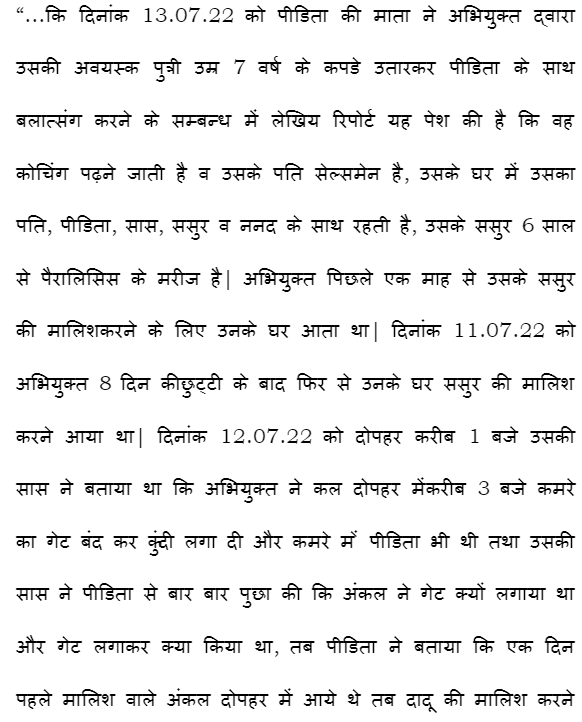
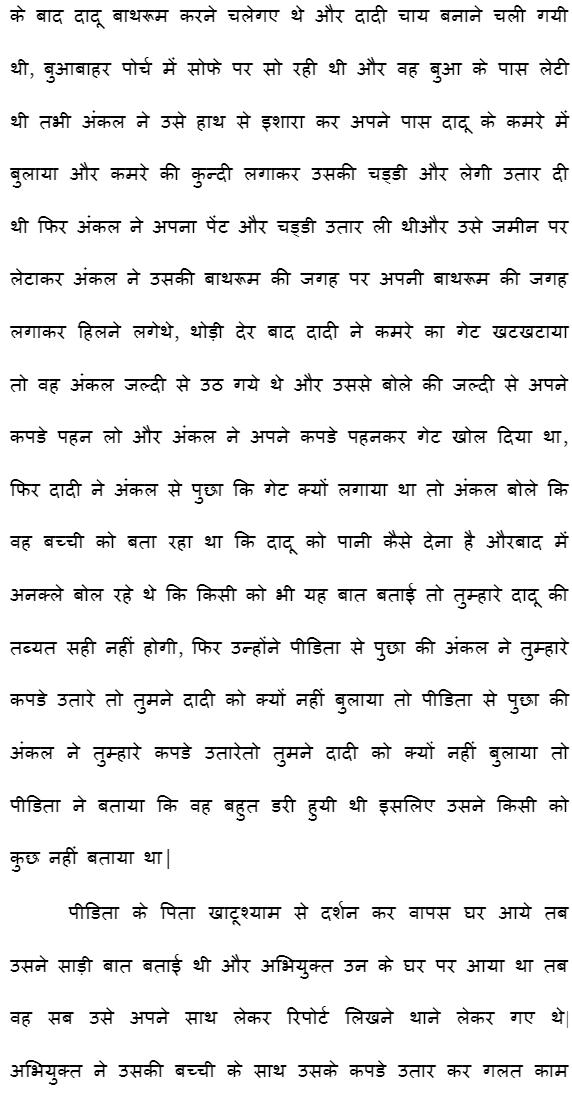
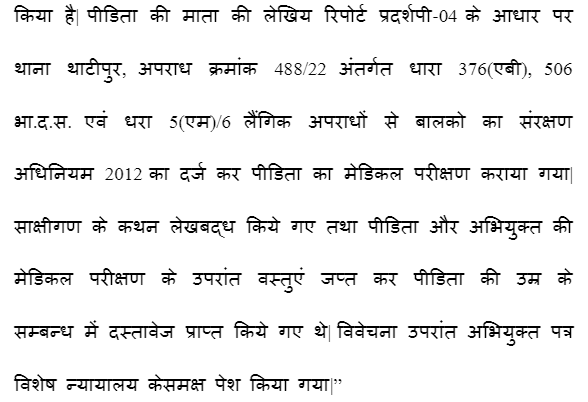
2. The factual matrix which led to the presentation of the instant reference is that an FIR came to be lodged at crime no.488/2022 at Police Station Thatipur, District Gwalior (M.P.) for the offences u/s. 376 (AB), 506 of IPC and Sections 5m/6 of POCSO Act giving the following particulars as is stated in para 4 & 5 of the judgment dated 14.05.2024 passed in SC Case No.186/2022:
3. On the basis of the aforesaid FIR, investigation got initiated and charge-sheet was filed along with all investigative processes being undertaken before the learned trial Court, whereinafter the trial began after framing of charges u/s. 376(AB), 506, 449 of IPC and Sections 5(m) r/w. 6 of POCSO Act, wherein the charges were denied by the respondent/accused through counsel.
4. During trial the prosecution witnesses from PW-1 to PW-11 were examined and when the trial was at the stage of accused examination u/s. 313 of Cr.P.C., the plea was raised by the respondent/accused through counsel that as the accused is deaf & dumb, therefore, his examination be conducted by the medical board or medical officer.
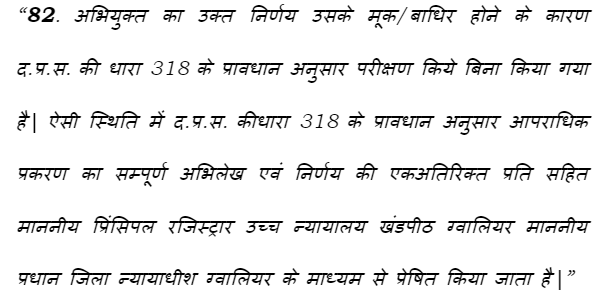
5. When the examination from the medical board was undertaken and even the sign language experts were called, the respondent/accused allegedly unable to understand the sign language and even was unable to understand the questions being asked for accused examination. Therefore, in view of Section 318 of Cr.P.C. and judgment of the Chhattisgarh High Court in the case of State of Chhattisgarh Vs. Deepak Kumar Sahu, (2007) 1 MPHT 80 trial Court without examining the accused u/s. 313 of Cr.P.C. and entering into defence evidence stage, directly rendered the judgment of conviction dated 14.05.2024 in SC Case No.186/2022 by learned Special Judge (POCSO Act), District Gwalior (M.P.) and thereafter, made the reference to this Court u/s. 318 of Cr.P.C. while concluding in para 82 as stated hereunder:
6. Hence, this reference is before this Court for further orders in view of section 318 of Cr.P.C.
7. Issue involved in the present reference is; “Whether the proceedings been submitted u/s. 318 of Cr.P.C. before this Court is proper and as per settled legal matrix in view of material available on record and otherwise ?”
8. Learned amici curiae argued at length and while placing reliance on several judgments in Re: Boura @ Drigpal, (2006) 4 MPLJ 72, State of Chhattisgarh Vs. Deepak Kumar Sahu, (2007) Cr.L.J. 1522, State of Rajasthan Vs. Gani Mohammad judgment dated 19.02.2009 passed in Crim. Misc. Pet. No. 222/2005, Charan Singh Vs. State of U.P., (2022) 4 ILR A53, Shantaram Dattatraye & Ors. Vs. State of Karnataka, 2003 Cr.L.J. 1775, Bijay Nanda @ Bijay Kumar Nanda Vs. State of Orissa, (2010) 2 Orissa Law Reviews 192, State of Orissa Vs. Rathlal Dhanwar @ Kunda, (2019) III ILR-CUT-37, submits that not in all cases where accused is deaf & mute reference can be made. If the accused does not understand the proceedings then he can be made understood the proceedings by way of his relative or interpreter. Trial may go in ordinary way and examination of accused under Section 313 of Cr.P.C. can be made in writing. Of course, if the case is genuine and accused is not acting or faking by all means adopted, the accused c