1. Refund of excess compounding deposit under search proceedings denied due to lack of statutory provision. (Para 1 , 2 )
 Back
Back
Next 





2026 Supreme(MP) 526
IN THE HIGH COURT OF MADHYA PRADESH AT JABALPUR
Vivek Rusia, Pradeep Mittal, JJ.
M/S Indraprasth Uniforms – Petitioner
Versus
The State Of Madhya Pradesh And Others – Respondents
Writ Petition No. 7572 of 2019
Decided On : 12-03-2026
Advocates Appeared:
For the Petitioner:Shri Ganesh Narayan Purohit, learned Senior Advocate, through Video Conferencing with Shri Uma Parashar & Shri Eshan Tripathi, Advocate
For the Respondent:Shri Rajvardhan Dutt Padraha, learned Government Advocate
For the Petitioner:Shri Ganesh Narayan Purohit, learned Senior Advocate, through Video Conferencing with Shri Uma Parashar & Shri Eshan Tripathi, Advocate
For the Respondent:Shri Rajvardhan Dutt Padraha, learned Government Advocate
Voluntary compounding deposits under Section 55A(a) of the VAT Act are final and non-refundable. Section 55A(b) bars challenges to the agreed evasion, and such deposits do not constitute illegal tax collection under Article 265, regardless of any lower liability determined in subsequent block assessments.
Headnote:(A) Value Added Tax Act, 2002 - Sections 55 and 55A - Constitution of India - Article 265 - Search and seizure - Voluntary compounding of tax evasion - Refund of excess amount deposited - Where a dealer opts to pay a lump sum amount in lieu of tax, interest, and penalty under Section 55A(a) relative to the block period, Section 55A(b) explicitly bars the right to challenge the evasion of tax agreed to by the dealer in any forum - Such payments, being voluntary deposits under a statutory compounding scheme, cannot be categorized as tax collected without authority of law - In the absence of a specific statutory provision for the refund of compounding amounts, the dealer is not entitled to a refund even if a subsequent block assessment determines a lower tax liability. (Paras 7, 8, 12)
(B) Constitution of India - Article 265 - Writ of Mandamus for refund - High Court's power to direct refund of illegally collected tax is a recognized principle, but such power cannot be exercised where the amount was deposited voluntarily under a statutory provision for compounding, as such deposits do not constitute illegal collection. (Para 12)
Facts of the case:
Following a search conducted under Section 55 of the VAT Act, a representative of the petitioner admitted to tax evasion and voluntarily deposited lump sum amounts as compounding deposits under Section 55A(a). Subsequently, block assessment proceedings were initiated, and the assessing authority determined the tax liability to be significantly lower than the amounts deposited during the search. The petitioner sought a refund of the excess amount, contending that the retention of funds beyond the finally assessed liability violates Article 265 of the Constitution of India.
Findings of Court:
The court found that the option to pay a lump sum under Section 55A(a) is voluntary and not compulsory. Once this option is exercised, Section 55A(b) operates as an estoppel, preventing the dealer from challenging the agreed evasion. Since the statutory scheme of the VAT Act does not provide for the refund of amounts paid under the compounding option, the request for a refund is legally unsustainable.
Issues: Whether a dealer is entitled to a refund of excess amounts deposited voluntarily as compounding under Section 55A(a) of the VAT Act when the subsequent block assessment determines a lower tax liability, and whether such retention violates Article 265 of the Constitution of India.
Ratio Decidendi: Payments made under the compounding option of Section 55A(a) are voluntary settlements in lieu of tax, interest, and penalty. Because Section 55A(b) precludes any challenge to the agreed evasion and the Act contains no provision for refunding such deposits, the retention of these funds by the State is not an illegal collection of tax and does not violate Article 265 of the Constitution.
Result: The writ petition is absolutely misconceived, accordingly, the same stands dismissed.
Legal Category Hierarchy
-
tax law
- madhya pradesh value added tax act, 2002
- entry tax
- constitutional law
- practice and procedure
Table of Contents
2. Petitioner claims refund of excess deposit as illegal; respondents contend voluntary compounding bars refund. (Para 4 , 5 )
3. Writ petition dismissed; no entitlement to refund of voluntarily deposited compounding amount. (Para 15 )
4. Can a dealer claim refund of excess compounding amount deposited under Section 55A(a) when later assessment determines lower liability?
No, because the Act has no refund provision for compounding amounts voluntarily deposited; the deposit is in lieu of tax, interest, and penalty. (Para 8 , 11 , 12 , 13 , 14 , 15 )
5. Does Article 265 of the Constitution require refund of voluntarily deposited compounding amount under Section 55A(a)?
No, because the amount was deposited under a statutory scheme, not collected without authority of law; hence Article 265 does not mandate refund. (Para 12 , 8 )
6. Once a dealer exercises the option under Section 55A(a), can he challenge the evasion or seek refund?
No, sub-section (b) estops the dealer from challenging the evasion agreed to, and no refund is provided. (Para 5 , 8 , 10 , 15 )
ORDER :
Vivek Rusia, J.
The petitioner has filed the present petition under Article 226 of the Constitution of India being aggrieved by the action of the respondents in denying refund of the excess amount deposited during search proceedings conducted under Section 55 of the Madhya Pradesh Value Added Tax Act, 2002 (for short “VAT Act”) on the ground that retention of such excess amount is without authority of law and violative of Article 265 of the Constitution of India. The petitioner has, inter alia, prayed for a direction to the respondents to refund the excess amount collected as compounding under Section 55 A (a) of the VAT Act, along with interest.
Facts of the case, in short, are as follows:-
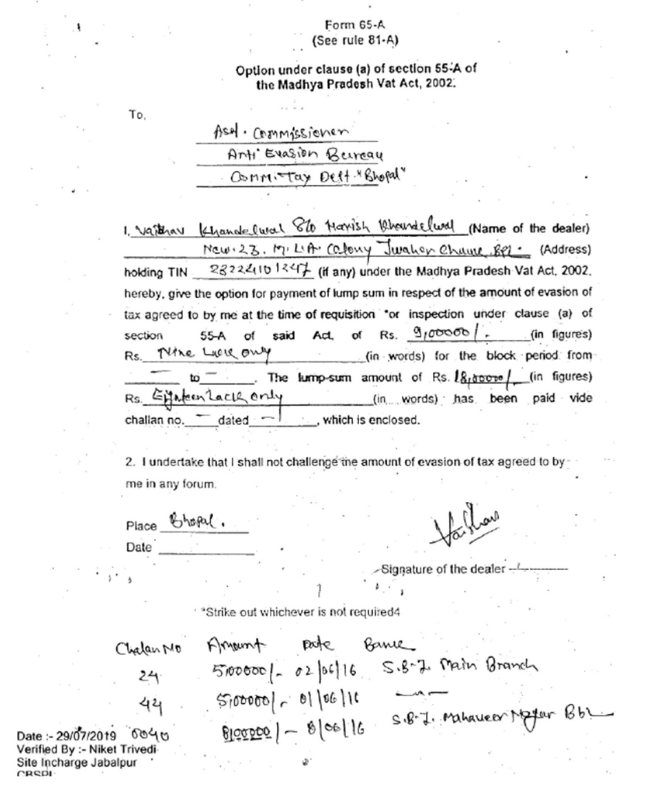
2. The petitioner is a registered dealer under the Madhya Pradesh Value Added Tax Act, 2002 (hereinafter referred to as the “VAT Act”) bearing TIN No. 23044105062 and has been engaged in the business of purchase and sale of cloth, school uniforms and manufacturing of school uniforms. The petitioner was regularly assessed under the VAT Act and Entry Tax Act. A search under Section 55 of the VAT Act was conducted at the business premises of the petitioner on 28.05.2016, upon authorisation issued by the Commissioner of Commercial Tax. At the time of search, the petitioner was not personally present in the business premises as his grandmother was critically ill and ultimately she expired on 21.06.2016. The search proceedings were attended by Shri Vaibhav Khandelwal, and his statement was recorded at the conclusion of the said search. According to the petitioner, under exceptional circumstances, Shri Vaibhav Khandelwal accepted the alleged tax evasion of Rs.8,50,000/-. Consequently, an amount of Rs.17,00,000/- (Rs.8,50,000/- + Rs.8,50,000/-) was deposited under Section 55 A (a) towards VAT as compounding amount vide challan Nos. 30 and 36 dated 02.06.2016 and Rs.5,00,000/- was also deposited towards Entry Tax. Apart from the above, two Demand Drafts bearing No. 32345 dated 02.06.2016 for Rs.3,22,698/- (Entry Tax) and No.32347 dated 02.06.2016 for Rs.20,22,458/- (VAT) were handed over to the search party as an advance payment of tax. However, according to the petitioner, the entire amount was treated and deposited by the search party as a compounding deposit under Section 55 A (a). Thereafter, block assessment proceedings were initiated under Section 55 A of the VAT Act for the period from 01.04.2010 to 28.05.2016. Upon verification and scrutiny of seized documents, the Assessing Authority finally determined the tax liability of the petitioner at Rs.5,51,537/- towards VAT and Rs.72,682/- towards Entry Tax.
3. The petitioner is not challenging the determination of liability as assessed in the block assessment. The grievance of the petitioner is confined only to the denial of a refund of the excess amount so deposited by it, which amounts to Rs.29,41,752/- towards VAT and Rs.3,54,636/- towards Entry Tax. The respondents, while passing the order dated 28.12.2017 under Section 55A of the VAT Act, denied refund on the ground that there is no provision under the VAT Act for refund of compounding amount once deposited under Section 55A (a). Being aggrieved by the denial of a refund and retention of the alleged excess amount, the petitioner has approached this Court by filing the present writ petition.
Submissions on behalf of the Petitioner:
4. Learned senior counsel appearing for the petitioner submitted that the respondents are not justified in denying a refund of the excess amount erroneously and coercively collected at the time of search as a compounding deposit under Section 55A (a) of the VAT Act. It is contended that Section 55A (b) merely bars the petitioner from challenging the evasion of tax agreed to by him; however, the petitioner is not challenging the assessment of tax liability as finally determined. The petitioner is only seeking a refund of the excess amount collected over and above the liability assessed. Learned senior coun