


1. Execution proceedings — Satisfaction of compromise decree — Validity of tender by cheque — Order XXI Rule 2 CPC. (Para 2 , 3 , 4 , 5 , 6 , 7 , 8 , 9 , 10 )

 Back
Back





IN THE HIGH COURT OF MADHYA PRADESH AT INDORE
ALOK AWASTHI, J.
Parth Credit And Capital Market Pvt. Ltd. And Others – Petitioners
Versus
Ideal Electronics Pvt. Ltd., Through Director Pavankumar Chopara – Respondent
MISC. Petition No. 2145 of 2025
Decided On : 27-01-2026
1. Execution proceedings — Satisfaction of compromise decree — Validity of tender by cheque — Order XXI Rule 2 CPC. (Para 2 , 3 , 4 , 5 , 6 , 7 , 8 , 9 , 10 )
2. Cheque as valid tender — Direct payment requirement — Res judicata bar. (Para 11 , 12 , 13 , 14 , 15 , 16 , 17 , 18 )
3. Petition allowed — Impugned order quashed — Judgment debtor directed to deposit decretal amount with interest. (Para 42 , 43 , 44 , 45 )
No, because the prior order did not decide the same application; it only rejected an objection, not the application under Order XXI Rule 2. (Para 21 , 22 , 23 , 37 )
Yes, payment by cheque is a valid tender. Unless cash is specifically required, a cheque, if honoured, relates back to the date of delivery and satisfies the decree. (Para 24 , 25 , 26 , 27 , 28 , 29 , 30 , 31 , 32 , 33 , 34 , 35 , 36 , 39 , 40 )
No, an executing court cannot travel beyond the terms of the decree. It must enforce the decree as agreed and cannot introduce new conditions like interest or mode of payment. (Para 25 , 40 , 41 )
ORDER :
ALOK AWASTHI, J.
With the consent of the parties, heard finally.
2. This petition has been filed by the petitioner/judgment debtor being aggrieved by the order dated 12.04.2025 in Execution Case No. 44/2023 pending before XIIIth District Judge, Indore by which the executing Court rejected the application filed by the petitioner under Order XXI Rule 2 read with Section 151 of the Code of Civil Procedure, 1908 (hereinafter to be referred as "CPC").
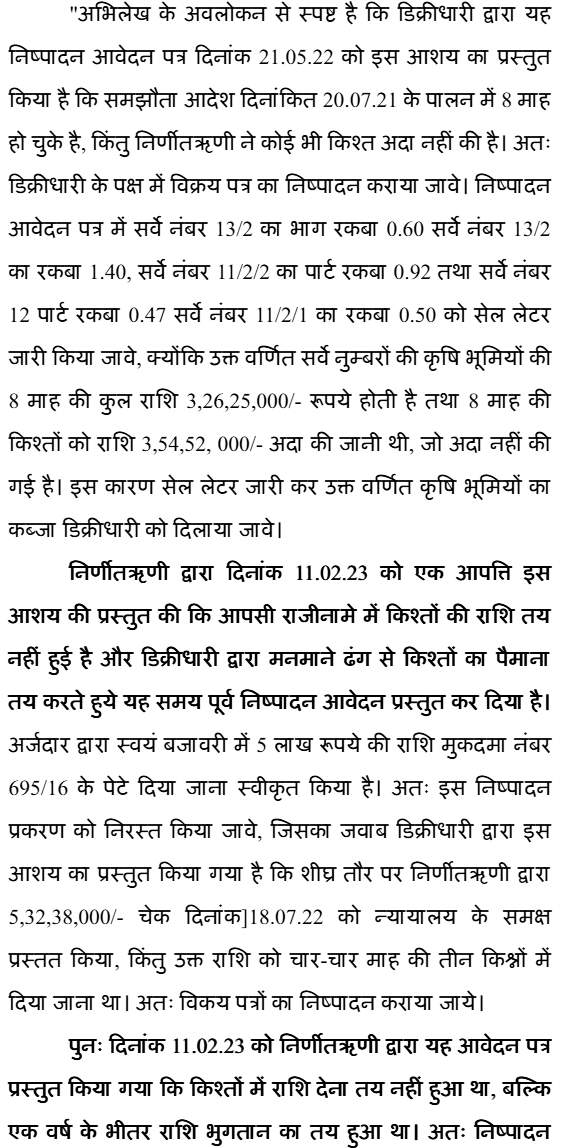
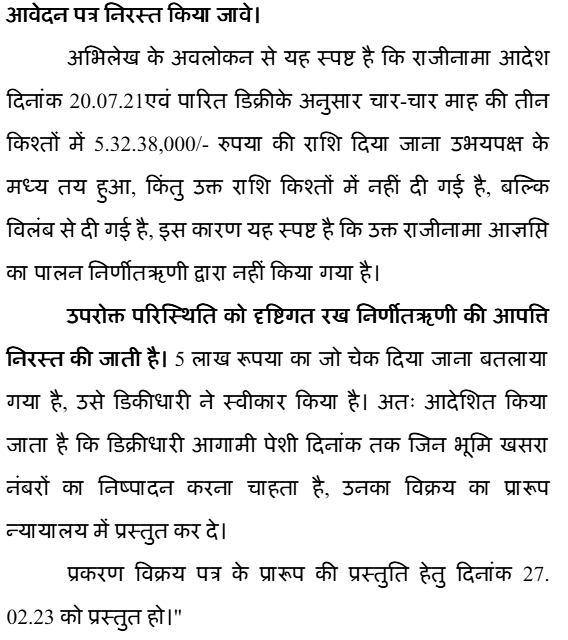
3. Brief undisputed facts of the case that are necessary for the disposal of the present petition are that a land sale agreement between the respondent and the petitioner for Rs. 35,50,000/- was executed as security against the loan, for which a case No. 69A/2016 was filed for the enforcement of a specific agreement and another Case No. 97/2020 for the amount of Rs. 1,10,73,972/- was filed for the recovery of the money. During the said period, a compromise was reached on 20.07.2021 for Rs. 5,32,38,000/-, in which, compromise order was passed by the Court below.
4. It was stated that the petitioner had agreed to pay Rs. 5,32,38,000/- to the respondent for the settlement of both the cases and the respondent himself who wanted assistance under a specific agreement, had given up the said assistance and accepted the money and had sought the right to assistance under a specific agreement on the land in lieu of security for receiving the money. Upon settlement, the petitioner promptly paid Rs. 5,00,000/- as an installment.
5. In the compromise application (Annexure-P/1) dated 19.07.2021, in Point No. 6, it is clearly mentioned that "that if the defendant does not pay the entire amount within one year as per the mutual agreement, then in such a situation, the plaintiff will be entitled to get the sale deed of the agricultural land mentioned in the plaint situated at Badiyakima, whose details have been given in step 2, executed through the court. But the condition will be that the plaintiff will release the agricultural land in proportion to the amount paid by the defendant to the plaintiff within one year, and in respect of the remaining land, the plaintiff will be entitled to get the sale deed registered from the defendant. And if the sale deed is not registered by the defendant, then the plaintiff will be entitled to get the sale deed registered with the help of the Hon'ble Court."
6. Further, vide order dated 31.07.2023 passed in M.P. 4318/2023 by this Court, it has been held that “Heard the counsel for both the parties and perused the record. Annexure P-2 is compromise order between both the parties passed by IV District Judge, Indore in Case No.69A/2016. According to the terms and conditions of compromise that judgment debtor paid the total amount in installment of four months within a year and if total amount is not paid within a year, then the decree holder may file execution of sale deed before the Court and have right to execute sale deed through Court. But it is the duty of the plaintiff to release the land in proportion to the amount deposited by the defendant in one year."
7. In compliance with the compromise dated 20.07.2021, the petitioner satisfied the order by submitting separate cheques of Rs. 5,32,38,000/- in the name of the Court and Rs. 5,32,38,000/- in the name of the respondent in the Court of the Fourth District Judge, Indore, within one year under Order XXI Rule 1 of CPC. It is an admitted fact that the amount has been deposited by the petitioners through cheque on 18.07.2022 within one year and on 25.07.2022, the Court informed the petitioners that the respondent refused to accept the cheque within 90 days which is mentioned in the order sheet dated 24.07.2023 and the cheque has not been dishonoured till date and under Section 266 of the Income Tax Act, any transaction of more than Rs. 20,000/- shall be done through cheque and not in cash.
8. The decree holder himself has accepted on 04.10.2023 in response to the application dated 20.09.2023 submitted by the judgment d
AI



An indispensable Tool for Legal Professionals, Endorsed by Various High Court and Judicial Officers
Please visit our Training & Support
Center or Contact Us for assistance

Scan Me!
India’s Legal research and Law Firm App, Download now!


For Daily Legal Updates, Join us on :



 Back to top