


1. Challenge to rejection of compassionate appointment under policy clauses 3, 13.1, 13.2 after cancellation of brother's earlier appointment. (Para 2 , 3 , 4 )

 Back
Back





IN THE HIGH COURT OF MADHYA PRADESH AT INDORE
JAI KUMAR PILLAI, J.
Priyanka Pandey – Petitioner
Versus
The State Of Madhya Pradesh And Others – Respondents
Writ Petition No.31332 of 2023
Decided On : 29-01-2026
1. Challenge to rejection of compassionate appointment under policy clauses 3, 13.1, 13.2 after cancellation of brother's earlier appointment. (Para 2 , 3 , 4 )
2. Petitioner argued rejection arbitrary and clauses inapplicable; respondents contended ineligibility and prior grant to brother. (Para 5 , 6 )
3. Impugned order quashed; competent authority directed to reconsider application in accordance with policy. (Para 17 , 18 , 19 )
No. The requirement of Clause 3 is satisfied at the threshold when the first application is made within seven years; the subsequent application by another dependent is also within time. (Para 10 , 11 )
No. These clauses apply only when a compassionate appointment has been granted and the appointee seeks re-appointment or transfer; cancellation means no appointment was ultimately granted. (Para 14 , 16 )
No. The delay and procedural lapse are attributable to the respondents, not the petitioner, as the policy mandates character verification prior to appointment. (Para 12 , 13 )
Compassionate appointment is an exception to regular recruitment, meant to mitigate sudden financial crisis due to death of breadwinner; must be provided immediately and not after crisis is over. (Para 15 )
ORDER :
JAI KUMAR PILLAI, J.
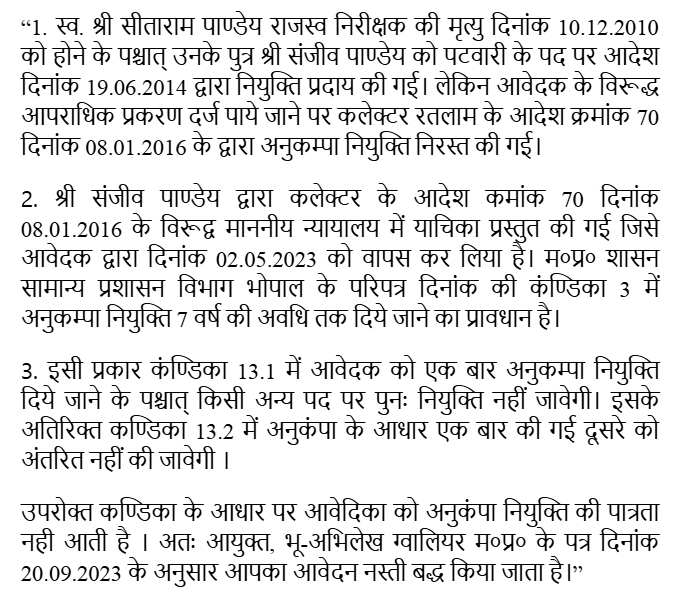
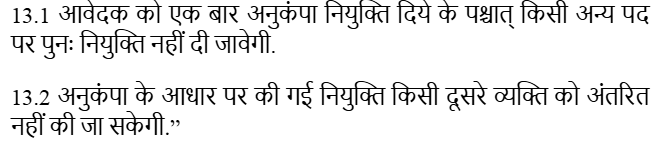
This writ petition has been filed by the petitioner under Article 226 of the Constitution of India calling in question the validity and legality of the impugned communication/order dated 30/10/2023 (Annexure P/1) issued by Respondent No.4, whereby the claim of the petitioner for Compassionate Appointment has been rejected on the ground of alleged ineligibility under Clauses 3, 13.1 and 13.2 of the Compassionate Appointment Policy dated 18/08/2008.
2. The facts of the case, briefly stated are that the father of the petitioner, Late Shri Sitaram Pandey, was working as Revenue Inspector in the respondent Department. He died in harness on 10/12/2010, leaving behind a widow, a son namely Sanjeev Pandey, one unmarried daughter and one married daughter. After the death of the father of the petitioner, the petitioner’s brother, Shri Sanjeev Pandey, applied for Compassionate Appointment in the month of January, 2011 and submitted the application along with all relevant documents. After scrutiny, he was called for training for the post of Patwari, which commenced from 01/07/2014.
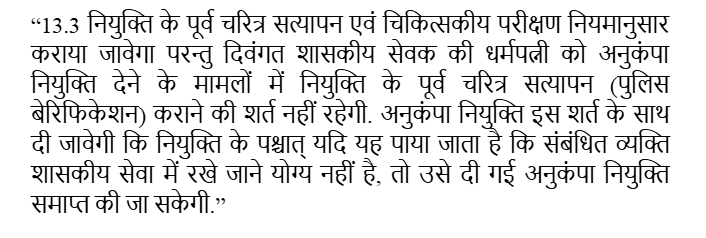
3. The petitioner’s brother participated in the training and successfully completed the training period. After completion of the training process, respondent No.3 sought police verification, in which two cases under Section 13 of the Gambling Act of the years 2008 and 2009 were found against him, in which he was held guilty and fined Rs.100/-. After receipt of the report, respondent No.3 rejected the candidature of the petitioner’s brother vide order dated 08/01/2015 (Annexure P/3). Being aggrieved by the said order, the petitioner’s brother filed W.P. No.1108/2016 before this Court, which was dismissed as withdrawn on 02/05/2023. After rejection of the candidature of the petitioner’s brother, on 01/10/2016, the petitioner’s mother submitted an application seeking consideration of the petitioner’s candidature for Compassionate Appointment along with all relevant documents, affidavits of other dependents and educational documents of the petitioner.
4. Afterwards, proceedings were initiated regarding Compassionate Appointment of the petitioner. In the said proceedings, it was stated by the respondents that after decision in the case of the petitioner’s brother, the application of the petitioner would be considered. On different dates, the same assurance was given. On the basis of such assurance, the petitioner’s brother withdrew the writ petition. After withdrawal of the writ petition by the petitioner’s brother, the respondents rejected the application of the petitioner by the impugned communication dated 30/10/2023, on the grounds that Compassionate Appointment can be granted only within seven years from the date of death of the employee and also on the grounds mentioned in Clauses 13.1 and 13.2 of the policy dated 18/08/2008 (Annexure P/7).
5. Learned counsel for the petitioner contended that the impugned order rejecting the claim of the petitioner for Compassionate Appointment is arbitrary, illegal and contrary to the policy governing Compassionate Appointment. It is submitted that the family of the deceased employee remained in penury after the death of the sole breadwinner and continues to face financial hardship. It is contended that the petitioner’s brother was never appointed, as his candidature was rejected after police verification and therefore Clauses 13.1 and 13.2 of the policy are not applicable to the case of the petitioner. It is further contended that the delay in consideration of the petitioner’s application occurred due to pendency of the proceedings relating to the petitioner’s brother and the delay is attributable to the respondents. It is urged that the impugned communication is violative of Articles 14 and 21 of the Constitution of India and deserves to be quashed.
6. Per contra, learned Government Advocate for the respondents/State submitted that the petitioner is not eligible for Compassionate Appointment in view

AI



An indispensable Tool for Legal Professionals, Endorsed by Various High Court and Judicial Officers
Please visit our Training & Support
Center or Contact Us for assistance

Scan Me!
India’s Legal research and Law Firm App, Download now!


For Daily Legal Updates, Join us on :



 Back to top