1. Petitioner sought mandamus for removal of encroachments from a public lane declared by a civil court decree under Cantonments Act. (Para 2 )
 Back
Next 


2026 Supreme(Telangana) 288
IN THE HIGH COURT OF JUDICATURE FOR THE STATE OF TELANGANA
Nagesh Bheemapaka, J.
Rishi Kanth Naresh Betha - Petitioner
Versus
The Secunderabad Cantonment Board, Rep. by its Chief Executive Officer & another - Respondents
Writ Petition No. 35604 of 2025
Decided On : 25-02-2026
Advocates:
Advocate Appeared:
Petitioner Counsel: M. Hareesh Kumar rep. Zeeshan Adnan Mahmood
Respondent Counsel: K.R. Koteswara Rao (SC for Cantonment); P. Venugopal, SC assisted by Ch. Jaya Krishna
Advocate Appeared:
Petitioner Counsel: M. Hareesh Kumar rep. Zeeshan Adnan Mahmood
Respondent Counsel: K.R. Koteswara Rao (SC for Cantonment); P. Venugopal, SC assisted by Ch. Jaya Krishna
Decrees for perpetual injunction are not subject to limitation periods. Once a civil court declares a lane as public, the local authority is statutorily and constitutionally obligated to remove encroachments and ensure unobstructed public access under the public trust doctrine.
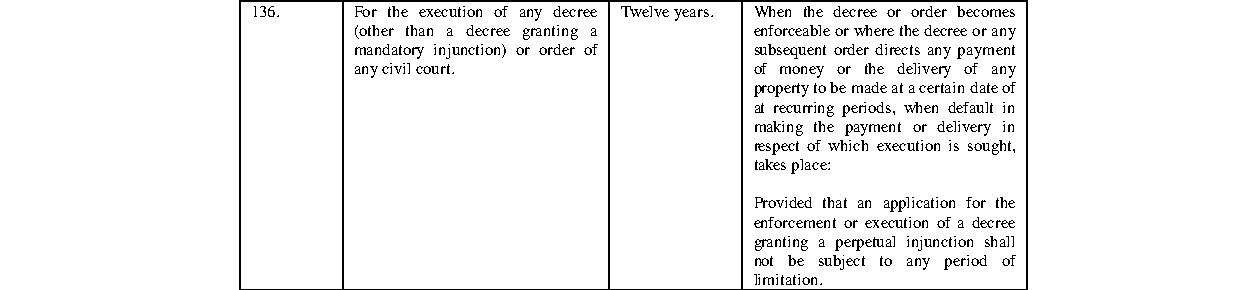
Headnote:(A) Limitation Act, 1963 - Article 136 - Decree for perpetual injunction - Enforcement of a decree for permanent injunction is not subject to any period of limitation under the proviso to Article 136 - A writ petition seeking the enforcement of statutory duties to protect a public lane, where the lane's status was established by a civil decree, is not an attempt to bypass the Limitation Act. (Paras 8, 9, 10)
(B) Cantonments Act, 2006 - Section 261 - Boundary walls, hedges and fences - Statutory duty of the Board to ensure that a public lane is not encroached and that ingress and egress is not hindered - Mandamus lies to compel a statutory authority to remove encroachments from a public lane as declared by a competent civil court. (Paras 15, 16, 17)
(C) Constitution of India - Articles 14, 21 and 226 - Public Trust Doctrine - Public streets and lanes are arteries of urban life dedicated to public use - Ensuring unobstructed movement and mobility is an incident of the right to life under Article 21 - State and local authorities hold such spaces in trust for the community and have a constitutional and statutory duty to keep them free from obstruction. (Paras 18, 19)
(D) Res Judicata - Once a competent civil court, after a full trial and appeal, has conclusively decided the status of a lane as a public passage, there is no requirement to file a subsequent suit to confirm the decree - Such findings attain finality and cannot be re-agitated or challenged collaterally in a writ proceeding. (Paras 11, 14)
Facts of the case:
The petitioner owns a property adjacent to a lane. A previous civil suit and a subsequent appeal had conclusively adjudicated that the lane in question is a public passage, granting the general public rights of access. Despite this, a third party allegedly erected unauthorized constructions and fences on the lane, restricting ingress and egress. The petitioner submitted multiple representations to the local authority to remove these encroachments under the relevant statutory provisions, but the authority failed to take action.
Findings of Court:
The court held that the decree for perpetual injunction does not expire under the Limitation Act. Since the civil court had already declared the lane as public, the local authority has a statutory duty to protect it from encroachments. The court rejected the argument that disputed questions of fact precluded the writ petition, as the issue had already reached finality in the civil court and is bound by the principle of res judicata.
Issues: Whether a writ petition is maintainable to compel the enforcement of a statutory duty to protect a lane declared public by a civil decree, despite the lapse of time since the decree; whether the status of a public lane, once decided by a civil court, can be re-agitated; and whether the local authority is obligated to remove encroachments from such a lane.
Ratio Decidendi: Decrees for perpetual injunction are not subject to limitation periods for execution. When a competent civil court's finding on the public nature of a road attains finality, the statutory authority is duty-bound to ensure it remains free of encroaching structures, as public lanes are essential to the right to life and mobility under the public trust doctrine.
Result: Writ Petition allowed; Respondent No. 1 directed to ensure the public lane is free from encroachments and obstructions within four weeks.
Legal Category Hierarchy
- administrative law
- civil procedure
- constitutional law
- property law
Table of Contents
2. Petitioner argued statutory duty to remove encroachments per decree; respondents argued writ bypasses limitation and involves disputed facts. (Para 3 , 4 , 5 , 6 )
3. Civil court categorically held lane is a public passage; no limitation for perpetual injunction decrees; res judicata applies. (Para 8 , 9 , 10 , 11 , 12 , 14 , 15 , 16 , 17 , 18 , 19 , 20 )
4. Perpetual injunction decree enforcement has no limitation under Article 136 proviso; res judicata prevents re-litigation of declared public lane. (Para 8 , 9 , 10 , 11 )
5. Writ allowed; directed removal of encroachments from public lane within four weeks; no costs. (Para 21 , 22 )
6. Is a writ petition maintainable to enforce a civil court decree declaring a public lane, despite limitation for execution?
Yes, because under Article 136 proviso, a perpetual injunction decree has no limitation period; thus the writ is maintainable to compel statutory duty. (Para 8 , 9 , 10 )
7. Can the status of a lane declared as 'public passage' by a civil court be re-agitated in collateral proceedings?
No, the principle of res judicata prevents re-litigation of the lane's status; the finding is conclusive and binding. (Para 11 , 12 , 14 )
8. Does a cantonment board have a statutory duty under Section 261 of the Cantonments Act, 2006 to remove encroachments from a public lane?
Yes, once a lane is judicially declared as public, the board is obliged under Section 261 to remove encroachments and ensure free ingress and egress. (Para 15 , 16 , 17 , 20 )
9. Does the directive to 'dispose of representation' function as proper disposal of a writ petition?
No, the Supreme Court in P. Venkatesh deprecated this practice; the court should call for counters and adjudicate merits finally. (Para 12 , 13 )
ORDER :
Nagesh Bheemapaka, J.
Heard Sri M. Hareesh Kumar, learned counsel representing Sri Zeeshan Adnan Mahmood, learned counsel for Petitioner, Sri K. R. Koteswara Rao, learned Standing Counsel for Respondent No. 1, Sri. P. Venugopal, learned Senior Counsel assisted by Sri Ch. Jaya Krishna, learned counsel for Respondent No.2.
2. It is the case of Petitioner that he is the owner of H. No. 2-6-7/8, admeasuring 65.55 Sq. Yards or 54.34 Sq. Meters situated at Sikh Village, Secunderabad Cantonment, Telangana having inherited the same from his father Betha Mallesh, who expired on 20.06.2015. The said Mallesh purchased the same from Ganta Sangeetha, wife of Ganta Rana Prakash Yadav by virtue of a registered Sale Deed dated 19.09.2002 bearing document No. 1425 of 2002 of the office of Sub Registrar, Bowenpally.
2.1. It is the further case of petitioner that in 1992, their predecessor-in-title viz. Ganta Sangeetha filed O.S. No. 1182 of 1992 on the file of the I Assistant Judge, City Civil Courts, Secunderabad against the father of the Respondent No. 2 by name Capt. Ramalingam, seeking perpetual injunction contending that he is interfering with the ingress and egress from the 15 feet public road. The father of Respondent No. 2, being the sole Defendant in the aforesaid suit, had taken an identical stand as taken by Respondent No. 2 in the present proceedings and contended that the passage in question was a private passage which was being used by them for cleaning the septic tank. The Civil Court had framed an issue as to whether the suit property is a public passage and plaintiff is entitled for perpetual injunction as prayed for?
2.2. It is further contended that civil Court had answered the issue in the affirmative and held as follows:
"... I therefore conclude on this issue the suit property is a public passage and the Plaintiff and the general public will have got right of access through this passage..."
2.3. Aggrieved by the Judgment and Decree in the above suit, A.S.No. 141 of 1997 was preferred by the father/predecessor-in-title of Respondent No. 2 namely Capt. Ramalingam before the I Additional Chief Judge, City Civil Courts at Secunderabad and the same was also dismissed on 05.09.2003. Petitioner contended that despite the Order of injunction, Respondent No. 2 made constructions without any permission on the public passage/road. Petitioner therefore, is stated to have submitted representations to Respondent No. 1 on 22.02.2025, 03.05.2025 and 03.10.2025 complaining of the illegal acts of Respondent No. 2, who, in order to circumvent his illegal acts, filed Writ Petition No. 6231 of 2025 with a false and baseless prayer by suppressing all these facts, and is trying to re-agitate the issue which has already been settled by the civil Court.
3. Learned counsel for petitioner after reiterating the pleadings, took this Court to the Judgment in O.S. No. 1182 of 1992, in detail, by showing this Court the contention of the father/predecessor in title of Respondent No. 2 in the suit which is nearly identical to his case in the present proceedings, the issue framed by the Civil Court and the ultimate decision rendered by the Civil Court. He vociferously contended that once the civil Court has decided the issue and categorically held that the subject lane is a public lane and the said judgment has attained finality on the dismissal of the appeal against it, it is the statutory duty on the part of Respondent No. 1 to ensure that access to the said lane is not restricted in any manner and there is no construction made on the said public lane. Placing reliance on the photographs and the representations dated 20.02.2025, 03.03.2025 and 30.10.2025 given by Petitioner, it is contended that there is a clear dereliction of duty by Respondent No. 1, as such, Petitioner was constrained to file the present Writ Petition.
4. Learned Standing Counsel for Respondent No. 1 contended that the Board would abide by the Judgment and Decree in O.S. No. 1182 of 199