
 Back
Back





HIGH COURT OF JUDICATURE AT ALLAHABAD
SAURABH SHYAM SHAMSHERY, J.
Balwant Educational Society And Others – Petitioners
Versus
State Of U.P. And Others – Respondents
Writ C. No. 10388 of 2019 Connected with Writ Petition Nos. 49372 of 2013, 55196 of 2016, 18418 of 2023
Decided On : 06-11-2025
| Table of Content |
|---|
| 1. historical dispute of family members regarding management of educational institutions. (Para 1 , 2 , 3 , 4 , 5 , 6 , 7 , 8 , 9) |
| 2. writ petitions rendered infructuous due to efflux of time and defective filings. (Para 10 , 11 , 12 , 13 , 14 , 15 , 16 , 17 , 18 , 19 , 20 , 21 , 22) |
| 3. court intervention to manage educational institutions in the absence of a valid committee of management. (Para 23 , 24 , 25 , 26 , 27 , 28 , 29 , 30 , 31 , 32 , 33 , 34 , 35 , 36 , 37 , 38 , 39 , 40 , 41 , 42 , 43 , 44 , 45 , 46 , 47) |
| 4. court-mandated rotational tenure for family representation in management bodies to resolve conflict. (Para 48 , 49) |
JUDGMENT :
SAURABH SHYAM SHAMSHERY, J.
1. Heard Sri Ashok Khare, learned Senior Counsel assisted by Sri Raj Kumar Mishra, learned counsel for the petitioners in Writ Petition No.49372 of 2013, Sri Zeeshan Khan and Sri Ali Bin Saif, learned counsel for the respondents in above referred writ petition and for petitioners in Writ Petition Nos.55196 of 2016, 10388 of 2019 and 18418 of 2023 and Sri Ashok Khare, learned Senior Counsel assisted by Sri Raj Kumar Mishra, learned counsel for the respondents in Writ Petition Nos. 55196 of 2016, 10388 of 2019 and 18418 of 2023.
2. Present bunch of Writ Petitions are arising out of a dispute regarding constitution of a Committee of Management to run an Educational Institution namely Raja Balwant Singh’s College, Agra being run by a registered Society in the name and style of ‘Balwant Educational Society’.
3. As per bye laws of aforesaid Society, it has a Board of Management, which has 9 members from State Government, a Teacher, a Principal as well as old students and 13 members are elected by the Board for a term of 5 years.
4. The dispute appears to be limited to the election of Vice President of the Board as per Clause 7 (ii) of Rules of the Society i.e. Raja of Awagarh. Clause 6 (1) (b) of Rules of the Society states that “Raja of Awagarh Estate, provided that whenever, the Raja is a minor the manager of the post for the time being. The Raja may nominate his major son to attend meetings in his absence”, will be a member of the Board.
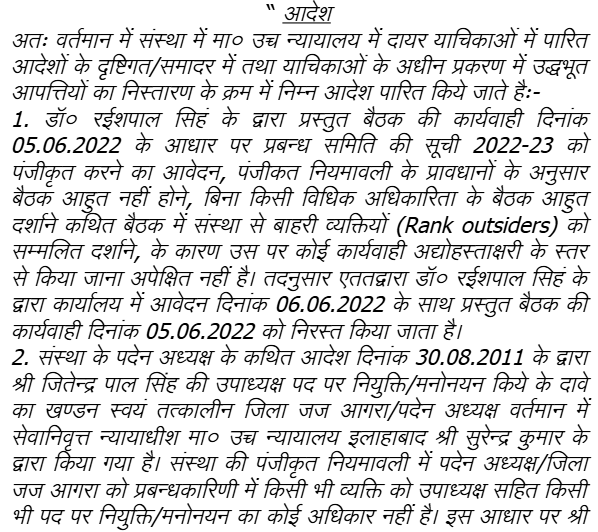
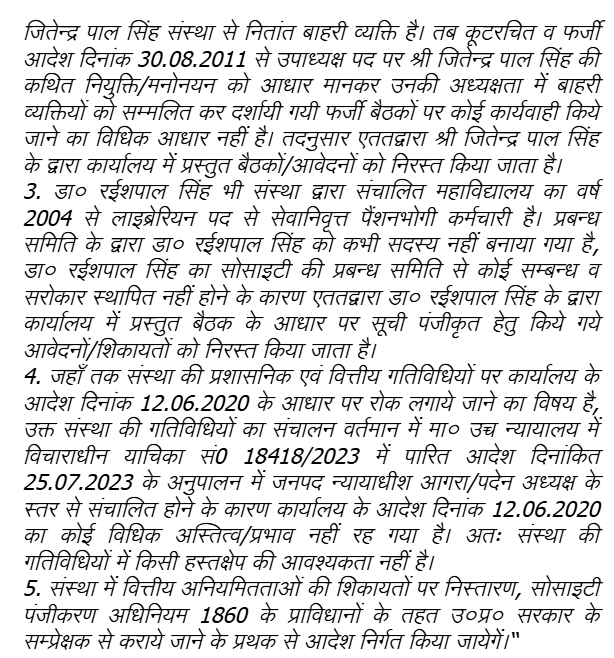
5. Presently, it is a dispute between two persons from the Pedigree of Late Raja of Awagarh Estate. Anirudh Pal Singh, younger son of Late Digviyal Pal Singh and on other side Sri Jitendra Pal Singh, eldest son of Yogendra Pal Singh. Digviyal Pal Singh was elder brother of Yogendra Pal Singh.
6. Earlier, a dispute of aforesaid society in regard to a proposed amendment in the Rules of the society has reached before this Court and a co-ordinate Bench of this Court in Dr. D.P.S. Bhati & Anr Vs. State of U.P. 2011 (8) ADJ 633 not only rejected the amendment a judgment dated 25.8.2011, but has observed and deprecated the monetary dispute among family members. For reference, paragraph 39 of the said judgment is reproduced hereinafter:
“39. Before parting this Court would like to state that petitioners' Society is running a prestigious educational institution at Agra. The College is one of the most recognised and acclaimed higher educational institution at Agra. It is the duty of all persons concerned including the members of Society, its office bearers as also the public in general that for petty managerial disputes, the educational institution may not suffer in any manner. The height institution has reached not only needs be maintained but attempt should be made to take it further up and not to bring down. The education, these days, has become highly commercialised. It has become a lucrative business for those who look upon it as a major intellectual resource which can yield huge wealth. The Court is inclined to take judicial notice of the fact that in respect to certain professional courses, management of educational institutions are running sophisticated and cultured shops collecting huge money under the table as capitation fees. They call it by different names like donation, etc. They provide their own justification but the fa
AI



An indispensable Tool for Legal Professionals, Endorsed by Various High Court and Judicial Officers
Please visit our Training & Support
Center or Contact Us for assistance

Scan Me!
India’s Legal research and Law Firm App, Download now!


For Daily Legal Updates, Join us on :



 Back to top


