
 Back
Back





IN THE HIGH COURT OF ANDHRA PRADESH : AMARAVATI
GANNAMANENI RAMAKRISHNA PRASAD, J.
Pioneer Spinning & Weaving Mills Ltd., rep by General Manager P.Rajendra Naidu, S/o P. Munireddy - Petitioner
Versus
Transmission Corporation of A. P. Ltd, rep by Chairman, Vidyut Soudha, Hyderabad – Respondent
W.P.Nos.26079, 14921, 18680, 20819, 24875, 26077, 26078 & 27170 of 1999; 453, 1676, 1842, 4304, 6312, 8343, 9529, 12256, 16354, 19336, 21611 & 21921 of 2000; 2074, 4143, 6755, 9180, 11575, 16726, 17237, 18926, 23243 & 25402 of 2001; 1025, 1033, 2227, 4550, 6296 & 8887 of 2002
Decided On : 17-04-2026
| Table of Content |
|---|
| 1. consolidation of petitions involving identical issues regarding electricity tariff notifications. (Para 1 , 2 , 3) |
| 2. the principle that rmd or cmd with the licensee (whichever is higher) governs voltage surcharge, not aggregate demand. (Para 4 , 20 , 24 , 25 , 26 , 27) |
| 3. contention that clubbing of contracted demand from renewable/alternative sources with the licensee's supply for voltage surcharge is arbitrary. (Para 5 , 6 , 7 , 8 , 9 , 10 , 11 , 12 , 13 , 14 , 15 , 16 , 17 , 18 , 19 , 21 , 22 , 23) |
| 4. direction for refund of surcharge if the consumer's recorded demand never exceeded the specified statutory limits. (Para 28 , 29 , 30) |
COMMON ORDER :
GANNAMANENI RAMAKRISHNA PRASAD, J.
Heard Sri K. Gopal Choudary, learned Counsel for the Writ Petitioners appearing online in (W.P.No.26077, 26078, 26079 of 1999, 1842 of 2000) assisted by Sri Sk. Md. Umar Abdullah, learned Counsel and Ms. Jyothi Ratna A, learned Junior Standing Counsel representing Sri Venkata Rama Rao Kota, learned Standing Counsel for APSPDCL.
2. The above batch of Writ Petitions are heard and disposed of together in view of the fact that they involve similar issues. Therefore, for the purpose of convenience, the facts mentioned in W.P.No.26079 of 1999 are referred to hereunder.
3. The prayer sought in the W.P.No.26079 of 1999 is as under:
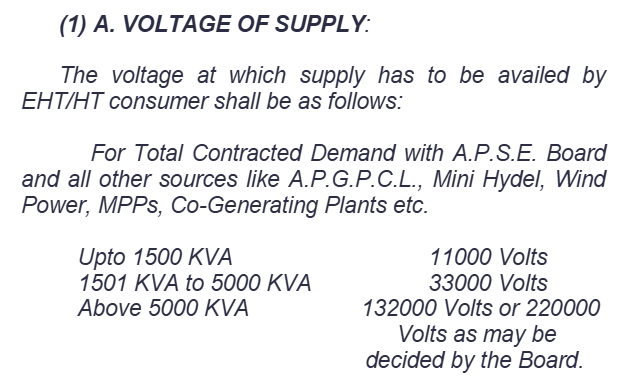
“issue an appropriate Writ, Order or Direction, more particularly one in the nature of a mandamus or a declaration, declaring the condition in Clause 1 A and B of the General Conditions of HT Supply in the tariff notification B.P. Ms. 62 (Operation & Commercial) dated 28.12.1998 providing for clubbing of the contracted demands with the Transmission Corporation of Andhra Pradesh and all other sources like APGPCL Mini Hydel, Wind Power, MPPs, Co-generating Plants, etc. for the purposes of determining the voltage of supply and the voltage surcharge as bad in law, arbitrary, illegal, unconstitutional and void; and
b) issue a appropriate Writ, Order or Direction, more particularly one in the nature of a mandamus, forbearing the respondents from demanding or collecting any voltage surcharges from the petitioner company including the disputed demands made in the respondent’s bill for November 1999 dated 26.11.1999; and
c) Pass such further or other orders as this Honourable Court may deem fit and proper so that justice may be done.”
4. At the outset, it is to be stated that the issues in controversy involved in this batch of Writ Petitions are no more a res integra inasmuch as the said issues were settled by the Order passed by the Andhra Pradesh Electricity Regulatory Commission dated 30.03.2011 in O.P.No.2 to 5 of 2011 and Order of the Division Bench of the Hon’ble High Court of Telangana in Civil Miscellaneous Appeal No.1593 of 2001 dated 10.09.2024 titled as M/s Deccan Cements Limited V. Transmission Corporation of Telangana Limited TS TRANSCO and that these two Orders have attained finality.
5. The facts involved in the present case, as emanating from W.P.No.26079 of 1999, are that the Writ Petitioner herein has entered into a Memorandum of Understanding on 17.10.1998 (MOU-I) for establishment of a group captive generating plant by name APGPCL; that it had a share equivalent to 500 KW out of the generating capacity of the said plant of APGPCL; that the HT Supply Agreement was executed for the Oil Division with Contracted Maximum Demand (CMD) of 1400 KVA on 14.10.1990; that HT Supply Agreement for the Spinning Division of the Writ Petitioner’s company was executed on 25.02.1995 with Contracted Maximum Demand (CMD) of 1495 KVA; that the Writ Petitioner has executed another Memorandum of Understanding on 19.04.1997 (MOU-II) for 172 MW expansion Stage-II, where, the Writ Petitioner had a share equivalent to 360 KW out of the generating capacity of Stage-II of the plant; that the Writ Petitioner had entered into Wheeling and Purchase Agreement for Mini Hydel Power Plant owned by the Writ Petitioner with capacity of 6.2 MW on



An indispensable Tool for Legal Professionals, Endorsed by Various High Court and Judicial Officers
Please visit our Training & Support
Center or Contact Us for assistance

Scan Me!
India’s Legal research and Law Firm App, Download now!


For Daily Legal Updates, Join us on :



 Back to top


