
 Back
Back





HIGH COURT OF ANDHRA PRADESH AT AMARAVATI
Ravi Nath Tilhari, Balaji Medamalli, JJ.
St. Katwal Abubakar – Appellant
Versus
Abbavaram Subba Reddy & others - Respondents
A.S.No.604 of 2010
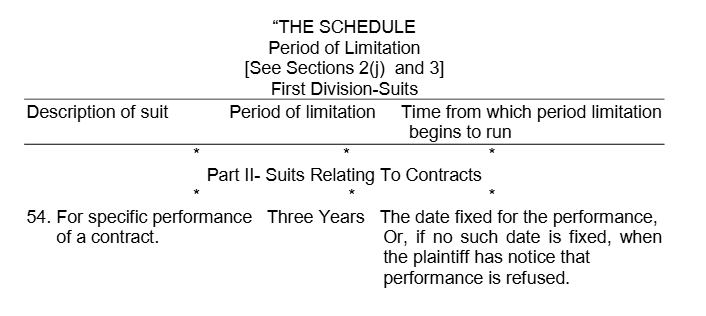
Decided On : 08-05-2026
Key Points: - The court discusses rejection of plaint under Order 7 Rule 11(d) CPC at registration stage vs. trial, emphasizing limitation questions are generally triable issues to be determined during trial (not at once) (!) (!) . - It analyzes Article 54 of the Limitation Act, distinguishing between "date fixed for performance" and "date of notice of performance refused," and holds that the relevant date can depend on actual knowledge disclosed in the plaint rather than deemed notice from registration, requiring trial to determine applicability (!) (!) (!) (!) . - It clarifies Section 3 of the Transfer of Property Act, defining "notice," and explains that constructive/deemed notice is a question of fact to be proven with evidence during trial, not presumed at the registration stage (with emphasis on Explanations I-III) (!) (!) (!) (!) - (!) . - The judgment sets aside the order rejecting the plaint and revives the suit, stating that limitation as a mixed question of law and fact should be resolved on evidence during trial, not at the threshold (!) (!) - (!) . - The decision references several precedents regarding the stage at which limitation and knowledge are to be determined, reinforcing the principle that such issues are triable and cannot be summarily decided at registration (!) (!) - (!) .
JUDGMENT :
Ravi Nath Tilhari, J.
Heard Sri Sita Ram Chaparla, learned counsel for the appellant, Sri N.Rupeswar Reddy, learned counsel representing Sri V.R.Reddy Kovvuri, learned counsel for the respondent No.6 and Sri S.Noor Mohammed, learned counsel representing Sri O.Manoher Reddy, learned counsel for the respondent Nos.7 to 10.
I. FACTS:
2. The plaintiff is the appellant and defendants are the respondents. The plaintiff filed O.S.(SR).No.792 of 2010 for specific performance of contract against the defendants/respondents to execute the registered sale deed in terms of the agreement of sale dated 05.11.2007 along with further reliefs.
3. At the stage of registration of plaint/suit, when the plaint was presented on 08.03.2010, the same was returned with the office objections, inter-alia and briefly stated:
i) on the ground of limitation i.e., to show how the suit was within the time, when the defendant Nos.3 & 4 have sold the part of the schedule property on 17.02.2004 and defendant No.1 gifted part of the suit schedule property in favour of defendant No.8 on 19.03.2004 under registered documents;
ii) as per the averments in the plaint, the suit schedule property was delivered possession to the plaintiff on 15.02.2004, but the suit document dated 02.11.2001 with the endorsement dated 15.02.2004 was silent about the delivery of possession, so it should be explained; with some other office objections.
4. The plaintiff represented the plaint on 09.03.2010 giving explanation that the plaintiff came to know about the sale of part of the suit property by the defendant Nos.3 & 4 only during the month of January, 2010, which was made behind the back of the plaintiff. The plaintiff had no knowledge about the gift deed made by defendant No.1 in favour of defendant No.3 of which also he came to know in the month of January, 2010.
5. So on the first objection, the plaintiff submitted that the suit was within limitation from the date of knowledge of the sale deed and the gift deed in January, 2010.
6. With respect to the other objection, the plaintiff submitted that the registered documents were sham and nominal documents and were never acted upon.
II. Order of Rejection of Plaint dated 06.04.2020:
7. Learned V Additional District Judge, Rayachoty by its judgment and decree dated 06.04.2010 rejected the plaint under Order VII Rule 11(d) of Code of Civil Procedure (in short ‘CPC’) recording the finding that defendant No.1 had executed a registered gift deed in favour of defendant No.8 on 19.03.2004 with respect to the suit schedule Ac.0.94 cents out of the suit schedule property and the defendant No.3 had also executed registered sale deed in favour of defendant No.8 with respect to Ac.0.44 cents in the suit schedule property. Defendant No.4 had executed a registered sale deed with respect to Ac.0.94 cents in the suit schedule property in favour of defendant No.8 on 17.02.2004.
8. Based on the execution of those registered documents out of the plaint schedule property, learned V Additional District Judge held that as per Section 3 of the Transfer of Property Act (in short ‘the T.P.Act’), the plaintiff shall be deemed to have notice of those registered documents on the date of execution of those documents and consequently, the suit ought to have been filed on or before 17.02.2007 within three years from 17.02.2004, the dates of the registered documents created by the defendants, as per Article 54 of the Limitation Act. So, the suit was barred by limitation and the plaint was rejected.
III. Submission of learned counsels:
i) For Appellants:
9. Learned counsel for the appellant submitted that the decree rejecting the plaint under Order 7 Rule 11(d) CPC is unsustainable. He submitted that as per the plaint averments plaintiff had clearly stated that those sale deeds and gift deed though registered but were between close family members. The plaintiff had no knowledge of those transactions and the plaintiff acquired knowledge at the end of January, 2010. So, th



An indispensable Tool for Legal Professionals, Endorsed by Various High Court and Judicial Officers
Please visit our Training & Support
Center or Contact Us for assistance

Scan Me!
India’s Legal research and Law Firm App, Download now!


For Daily Legal Updates, Join us on :



 Back to top


