
 Back
Back





APPELLATE TRIBUNAL FOR FORFEITED PROPERTY
V. Anandarajan, Member
Mohammed Ismail – Appellant
Versus
The Competent Authority, Chennai – Respondent
Stay MP-349/CHN/2023 | FPA-150/CHN/2023
| Table of Content |
|---|
| 1. overview of the factual background of the case. (Para 2 , 3 , 4 , 5 , 6) |
| 2. arguments presented by the appellant regarding the property acquisition. (Para 7 , 8 , 9 , 10 , 11 , 12 , 13 , 14 , 15 , 16) |
| 3. counterarguments from the respondent disputing the appellant's claims. (Para 18 , 19) |
| 4. ratio decidendi regarding the burden of proof and necessity of nexus. (Para 20 , 21 , 22 , 28 , 29) |
| 5. court's analysis of the evidence and applicable legal standards. (Para 23 , 24 , 25 , 26 , 32 , 33) |
| 6. final decision to allow the appeal and comments on procedural aspects. (Para 34 , 35 , 36 , 37 , 38) |
FINAL ORDER
09.02.2026
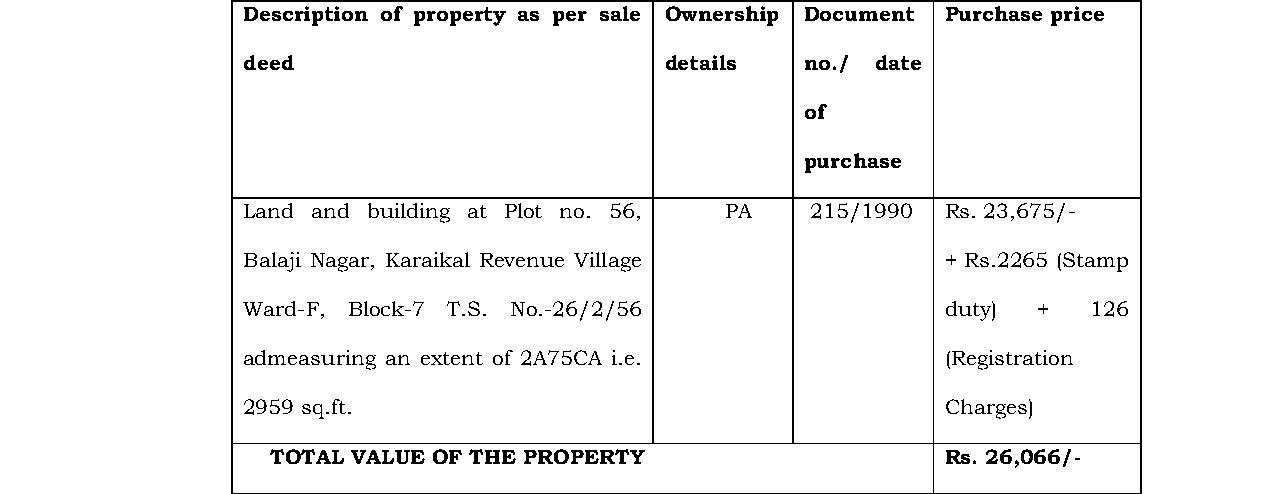
The present appeal has been filed under section 12(4) of the Smugglers and Foreign Exchange Manipulators (Forfeiture of Properties) Act, 1976 (“SAFEMA”) challenging the order dated 30.06.2023 passed by the Ld. Competent Authority, Chennai, wherein the following property was forfeited:
Facts in brief
2. The brief facts of the case are that Sh. Mohammed Ismail, s/o Sh. Abubacker was detained under the provisions of Conservation of Foreign Exchange & Prevention of Smuggling Activities Act, 1974 (COFEPOSAA) by the Government of Tamil Nadu vide order dated 29.04.1999. This detention order was quashed by the Hon‟ble Supreme Court vide order 193/1999 dated 14.12.1999. However, separately, pursuant to Air Customs Spot Adjudication Order No. 14/99 in connection with a case of smuggling of 932.8 grams of gold (eight gold bars of 10 tola each) through the airport, prosecution proceedings were launched by the Airport Customs, Chennai and a conviction order was delivered in case number 232/2000 dated 03.05.2000 by the District Magistrate, Alandur Court, Chennai. Sh. Mohammed Ismail was convicted and sentenced for nine months under section 135(1)(a)(1) of the Customs Act and six months of rigorous imprisonment (running simultaneously) under section 132, with penalty, under the provisions of the Customs Act, 1962 .
3. In view of the aforesaid conviction, Sh. Mohammed Ismail came within the scope of the SAFEMA, 1976. In the meantime, the impugned property was alienated by him and settled as a gift deed in favour of his wife, Smt. Faritha Begum vide doc. No. 1849/2002 dated 07.10.2002.
4. Proceedings under the said Act were initiated based on a reasonable belief that the aforesaid property was “illegally acquired property” within the meaning of the Act. The Competent Authority issued a notice under section 6(1) of the Act on 17.08.2004 wherein Sh. Mohammed Ismail (hereafter referred to as “Person Affected” or “PA”) was called upon to indicate his source of income, earnings or assets out of which the above property was acquired.
5. After considering the reply of the PA, an order of forfeiture was passed by the Ld. Competent Authority on 30.06.2023.
6. Aggrieved by the said order of the Ld. Competent Authority, the appellant has pressed this appeal.
Submissions on behalf of the Appellant
7. In the written pleadings filed on behalf of the appellant, it is firstly submitted on behalf of the Appellant/PA that the subject property was purchased in the year 1990. Even in the judgement of his conviction, it is clearly stated that he was a first-time offender, which means that he had not indulged in such activities before the said instance. The Competent Authority, therefore, erred in assuming that the Appellant/PA had indulged in such activities 9 years prior to the case for which he was convicted, without any piece of material before it. It also shows that the Competent Authority had failed to read the judgment fully.
8. It is also submitted that even according to the 'reasonable belief‟ recorded by the then Competent Authority, which was not furnished to the Appellant/PA, the reasoning given by the Competent Authority to believe that the property was acquired out of illegal money is fallacious. According the statement relied on by the Competent Authority, the appellant was doing tailoring and, thereafter, he used to take goods from Chen



An indispensable Tool for Legal Professionals, Endorsed by Various High Court and Judicial Officers
Please visit our Training & Support
Center or Contact Us for assistance

Scan Me!
India’s Legal research and Law Firm App, Download now!


For Daily Legal Updates, Join us on :



 Back to top


